Monthly Archives: September 2013

When the BSNL employees lost their LTC…..

Q 1. Why did the BSNL employees lose their LTC and the benefit of encashment of Leave?

A. Because, they did not care to know what was going on, when their Management was leading the BSNL in wrong direction to land that organisation in the red. These employees simply were imagining that it was not necessary for them to know anything about what was going on at higher levels of the organisation.

Q 2. When did the BSNL employees start evincing interest in knowing what their Management was doing?

A. They became alert and curious to know what was ailing their organisation, only when they lost promotion prospects and started stagnating in their career, when they were about to lose their service benefits one after the other, when they were offered VRS, and when the BSNL Management started saying openly that the financial position was not okay with it.

Q 3. What do the employees of BSNL do now?

A. They delve deep into the issue and examine where their Management went wrong. They show keen and real interest in extending the reach of the BSNL to new areas, where people want BSNL broadband but the BSNL Management is showing royal indifference to their suggestions so that the  situation would facilitate the private players to make money in those areas. They are not happy when their Management tells them not to bother themselves about expansion but just to maintain whatever they already have. They want the management to purchase new machinery and equipment to match the services rendered by private operators. They want vibrant BSNL. They protest against the slackness of the company in making fresh investments. “The new machinery is not being bought by the company which is hitting the growth prospects badly” said Mr. Nalawade, Secretary of BSNL Employees’ Union. (Indian Express – Dec 16, 2011).

Q 4. Could things have been different in BSNL?

A. Possibly, if the employees (Staff and Officers) and their Federations had woken up earlier to save the organisation and raised these demands at that time itself. These Federations could have taken the unlawful activities of the Management of the BSNL to the knowledge of the public in time. They could have played their role effectively in averting the calamity. But, they did not do anything when they knew that things were going wrong. The Federations of the employees did not act when they should have acted. In other words, whatever they are doing now could have been done by them earlier. That could have changed the scenario.

Q 5. What is the reason for BSNL to remain in the red?

A. Interference of the politicians in power. The BSNL management should have been given freehand to run its affairs in a competitive market. They should have ensured that the Management was functioning effectively and also objectively without there being any misuse of power by the bureaucrats. But, the politicians did not permit professional management of BSNL. They wanted to favour the private players by curtailing the role of the BSNL in the nation. “In the past four years, BSNL has accumulated a loss of Rs.25,258 crore spectrum as payments for 3G and broadband spectrum depleted its reserves and expansion plans were hobbled because of political interference and litigation, harming its ability to compete with private companies such as Bharti Airtel Ltd and Idea Cellular Ltd.” (Live Mint. Aug 06, 2013).

As long as they are governed by the ministry and ministers and not their own board, whether they get government help or not will not make a difference, said B. K. Synghal, former managing director of Videsh Sanchar Nigam Ltd (now Tata Communications)” . This is what many Ministers do when they are given power to play a role in the Administration. They have their own commitments to so many that they spare no chance to make the organisations under their control to cater to their various needs. They do not allow autonomous bodies function autonomously. Honest bureaucrats who run those autonomous bodies are found by them to be inconvenient. If there are dishonest bureaucrats, these Ministers, instead of pulling them up, join hands and and make hay. There are and were some exceptions, but they are rare and are not encouraged. As a result, many honest bureaucrats develop a tendency to seek transfer out so that they were not required to be party to the misdeeds of such ministers. This makes the designs of the Ministers easier.

Q 6. What are the suggestions by ‘experts’ to revamp the BSNL?

A. “In 2009, a panel consisting of technocrat Sam Pitroda and banker Deepak Parekh had recommended that the government sell a 30% stake in the company to the public and also cut its staff by 100,000.” (Ibid.).

Q 7. What is the need to sell 30% stake of the PSU?

A. These ‘experts’ have their own axe to grind. They do not want BSNL to flourish. The BSNL does, in fact, have the potential to provide cable connection to the Televisions of all the house-holds in India. They can facilitate people seeing all channels or any channel of their choice at a much cheaper cost. At one stroke all the private DTH service providers and cable connection providers would vanish from the scene. That would facilitate the common people immensely. But, such an arrangement is not convenient to the politicians in power, irrespective of the party in power, as the BSNL would not give money to them, in black or in white while the private players do, in both. That is why these salesmen of the nation are out to sell the government undertakings to private people. Earlier too, a successfully-run VSNL was, unnecessarily, sold to private hands by the erstwhile rulers.

Moreover, these politicians do not bother to enforce RTI Act in the institutions of Airtel, Tatadocomo and other private service providers. But, the BSNL and MTNL are subjected to it. When all are in the same field, if the private players are also subjected to RTI Act, the money squandered away to the politicians by these private players would become known to all. The politicians and the so-called experts are, therefore, not for it.

The politician-top level bureaucrat-businessman nexus is all out to spoil the BSNL and the nation too, in that process. The very salary drawn by the top-brass of the private service providers and the top-level officers of the BSNL would show that the gap is extreme. Likewise, a comparison of the lower level workers in both would show that the BSNL pays them reasonably while the private service providers pay just pittance and have contracted the work out. While BSNL and MTNL pay all its employees well, the rich and poor gap is made very very wide in the offices of the private service providers. The Indian society does not grow on healthy lines with such private players around. An unjust society is created by these private players duly encourage by the politicians and the ‘experts’ who are out to sell the nation.

Q 8. The VSNL’s former Managing Director blamed the interference and control by the Ministers over the BSNL for the problems faced by the BSNL. But, who is blamed by the Minister for the ills of BSNL?

The Minister blamed the employees and accused them of inefficiency. The BSNL is not permitted to function even upto its Equipped Capacity. The Working Capacity is just two third of the Equipped Capacity. Still, the employees are blamed in public to justify privatisation of telecommunications. But, the VSNL was sold, by the BJP-run government even when that undertaking had been run efficiently by the officials.
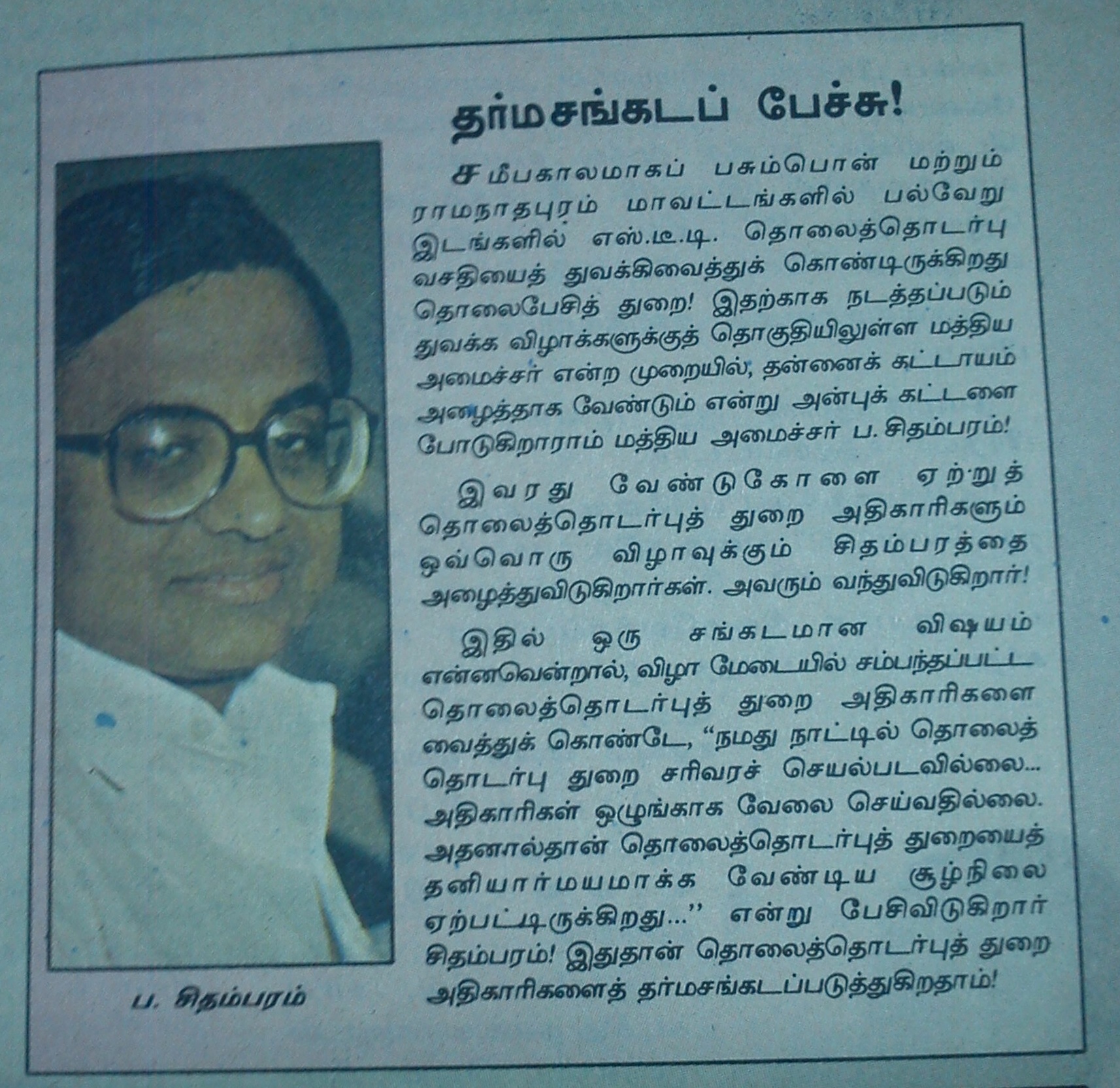
Junior Vihadan - January 7, 1996

Junior Vihadan – January 7, 1996

Q 9. Is the financial position of the BSNL still in the red?

A. Yes. Their letter dated 06.05.2013 says so. The text of the letter is given below (Emphasis supplied).

======================================================================================================

BHARAT SANCHAR NIGAM LTD

(A Government of India Enterprise)

Bharat Sanchar Bhawan H.C. Mathur Lane, New Delhi-01

No. 13-1/2013-PAT(BSNL)                                                                                                                                                                                                         Dated: 6-May-2013

To

All Heads of Telecom circles.

All Heads of other Administrative units.


Sub: Expenditure Control in BSNL.

In partial modification of BSNL letter No. 7-8/2010/EF/Part/1 dated 05.09.2011, the competent authority has decided that as financial performance of BSNL is not improving, All India LTC facility will remain frozen for all BSNL Employees till further orders. However, the employees who cross the age of 59 years shall be allowed to avail one All India LTC during the last year of their retirement.

Other terms & conditions of the above letter dated 05.09.2011 will remain unchanged.

Sd-

[Sheo Shankar Prasad]

Assistant General Manager (Pers.V)

=======================================================================================================

Q 10 . Who is the ultimate sufferer now that the BSNL is in the red?

A. (1) The common public of the entire nation, especially the rural folk, because once the BSNL is out, the private players can form a cartel and loot the entire nation, the way the cement cartels and oil cartels do, at present and

(2) The employees of the BSNL who chose to remain ignorant in the blissful belief that they were just employees and were required to do only the duty assigned to them and were not required to spare time or tax their brain to know what was actually going on in the top echelons of the organisation. Their promotions, perquisites and career are in jeopardy today, as they remained, until yesterday, totally unconcerned about the events that actually involved them and were to affect them.

Q 11. What is the moral of the story?

A. ———. (Readers to fill up the blank).

Leave a comment

Filed under Amendments 2010, Benefits, For Trainees

For “Efficient” transaction of “ESI Corporation’s” business!

The ESI Corporation has been set up as per the ESI Act, 1948, which is a social security legislation that provides for medical care and cash benefits in the contingencies of sickness, maternity, disablement and death due to employment injury to the employees drawing Rs.15,000 or less as wages in the factories and establishments covered by the Act. The social security system of a nation aims at providing the much-needed economic basis, thus, for the development of the resources of a nation. The security-net provided by the ESI Corporation constitutes the essential basic structure of such a social security system in India by ensuring the “willing participation of labour”in the making of the nation.

The Charter of the International Labour Organisation had declared, in the year 1919 itself, that “the peace and harmony of the world are imperilled” when “the condition of labour exist involving such injustice, hardship and privation of large numbers of people (so) as to produce unrest”. The link between the ‘peace and harmony of the world’ and the ‘security-net provided to the labour’ is  intimate and intertwined. It is in the interest of every nation that its social security system is run in a flawless manner so that there is no social upheaval and unrest in the nation.

 The ESI Corporation which was set up in India to carry forward the lofty ideals of the International Labour Organisation, as per Art. 41 of the Constitution of India, is an important organ of the Government of India to ensure peace and progress of the nation. It is only because the Government had realized the importance of the organization, the ESI Corporation had been made an autonomous body and its officers empowered with functional independence to enable them to concentrate, without any interference, on the goal for which the organization had been set up.

In order to discharge the responsibility enshrined in the ESI Act, 1948, the ESI Corporation needed the services of employees. The ESI Corporation had, therefore, been empowered, as per Sec.17 of the ESI Act, to appoint employees in various cadres as may be necessary for the efficient transaction of its business.

Such an “efficient transaction of its business” necessitates proper management policies in the area of Human Resources Management to ensure fair and just conditions of serviceof the employees. It is a constitutional requirement that such conditions of service are made applicable to all the employees universally and are enforced without any partiality and bias.

One of the conditions of service governing the employees of the ESI Corporation is periodical transfers and placements. Such periodical transfers of the employees have been recognized by the Government of India and the Central Vigilance Commission as one of the many aspects of preventive vigilance. Formal and routine transfer of officials from one place to another is not a new phenomenon.  The procedure of “routine transfer of officials from one province to another” was initiated by Sher Shah Suri (1540-1545) ( Page 54 – Part II – History of Medieval India – V.D.Mahajan – S.Chand Publications – 1995) and it had become the hallmark of administration thereafter. It is, therefore, in the interest of the Organization to make use of this concept of preventive vigilance and enforce periodical transfers to reap the benefit for the organization “for the efficient transaction of its business, as mandated by Sec. 17 of the ESI Act, 1948. While enforcing such periodical transfers, the Administration has to take into account the individual interests of the employees also. The Government of India have, in their MHA, OM, No.75/55-Ests (A)- dated 24.3.1955, said, “In a Welfare State, a balance has to be struck between the public interest and the welfare of the individual concerned. The Government of India have also accepted the position that a transfer to distant place involves hardships not only to the Officer concerned but also to his dependants.....

In the context of the ESI Corporation, all the employees in the cadre of Inspectors and above in the ESI Corporation join the organization only with prior knowledge and clear understanding that they are liable to be transferred anywhere in India during the period of their service. But, all of them can have a reasonable expectation that such transfers would be ordered in respect of all the officers in their respective cadre without any bias and in a systematic, pre-determined and impartial manner universally without any discrimination. They have, therefore, no reason to nurture any legally valid grievance, if and when they are subjected to transfers in public interest in the exigency of public service. But, they can have legitimate grievance if the transfers are ordered by the persons in power in the Administration Division selectively on subjective considerations. Because, the “right to transfer an employee is a powerful weapon in the hands of the employer. Sometimes, it is more dangerous than other punishments. Recent history bears testimony to this. It may, at times, bear the mask of innocuousness. What is ostensible in a transfer order may not be the real object. Behind the mask of innocence may hide the sweet revenge, a desire to get rid of an inconvenient employee. ..” Asserting that there can a “deceptive innocuousness” in the transfer orders, the Hon’ble Court said, “ a transfer can uproot a family, cause irrepairable harm to employee and drive him to desperation.” {Pushpakara Vs Chairman Coir Board, Cochin 1979 – SLR-309-315 316 Kerala) and in llyas Ahmad Vs Station Director, All India Radio, Hyderabad (1979 – 2.5 LR -58, 1979-Slj -592. K. K. Jindal Vs. General Manager, Northern Railway}.

But, there had been no transfer policy in the ESI Corporation for a very long time. The ESI Corporation had even filed Counter Affidavits in the Honble Central Administration Tribunal, Jabalpur, in the year 1989, alleging that there was no transfer policy in the Corporation, which observation was not viewed favourably by the Hon’ble Tribunal. There arose many power-centres in within and outside the organization on the issue of transfers and postings. Total adhoc-ism was prevailing in the matters of transfers. Transfers and postings were made as per the whims and fancies of the persons in position in the Administration Division of the Organisation. The organizational interest had been the prime consideration only occasionally as exceptions. The loyalty to the persons in position in the Administration Division had been the prime factor of consideration while deciding transfers and postings. Consequently, political interference was also at its peak and influence-peddlers had a heyday. Persons inside and outside the organization had been playing godfathers to the officers of the organization.

The consequences of such political interference in the matters of transfers of public servants have been summed-up best by the Hon’ble High Court of Himachal Pradesh in Ram Krishan Vs. District Education Officer(ILR 1979 H.P.481). The Hon’ble Court has observed, We hereby record our strong disapproval of such type of interference from outsiders in day-to-day administration of the State. If such interference is to be allowed, it would only mean that the government servants should run after those who are taking part in public life and in politics for getting better terms of service and better place of their postings, and should do everything to please them and not to please the department by their ability, honesty and integrity. It need not be emphasized that such interference of outsiders in day-to-day administration of the State is highly detrimental to the public interest as it would result in nepotism and corruption wherein only those who can wield influence and purse can succeed. Therefore, we want by this judgment to bring it to the notice of all concerned that sooner this type of interference is discouraged and stopped the better for the administration and people of the State.” The direct link between the political interference and the corruption has, thus, been clearly recognized and recorded by the Hon’ble High Court, in the aforesaid judgment. That precisely was the situation prevailing in the ESI Corporation for a long time and the organization had been affected very much in various spheres because of such adhoc-ism in the matter of transfers and placements of its officers.

Wherever a cadre in the ESI Corporation consists of more than one person, the principles of equity and justice necessarily demand that the Administration must keep a reasonable system in place regarding their transfers and postings. Because, the officers who were subjected to transfers had been resorting to inter-personal comparison when it came to their transfers and postings, and rightly so, because the concept of inter-personal comparison is also an element of natural justice. But, such a comparison with fellow-officers resulted in bitterness among colleagues, which could have been avoided if only the Administration had been fair and enforced the transfers in a just and transparent manner through a publicized Transfer Policy. But, that was not to be. Consequently, the officers’ fraternity got divided by the Administration into two classes, viz., those who were ‘Favoured’ and those who were ‘Not Favoured’. This affected the normal official work too.

Justice being always relative, natural justice demanded the Administration to demonstrate and convince that such transfers were effected in a fair manner by observing all parameters of objectivity like the Doctrine of Equality, the Doctrine of Transparency, and the Doctrine of Predictability. But, that the Administration division of the ESI Corporation could not do, in the absence of any Transfer Policy. It had been rightly observed in K.K. Jindal Vs. General Manager, Northern Railway & Others (ATR – May 1986 – Page 304 & 305) that “a welfare state, governed by Rule of Law, has, therefore, attempted to ensure fairness and equality of treatment and eliminate arbitrary action even in the matter of transfers by enunciating a policy.” But, the ESI Corporation did not have any Transfer Policy at all. This had its own negative effect in the Administration of the organization as could be seen from the Agenda Item No. SC-12 of the 166th meeting of the Standing Committee of the ESI Corporation held on 8.6.2004, which says, the absence of transfer policy for long in the ESI Corporation had resulted in many visible and invisible negative effects both to the Corporation as whole and also to many individual employees.

It was, in this context, the Director General, who assumed charge of the organization in January, 2003 introduced the Transfer Policies in respect of the Group A and B officers on the Administration Side and in respect of the Medical Officers on 29.5.2003. The Director General of the ESI Corporation is the Head of Department as per Reg. 8 (5) (vi) of the ESIC (Staff & Conditions of Service) Regulations, 1959. By virtue of the said status, as per the Appendix – 3 to the F.R Part I read with F.R 6 and F.R 15, he is vested with full power to transfer employees of the ESI Corporation. Yet, the Director General promulgated the Transfer Policy on 29.5.2003 with the avowed objective of ensuring and demonstrating transparency and equity in the enforcement of transfers and informing the world how he was going to enforce the “full powers” vested in him in this regard. “It is the basic principle of rule of law and good administration that even the administrative actions should be just and fair” (Shesharao Nagarao Umap Vs. State of Maharashtra and others – Services Law Reporter- Vol. 36- 1984 (2) Page 332). He ensured that there was a transparent system in place to ensure justice and fairness in the matter of transfers and postings.

However, the All India ESIC Officers’ Federation, which had been demanding introduction of Transfer Policies from the year 1991 on various occasions, had, all of a sudden, changed its stand and resorted to manipulations to avoid enforcement of the Transfer Policy introduced by the former Director General on 29.5.2003. The letter dated 22.2.1991 of the All India ESIC Officers’ Federation demanding introduction of the Transfer Policy explains in detail the methods of enforcing the Transfer Policy and says that this was a “vexed issue bothering the Administration as well as ourselves (officers)”. Strangely enough, when the much-sought-after Transfer Policy was introduced, the Federation did a volte-face and conveyed a totally contradictory stand in its letter dated 28.1.2004.

What the then office bearers of Federation had demonstrated through that letter dated 28.1.2004 was that the Federation had had no concern at all for public interest and also about the interests of the affected officers who also belonged to the same Federation. It would become very clear from the said letter that the Federation did not intend to look after the interests of either the organization as a whole or the interests of all its members but only a majority of them.

The criterion for being included in that majority had also not been made public by the Federation. It was not in public knowledge as to who would be in that majority and whether those in the majority would always be in the majority or whether anyone in the majority would also become part of the minority and vice versa, now and then. The fact, however, was that it was subject to variation and dependent on the fancies and whims of the individuals who happened to occupy the positions of power in the Administration Division of the Headquarters Office. As a result, the officers tended to discharge their functions in such a manner that it pleased the bosses and not in the manner that would please the organization, which is an impersonal body. The way they submitted their notes without bringing all the relevant facts pertaining to the issues in hand on various crucial issues would show that while dealing with each and every file, the prime consideration of the officers had been whether the facts recorded by them would please or displease the superiors in the hierarchy. Adhoc-ism in transfers and placements had such a negative effect in the manner in which each and every crucial file in the organization was dealt with by each and every officer. Consequently, public interest became the casualty and the mandate of Sec.17 of the ESI Act for “efficient” transaction of the business of the ESI Corporation stood violatedin a very flagrant manner.

(N.B: The above are part of the excerpts from the Affidavit filed in the Central Administrative Tribunal by an Applicant. More from that document would follow in the next post.  It is proposed to submit a comprehensive note to the Sub-committee on these lines.  Readers are welcome to communicate their views and additional information relevant to the issue for inclusion in the note being prepared for submission to the Sub-committee. This portion of the note deals only with transfers. The desires of the Hon’ble Minister of Labour to be the Appointing Authority and Disciplinary Authority of officers in the ESIC  and its consequences would be dealt with later.)

1 Comment

Filed under Amendments 2010, For Trainees, Transfers

ESI Corporation Meeting on 19.09.2013

The meeting of the ESI Corporation took place on the after noon of 19.09.2013. We came to know that there was on the Agenda a subject for conferring on the Hon’ble Minister of Labour and Employment in the capacity of his being the Chairman of the ESI Corporation, the power to be the Appointing Authority of the officers in Group ‘A’. That power would automatically confer on him the power to those officers also. We also came to know that Sec. 92 of the ESI Act, 1948 had been invoked in this regard and a direction had been given to the ESI Corporation to that effect. Giving direction is different from taking over the Administration. There cannot be any method of Administration that would change the basic structure of the ESIC being an Autonomous Body.

We sent the following SMS to three members of the ESI Corporation at 2.12 p.m on 19.09.2013:
=======================================================
“Sir,
Hon’ble Minister wants power to transfer officers. Any ESIC resolution to confer such power is ultra vires. Please refer the mater to ESIC Sub-committee. Please do not permit hasty decision. Thankyou! – flourishingesic.info”
=======================================================
This SMS was sent to Mr. Kali Ghose, Mr. Ram Kishor Tripathi and Mr. Dipak Sarkar. We came to know later that the matter had been referred to the Sub-Committee.

We, on behalf of the insured population, thank all those who contributed to that very meaningful decision taken by that Body.

Now that the Sub-Committee is to go into the issue, we request the readers to send their opinions, representations, if any, on the issue to the Sub-Committee for their considered decision. If the copies of such references are forwarded to this website, the contents thereof will be displayed here for the benefit of all. First of all, the Ministry of Labour which is stated to have issued the direction under Sec. 92 must explain how and why it felt it necessary to issue such direction, which is totally contradictory to the decision taken on the floor of the ESI Corporation in February, 2005 when it was chaired by Hon’ble K.C.Rao, the then Minister for Labour and Employment. That meeting had set right the anomalies sought to be perpetrated by the earlier Minister who also wanted to wield power in the matter of transfers and postings of officers of the ESIC.

It is proposed to submit a detailed representation to the Sub-Committee after collecting necessary information in this regard. One thing is certain. Public interest will be served only when transfers of officers are made on the basis of set guidelines, in a transparent manner. There should be no need for the officers to go the PAs of the Ministers to salam and stand before them, whatever be the party in power. Such situation will be beneficial only for those officers who believe in manipulations and not for others who do serve, really, for the welfare of the organisation.

In the context, the readers are also informed that the issue of running Medical Colleges by the ESIC had come in for serious discussion during the said Meeting. The Chairman of the ESIC was annoyed and he asked the members why they did not raise such objections when the previous Ministers were pressing for so many medical colleges. That was a right question, anyway. But, it did not justify opening more such colleges as desired by the present Minister.

It is also understood that the Finance Division informed the Body that the funds position of the ESIC was estimated and predicted to be in the negative after two years. The reasons are not far to seek. The improper amendments rammed down the throats of Parliament without any discussion on the day the issue of Mr. Sibu Soren rocked the house are the main reason for such state of affairs. The details in this regard have already been posted with evidence in this forum.

At present, we only hope that the Minutes approved by the Chairman of the ESI Corporation would faithfully record the complete discussion that had, actually, taken place on 19.09.2013 on all subjects.

3 Comments

Filed under Amendments 2010, For Trainees, Transfers

The Basic Structure of the ESIC!

Central Autonomous Body

The E.S.I. Corporation is a Central Autonomous Body. It is a Central Body. It is an Autonomous Body. It is also a Statutory Body. Every Autonomous Body is a Statutory Body too. But, every Statutory Body need not be an Autonomous Body. The intricacies on these aspects can be understood only when we examine Reg. 8 of the ESIC (Staff & Conditions of Service) Regulations, 1959. Reg. 8 would, then, lead us, necessarily, to Reg. 24 and Reg. 24-A and the CCS (Pension) Rules, 1972.

We will then find that ESIC is described as an Autonomous Body in the instructions issued by the Government under Rule 37 (3) of the CCS (Pension) Rules, 1972. One may go through Rule 37B too. (http://ccis.nic.in/WriteReadData/CircularPortal/D3/D03ppw/Notification1_211212.pdf). As per the Explanation given under the said Rule 37 (3), “Body” means autonomous body or statutory body. The word “or” used in the Explanation under Rule 37 makes it clear that a “statutory body” need not necessarily be a “[Central] Autonomous Body”.

As per Rule 37 (3) of the CCS (Pension) Rules, 1972, two factors are taken into account to enable a Central Government employee to claim the benefit of counting of past service when he migrates to an autonomous body or statutory body:

  1. (1)Being controlled or (2) being financed by the Central Government.

The existence of any one of the two elements is enough to call an organisation as a Central Autonomous Body.

Rule 37 (3) which carries an Explanation regarding the applicability of the Rule to “Statutory Bodies” has been inserted in the CCS (Pension) Rules, 1972 much later by the DP&PW on 25.6.1997. The Government of India, Dept. of Per. & A.R., O.M. No. F. 27 (16)-PU/79, dated the 27th September, 1980, w.r.to the CCS (Pension) Rules, 1972, as available online shows that the ESI Corporation fulfils the requirement of being a Central Autonomous Body.

The O.M. says, “Since the criterion is satisfied in the case of ESIC in view of the statutory provisions of the ESI Act which confers on the Central Government the power to constitute or supersede the Corporation, to appoint Principal Officer, to accord approval to recruitment rules and to approve the budget, etc. the benefits in terms of the provision of Rule 37 of the CCS (Pension) Rules, are clearly available to the Central Government employees absorbed by ESIC.”

A “Central Autonomous Body” is one which is financed wholly or substantially from cess or Central Government grants.

“Substantially” means that more than 50 per cent of the expenditure of the Autonomous Body is met through cess or Central Government grants.

Does the Central Government meet any expenditure of the ESI Corporation? No. At least, not yet.

But, Section 26 (2) of the ESI Act, 1948 permits the ESI Corporation to accept grants.  It may accept grants, donation and gifts from the Central Government for all or any of the purposes of the Act.  There is, thus, an enabling provision for the ESI Corporation to receive grants from the Central Government.

 As per Section 27 of the ESI Act, 1948, “the Central Government shall, every year, during the first five years, make a grant to the Corporation of a sum equivalent to two-thirds of the administrative expenses of the Corporation not including therein the cost of any benefits provided by or under this Act.”  The mandate was to meet 2/3 of the expenditure.  Thus, the Centre was required to finance the ESI Corporation substantially.  The criteria for being declared as a Central Autonomous Body were fulfilled by the ESI Corporation.

Section 27 however, had been omitted by an amendment w.e.f. 17.6.67.  This is because the ESI Corporation had been functioning in a viable manner with and within the contribution income collected from employers and employees.  Even, now Section 26(2) of the ESI Act remains on statute.  The ESI Corporation is, therefore, eligible to accept grants from the Central Government.  The ESI Corporation, therefore, fulfils all the requirements for being defined as a Central Autonomous body.

But, Sec. 26 shows that although the ESIC is not centrally financed at present, such central financing is possible within the existing provisions, if need arises. The ESIC is, therefore, a Central Autonomous Body which is controlled by the Central Government. It is a Central Autonomous Body which is not but can be financed by the Central Government.

Statutory Body

The ESI Corporation is a Statutory Body. “A statutory body is an institution owing its very existence to a statute which would be the fountain head of its powers” – (Vaish Degree College Vs. Lakshmi Narain – AIR – 1976 – SC – 888, 893). The ESIC is a Statutory Body controlled by the Central Government although not financed by it. One of the elements of that control is through the Director General and Financial Commissioner who are appointed by the Central Government.

The DP&PW, O.M. dated 31.3.1987 read with the O.M. dated 29.8.1984. refer to the term ‘Central Autonomous Body’ stating that the term included Statutory Body also. However, the following organisations have also been classified, therein, as Central Autonomous Bodies:

  • ¬The Nationalised Banks
  • ¬The LIC of India
  • ¬The National Insurance Company Limited, the New India Assurance Company Limited, the Oriental Insurance Company Limited and the United India Insurance Company Limited.

One could see the letter dated 5.6.1992  of the DP&PW given as Note 2 in Appendix 12 in the Swamy’s Pension Compilation also for reference of the term Central Autonomous Bodies.

Reg. 24 & 24 –A of the ESIC (S&CS) Regulations, 1959.

The Employees’ State Insurance Corporation (Staff & Conditions of Service) Regulations, 1959, is not a complete and comprehensive compendium regarding various conditions of Service governing the employees of the ESI Corporation. So, in respect of any condition of service for which no provision or only inadequate provisions had been made in the said ESIC (S&CS) Regulations, 1959, a provision was made through Regulation 24 to enable one to make use of the Central Government rules in such matters.

It is Reg. 24 that enables one to make use of the F.R, S.R, Pension Rules, etc., of the Central Government for regulating various conditions of service of the employees of the Corporation.

But, applying these Rules in day-to-day work posed some practical and technical problems. These Central Government rules refer to various authorities who would exercise various powers at various levels. One could see the Appendices to F.R & S.R. Part I of Swamy’s Compilation for the list of such officers who are entrusted with the powers of the President in respect of various departments of the Central Government. The ESI Corporation had not identified and specified the authorities who would exercise such powers. In the absence of such specification, the ESI Corporation had been referring various matters to the Ministry of Labour & Employment even for minor issues. It was causing avoidable delay.

Moreover, it was found that such references practically did away with the basic structure of the Corporation, i.e., its autonomous nature. Such references were also found to be inconsistent with the provisions of Sec. 18 of the ESI Act, 1948 which provided that the Standing Committee of the Corporation shall administer the affairs of the Corporation, subject to the general supervision and control of the Corporation. It was not the Central Government that had to ‘administer’ the Corporation but the ‘Standing Committee’. The report of Prof. Adharkar says that a statutory corporation to be called “Central Board of Health Insurance” shall be set up comprising representatives of various interests including medical profession at the apex committees to administer the scheme. The ESI Corporation was not meant to be yet another department of the Central Government.

The issues came up immediately after the enforcement of the ESIC (S&CS) Regulations, 1959. So, the Corporation had passed resolution somewhere in the early Sixties that the ESI Corporation was not one of the offices of the Central Government.

The following provision was inserted as Reg. 24 – A, as per Gazette notification in 1965:

“For the purpose of application of Central Government rules to the employees of the Corporation under these regulations, the Standing Committee shall be competent authority to exercise all the powers and functions which are vested in the President/Local Government/Ministries or Departments of the Government of India, under the various Central Government Rules.”

To sum up, the ESIC is a Central Autonomous Body controlled by the Central Government. There is power for the Centre to give directions to the Autonomous Body but its Minister cannot directly administer this Autonomous Body. Any such interest by the politicians in power to acquire power in the matter of transfers and postings of the officers is to be resisted in public interest.

N.B: The next post will be on the purpose of some other provisions of the ESI Act, 1948 and how it cannot be misused to subvert the Basic Structure of the ESI Corporation.

1 Comment

Filed under For Trainees