Category Archives: Amendments 2010

ESIC: A review in Heavens! – Episode 1

It so happened that we had a chance, recently, to visit the Heavens,  and come back too. What we saw and heard there were found to be worth-sharing. Hence this attempt. 

When we were wandering ‘lonely as a cloud’ in the Heaven, we came across a person sitting under a tree in a pensive mood for a long time. How could there be a man so sad when he was in Heaven? We went nearer to see who he was. What a pleasant surprise! The unpleasant person was Prof. B.P. Adharkar, the Father of Social Security in India. We were just watching him, without his being aware of our presence. All of a sudden, there was a flash in his eyes when he looked in a particular direction. We could then see  the reason for his lit up eyes. He got up and cheerfully welcomed the person who came near him and shook hands. He was Sir William Beveridge.

“Good Morning, Mr. Beveridge! How are you? Happy to see you here.”

“Good Morning, Mr. Adharkar! I wanted to meet you for a long time. I could make it only today. I saw you sitting as if you were lost in thoughts. What is on in your mind?  May I know that?”

“Oh, sure! I was just thinking about the way the Social Security system is functioning at present in India. How marvellous the scheme was, when you prepared the blue print for it!”

“It is okay! All of us had done our bit for the society. But what made you to be lost so much  in your thoughts today?”

“A lot, A LOT!. I do not know how to describe or where to start from. But, the only positive thing is that the present CEO of the ESI Corporation really wants to bring the organisation back on rails. But, there are many vested interests working against that objective. I do not know what the future holds for the ESIC. It is the backbone of the nation’s economy. But, people do not seem to realise its importance.Things had gone awry for quite some time. The after-effects are felt, still. The organisation must recover from those effects.”

“Oh, no! What do you say? It was you who were instrumental in preparing the ESI Act. It was prepared on the basis of the report given by you on 15.08.1944. Was there anything wrong in your report?”

“I do not know! I just prepared the report as per the standards of the 1940s. I did not know that things would move this way.”

“Can you please elaborate?”

“That is what I said. I do not know where to start. There are so many things that we have to discuss. I am just flabbergasted at the way things had gone astray for some time that it has become a Herculean task for the present day Administrators to clean the Augean Stable.”

“Mr. Adharkar, you are just increasing my anxiety and worry with all these statements. You please start from somewhere, anywhere. We are not writing a book here to narrate things in an orderly fashion. Do share what comes to your mind, and whatever you feel like saying. We can revisit the same issue again and again during our discussion, and there is no statutory bar of any kind to it.”

“Yeah, that’s true! Mr. Beveridge. Let me tell you about the Standing Committee and the ESI Corporation. I conceived of them as autonomous bodies consisting of people who would exhibit real and sincere interest in the welfare of the working population. I thought these bodies would function like brain-storming centres and decisions would be taken after no-holds-barred discussion. But, contrary became the reality. Discussions were managed. You can see the article “Executive Powers of the Chairman, Standing Committee” published in the website ‘flourishingesic.info’ in this regard.  Except a very few, the other members are not evincing keen interest and involvement in the state of affairs. Take for example, the officers who are on these Bodies as members representing their respective State Governments. Do they take part in any discussion on important matters? Do they, at least, want to get things clarified, when information that affects the System, is made available to them? No!”

“But, why? After all, they are there in these Elected Bodies as representatives of their State Governments. If there is nothing to represent for their States, why should they speak?”

“No, the meetings of these Bodies are not like the meetings of Chief Ministers for allocation of funds, where they need not bother themselves about anyone except their own States and where they do not really know much about the area of the others. These members in the Standing Committee and the ESI Corporation have voting rights. The resolutions passed by these Bodies are shown to have been passed with their approval too. Their silence gives room to declare that every resolution was passed with majority support. Nobody has barred them from voicing their opinion as members of the Standing Committee or ESIC  on any issue placed before them on the Agenda. Yet, they maintain silence, presuming that it was courtesy. But, it is really indifference. Likewise, many representatives of  employers and employees too do not bestow adequate attention to details. The Bureaucrats Vs. Political leaders episodes of the serial ‘Yes, Minister’ are re-enacted on many occasions.”

“I am simply surprised. How does it happen?”

“I am also puzzled. But, they do happen. Please take the issue of I.T. Roll-out. Every department that wants to computerise its activities starts it only as a pilot project in a small area. That way the trials and errors would not affect the routine of the organisation even for  a single day. Take for example, the Railways.  Did they stop any train even for a single day, to computerise their activities? But, in the ESIC the inspection work and the work in many other areas came to a standstill for long, even for the preparation and supply of Identity Card. Did anyone assess the cost-benefit ratio of this kind of approach, as this work was done simultaneously throughout the nation. So many wrong orders were issued affecting not only the office work but also the insured persons and their family members for the photo sessions. Yet,these ID cards have not become fully functional. These cards must prevent duplication, in the ideal situation. But, that ideal situation has not yet come, in spite of the passage of more than four years. The finger prints and the other bio-metric data are not used for de-duplication process. Employers and Employees have found various methods to circumvent the System. The mounds and mounds of ID cards returned undelivered speak volumes of the flaw in the planning. If only there had been pilot project, the damage would have been limited only to a small area. You know, I have, so far, told you only about the ID card matter. I have not told you anything about the defect in the System in preparing Payment Dockets in the Branch Offices or processing the Inspection Report in the Insurance Branches, or others.”

“Mr. Adharkar, you, surely, have reason to feel worried. But, it does not matter much, I think. After all, you can dump the I.T. Roll-Out and go back to the time-tested manner in which your Scheme was functioning earlier with pen and paper. Take heart! Not much has been lost.”

“I agree with you Mr. Beveridge. The Airforce of the USA provides a precedent in this regard. I saw one article titled ‘BOOTS or COTS’ in this regard in the website ‘flourishingesic.info’.’ But, the white elephants, the ESIC Medical Colleges worry me so much. The way the construction work was started even before the Parliament amended the Act, the way Deans were appointed, the way money was spent, the way some projects were abandoned midway, the way the authorities have been left to wonder now, how to make use of the buildings constructed for the abandoned Medical Colleges are really making me apprehensive.”

Mr. Adharkar continued. “While formulating the ESI Scheme, I had, very consciously, specified eleven Fundamental Principles. They are, in fact, sound directive principles to be kept in view by the Government not only for any social security measure to be introduced through the ESI Scheme but also on any labour-welfare related matter. One of the Fundamental Principles is that the proposed schememust not be too ambitious in the beginning”. But, this fundamental thing has not been examined on record before starting I.T.Roll-Out all over the nation or before starting construction work for so many medical colleges.”

“I do understand. …(Looking off into the distance)  Oh, you see there comes the trio, Mr. Wagner, Mr.Murray and Mr.Dingell, the architects of the Social Security Scheme in the USA. Let us hear them too.”

These three gentlemen arrive on the scene. They join the discussion after exchange of courtesies.

“It is not just these things”, continues Mr. Adharkar, “The way the Ministers wanted to interfere in the day-to-day administration of the autonomous body by influencing the transfers of officers is more worrisome. The evil effects of such interferences had been felt in the past and had been narrated in detail in the agenda for the Standing Committee in the year 2004. It was only Mr. Chandrasekar Rao who allowed the Rule of Law to prevail in the matter of transfer of officers. His period as Chairman of the ESI Corporation was short. But, it had a telling effect in establishing Rule of Law in the matters of transfer of officers. He said in the open meeting of the ESI Corporation that there would be no interference from the Minister or Ministry in the matter of transfer of officers and the Director General would, as the Team Leader, be free to decide the issues. The Transfer Policy assuring equality for all, was enforced thenceforth. But, as I said, his tenure was short. Again interference in the matter of transfers started. There became so many power-centres de facto. Such interference by the Ministers and other power-centres would sink the organisation and we can discuss about it in detail later”.

“Yes, yes. What you told, so far, appears to be only an introduction of various things that had taken place. The burden on the shoulders of the well-meaning administrators of the present  to put things again in proper shape and perspective is just enormous.    But, I feel not only worried but also tired just by hearing these things. Anyway, what about the financial aspects, especially with so many medical colleges? There would be heavy running costs without any income from these medical colleges. Was that issue analysed on file before the proposals were submitted? What would be the long term effect?”, said Mr. Beveridge.

At this moment, Mr. Wagner chipped in. “Friends, have you heard of a scheme in the USA started by one Mr. P….?”

(Continued in Episode 2.)

3 Comments

Filed under Amendments 2010, Benefits, For Trainees, Transfers

Apprentices and the ESIC Revenue Manual.

The concept of Apprenticeship and the need for the Government to give encouragement to that concept can be seen from the Statement of Objects and Reasons of the Apprentices Act, 1961.

Coverage of Apprentices is not permitted under the ESI Act, 1948. For this purpose, the coverage of persons called as Apprentices required deeper examination. Industrial Employment (Standing Orders) Act, 1946 and the Industrial Disputes Act, 1947 refer to Apprentices. After the enactment of the Apprentices Act, 1961, also the ESI Act did not specifically refer to Apprentices. .But, that situation led to ambiguous interpretations and large-scale misuse. The Inspectors were to examine whether there was real training system in the factory, class room, etc., The employers argued that the learners, trainees were also excluded as they were apprentices too. The judgment of the Hon’ble Supreme Court in ESIC vs. Tata Engineering Co and others on October 8, 1975 would throw light on various issues pertaining to the Apprenticeship and the coverage of apprentices under the ESI Act.

“The Apprentices Act, 1850, defines an apprentice as a person who is undergoing apprenticeship training in a designated trade in pursuance of a contract of apprenticeship. Whenever the legislature intends to include an apprentice in the definition of a worker it has expressly done so, for instance, while defining a worker under s. 2 of the Industrial Disputes Act, 1947. The very next year while passing the Employees State Insurance Act, 1948, the Legislature did not choose to include apprentice while defining the word employee. Such a deliberate omission on the part of the Legislature can be only attributed to the well known concept of apprenticeship which the Legislature assumed and took note of for the purpose of the Act.”, said the Hon’ble Supreme Court of India. (http://www.indiankanoon.org/doc/1405877/)

The problems were being encountered in numerous cases at the time of inspections and hearing under Sec. 45. So, the ESI Amendment Act, 1989 addressed the issue and made it specific to exclude only the Apprentices who were covered by the Apprentices Act, 1961 and the Apprentices as per the Standing Orders of the factory (Industrial Establishment).

The ESIC authorities had, however, to examine deeply various aspects pertaining to the Standing Orders and the way in which the Certifying Authority exercised his power to approve those Standing Orders. The Amendment Act, 2010 has put an end to all these problems. Now, only the persons who are Apprentices as per the Apprentices Act, 1961 are excluded from coverage.

But, the ESIC Revenue Manual says something different. The details in this regard are given below for the benefit of readers. They are welcome to offer their views.

Apprentices Act, 1961:

Sec.18: “Apprentices are trainees and not workers –
Save as otherwise provided in the Act, –
(a) every apprentice undergoing apprenticeship training in a designated trade in an establishment shall be a trainee and not a worker; and
(b) the provisions of any law with respect to labour shall not apply to or in relation to such employee.”

Position in the ESIC from 1989:

Sec. 2 (9) of the ESI Act, 1948 says that “employee means …… any person engaged as an apprentice, not being an apprentice engaged under the Apprentices Act, 1961 (52 of 1961), or under the standing orders of the establishment”.

Accordingly, all those appointed as Apprentices under the Standing Orders approved by the competent Certifying Authority as per Sec. 4 of the Industrial Establishment (Standing Orders) Act, 1946 were excluded. But, it was not that simple. The ESIC would see whether the Certifying Authority had really ensured that the Standing Orders were in accordance with the Model Standing Orders. There were cases where the period of training as per the approved Standing Orders was much more than what was permitted as per the Model Standing Orders, both for skilled and unskilled persons. In that event, the ESIC would seek confirmation from the Certifying Authority how he certified and whether he had, indeed, certified those Standing Orders which were produced before the ESIC authorities. In many cases, the Certifying Authorities chose to keep mum, as they had certified those standing orders in violation of the provisions of the Act concerned. In such cases, the ESIC would not accept those employees as Apprentices. The Certifying Authority cannot approve any Standing Order for any factory or establishment, if those Standing Orders are in deviation of the Model Standing Orders.

There were also cases where large number of employees were shown as Apprentices as per the Standing Orders and payment of ESI Contribution avoided. But, in regard to Tamilnadu Region, disproportionate number of employees in any cadre were not permitted to be shown as Apprentices. Contribution was claimed in respect of all persons exceeding 5% in every cadre as ruled by the Hon’ble High Court of Chennai in the Pallavan Transport Corporation Vs. Appellate Authority in the year 1979 . This case was with reference to the provisions of the Industrial Establishment (Standing Orders) Act, 1946. The decision is available in the Book of K.D. Srivastava on the said Act published by the Eastern Book Company.

(1979) 2 LLJ 262

(1979) 2 LLJ 262
Click on the image to have a larger view

Position in the ESIC from 01.06.2010:

Sec. 2 (9) of the ESI Act, 1948 says that “employee means ….any person engaged as an apprentice, not being an apprentice engaged under the Apprentices Act, 1961 (52 of 1961), and includes such person engaged as apprentice whose training period is extended to any length of time.”

The amendment of 2010 did away with the need to examine the contents of the Standing Orders. All those who are called as Apprentices by the employer are now coverable under the ESI Act, 1948 except only those who fall within the purview of the Apprentices Act, 1961.

What does the ESIC Revenue Manual say?

But, Para L.2.12 in Page 23 of the Revenue Manual published by the ESI Corporation in the year 2011 says as under:

“Exceptions: The following categories need not be counted for the purpose of coverage of the factory or for their own coverage.
…. c) An apprentice engaged under the Apprentice Act, 1961 excluding the Apprentice whose training period is extended to any length of time.”

This is again reiterated against Item 1 under the category “Exclusions” in Page 78 under the Para L.6.4 which reads as follows:

“Exclusions are:
(1) An Apprentice engaged under the Apprentice Act 1961. Consequent to the Amendment to the Act in 2010, only the Apprentices covered under Apprentice Act 1961 are not coverable as employees under the Act. Apprentices engaged under Apprentice Act whose training period is extended to any length of time and all other trainees working under the Standing Orders of the companies are coverable as employees.”

  1. Does it imply that the ESIC says that the Apprentices engaged under the Apprentices Act, 1961 are coverable, if their training period extends to any length of time?
  2. Does this not run contrary to what is, correctly, mentioned against Item 6 in Para L.2. 11 in Page 22?
  3. Is not Item (c)  under Para L.2.12 , then, in violation of Sec 18 (a) and (b) of the Apprentices Act, 1961?
  4. Can the ESI Act, 1948 supersede the Apprentice Act, 1961 on the core issue of the status of an Apprentice, when there is no specific provision in the ESI Act for such supersession?
  5. Is it not reasonable on the part of the employers to expect clarification from the ESIC authorities with reference to the aforesaid interpretations and discrepancies in the Revenue Manual?

4 Comments

Filed under Amendments 2010, For Trainees, Inspections

Sec. 45 AA and the Questions of Mr.Hiren Chheda!

Mr. Hiren Chhedha has raised the following questions with reference to Sec. 45 AA of the ESI Act, 1948. He is awaiting reply to these questions under the Right to Information Act, 2005. As many of the issues raised by him are relevant to all the employers, his write-up is hosted here as a separate Post for the benefit of all. (Upadate on 12 05.2013: Mr. Hiren Chheda has forwarded the reply received by him from the Regional Office, Mumbai. That is also uploaded here in this thread for the benefit of the readers).

Now, the text of what Mr. Hiren Chheda has written:

1. If an appeal u/s 45-AA is submitted after 60 days from the issuance of the Order u/s 45-A whether the Appellate Authority is empowered to entertain the same? a. If the answer to the above query is affirmative please provide me the copy of the instructions issued. b. If yes is the reply to the above query, is it mandatory to file an application for condoning the delay? ====================================================

2. In case, if the deposit of 25% of the assessed amount u/s 45-A of the ESI Act is deposited along with appeal u/s 45-AA after 60 days from the issuance of the Order u/s 45-A than the Appellate Authority has power for forfeiture of the amount deposited while issuing the order u/s 45-AA where in impugned order was set aside? If the reply is yes, kindly provide me the copy of the provisions or instructions in this regard. a. Whether RO Mumbai has intimated to HQ of any such forfeiture of the amount deposited by the employer u/s 45-AA. I enclosed (Annexure A 1 ) herewith the copy of the Order u/s 45-AA dated 13.02.2012 where in the impugned order u/s 45-A was set aside but the deposit was forfeited by the Appellate Authority of RO Mumbai. b. I would like to know where the forfeited amount does is booked by the RO Mumbai and under which account head it is reflected in the annual financial statement of the ESIC. Please provide me the duly certified copy of the same. c. Please provide me the copy of the certified provisions of the ESI Act where in such power is delegated to the Appellate Authority for forfeiture of amount deposited by employer under the trust incorporated under the section 45-AA of the Act. d. If no power is delegated under the ESI Act to the Appellate Authority for forfeiture of amount deposited by employer, does the issuance of order referred at supra dated 13.02.2012 amounts to mental harassment to the employer and does it amounts misconduct under service rules or not? What steps have been taken by the corporation to alleviate these fears of the Employers? e. Please provide me the certified copy from Office the Financial Commissioner stating under which rules & provisions the noble ESIC department can hold the said amount. If the said deposit with interest is returnable to the Employer than who will bear the cost of the interest for the default on the part of the Officer? Please inform me the correct rules in this regard. f. If above act on the part of the Senior Officer of the noble ESI Corporation is against the norms & provisions under the ESI Act, whether remedies are available for the employer to register his grievances against such high handiness of the said officer. Please provide me the procedure as well as the name and address of the authority with whom the grievance should be registered for redressal. Is the officer guilty of violating rules and hence guilty of misconduct under conduct rules? Please give a copy of their conduct rule, which they have violated by violating the above mentioned rule. g. The said authority of RO Mumbai has caused serious mental agony/injury by making the employer to run helter-skelter around all the way. Is said officer is guilty of causing mental harassment to the Employer/public or not? h. What actions can be taken initiated against the officer for violating the rules and for causing mental agony to the Employer/public? Is any time-frame fixed by the Department for initiating action against such Officer? Please state in crystal clear terms. =================================================

3. I enclose (Annexure A 2 ) herewith the order passed u/s 45-A & 45-AA by the officer of the RO Mumbai in respect of the Establishment whose code number is 31001010500001001/Pin-07 along with a letter addressed to the IC dated 24.04.2012 and request you to provide me the following information. i. Whether the Appellate Authority u/s 45-AA has the power to enhance the period sue-motto for which the order u/s 45-A was issued? ii. Whether the Appellate Authority u/s 45-AA can revert back to the date of coverage of the establishment when said issue was not covered under the Order u/s 45-A of the Act or rose by the Appellant in his appeal? iii. Are there any instructions issued by the Head Office to claim the ESI contributions on labour charges RECEIVED by the employer? If so please provide me the copy of such instructions. iv. What is the present status of the employer letter dated 24.04.12 (copy enclosed) at the Office of the IC and RO Mumbai, please inform. v. Can the Appellate Authority u/s 45-AA enhance the amount of contributions determined under the Order u/s 45-A without issuing fresh notice or revising the Notice to the Employer to submit his pleadings on the issues rose? vi. Whether the actions of the RO Mumbai are justified in recovering the amount by following coercive and harsh measures from Woman employer without replying to the humble submissions made by her? vii. Is it not mandatory on the part of the Officer concerned to reply to the grievance of the employer at least on recovery of money, to pay attention and redress the grievance by way of reply quoting the rule book? =================================================

4.        As per the instruction of the ESIC Head Office on the issue of the outside labour charges specific directions are issued to the inspecting authorities to bring out in their reports details of their observations which could establish supervision on those jobs or otherwise and then only to claim contributions. However, some of the inspecting authorities do not adhere to the said directions. Are these officials guilty of violating these rules and hence guilty of misconduct under their conduct rules. Please provide me a copy of their conduct rule, which they have violated by violating the above mentioned rule. What actions can be taken against concerned officers for not adhering the instructions of the Head Office? ================================================

5. Is there any circular issued by the ESIC Head Office to claim the contributions on outside labour charges even though the inspecting authority failed to discharge its duty in accordance with the instructions of the ESI HQ. If yes, than please provide me the copy of the same. ================================================

6. Do the authorised officer u/s 45-A has the power to cancel his own order passed u/s 45-A without prior approval of the higher officers? If so under what circumstances? Please state and explain the circumstances. If such provision exists kindly provide me the copy of the instruction. In case no such provision exists cancelling the order issued u/s 45-A without jurisdiction will amount to misconduct in accordance to service rules or not? ===============================================

7. As per the instruction of the Head Office the burden to prove the supervision in case of outside labour charges is on the inspecting officer. Can this burden be shifted to employer under proceeding u/s 45-A of the Act? If yes, please provide the circular instructions on the issue making responsible the employer to prove that no supervision by him in case of outside labour charges. ===============================================

8. Is it correct on the part of the Authorised Officer to determine the contributions on the total amount paid to other establishment which is duly covered under the ESI Act for getting job work done from its premises? If the answer is no, than is it not misconduct on the part of the authorized officer. [In case you require more details in this regard you may please refer to file of RO Mumbai bearing code number 31000090450000108 Pin-25] ===============================================

9. What is the reasonable time limit to issue order under Section 45-A of the ESI Act 1948 from the date of conclusion of the final hearing u/s 45-A? Please specify the time limit prescribed by the department. In case no order is passed within the stipulated time schedule what actions are initiated by the department who violated the time schedule? In case no such instructions are existing prescribing time limit for issuance of order on completion of hearing/inquiry, can the authorized officer pass the order after lapse of 6 months from the date of last hearing? ==============================================

10. Under which circumstances or parameters a Corrigendum to an order passed under section 45-A can be issued? ===============================================

11. Does is it require to call for hearing before issuance of the Corrigendum to the order issued? Whether officer who has not issued the order can issue the Corrigendum? Is it necessary to record the reasons for issuance of the Corrigendum in the corrigendum order? ===============================================

12. Under which provision of the ESI Act, Corrigendum to order u/s 85-B can be issued? Kindly provide the extract of same and also ESIC HQ directions on the issue. ===============================================

13. Are there any instructions issued by HQ office OR any provisions under the ESI Act to issue the Order u/s 45-A of the Act on mere presumptions of the authorized officer? If yes, please provide me the copy of such instructions. If the answer is ‘no’, whether the actions of the Authorized Officer shall be treated as misconduct for harassing the employer? ================================================

14. Does the Recovery Officer has the power to issue the Order u/s 45-A while discharging duty as Recovery Officer but not holding any charge of the insurance branch? If the answer is yes, than please provide me the copy of the Notification or delegation of powers. ===============================================

15. Is it a right or not that an employer to get a copy of the inspection report based on which the show cause notice u/s 45-A was issued? Whether the Authorized Officer can reject the request made by the employer to provide the copy of the inspection report during the proceedings under section 45-A? Please state the rule position. ==============================================

16. What are the remedies available with the employer, if the Authorized Officer does not provide the copy of the report of SSO relied in issuance of the Notice (C-18)? Please furnish the details thereof. ===============================================

17. After issuance of the Order u/s 45-A of the Act, can another Order u/s 45-A for the same period is permitted? If reply is no to the above query, whether any instructions were issued on the issue, and if so please provide me the copy of the same. ===============================================

18. Please provide me the certified copy of full set of the Special Leave to Appeal (Civil) No(s).4746/2006 filed in the Hon Supreme Court of India in case of ESIC V/s WESTERN INDIA PLYWOOD LTD along with final order dated 24.03.2006. ===============================================

19. Does ESIC have filed any Appeal to the Apex Court after losing at the Hon High Court of Bombay in case of ESIC v/s Hotel Suresh (FA 2284 of 2005) and H. Fillunger and Co. Pvt. Ltd vs. ESIC? If not filed than is it correct that it amount to acceptances of the question of law declared by the Hon High Court by the ESIC? ================================================

20. Can the authorized officer pass an order under section under 45-A for an amount higher than the amount proposed in the notice (C-18) without revising the show cause Notice or calling for objections from the employer?=========

Mr. Hiren Chheda has received the reply from the Regional Office, Mumbai with reference to his application under the RTI Act, 2005. The reply in Pdf. format is posted here. Readers may please click on the following link to download the pdf. file and read the contents. RTI reply to Mr. Hiren Chheda from the Regional Office, Mumbai The same file in pdf format has been converted into png. format and displayed here.

While many issues raised by Mr. Chheda pertain to the errors and omissions on the part of individual officers, the questions of law raised by him have been replied to in various other posts. Wherever there is deficiency in the Amendment of 2010, the same had been taken to the knowledge of the authorities also, as could be seen from the relevant posts, although the authorities at New Delhi have not exhibited any involvement, to set matters right.

Leave a comment

Filed under Amendments 2010

45 AA – Part V: And, the ire of the British Judges on the law-makers

Law making is always a serious matter. But, it had been done in a casual manner when the Amendments were made in the year 2010 in the ESI Act, 1948. Sec. 45AA of the ESI Act is not an example to be emulated but a warning to be shunned by any organization that wants to have an in-house Appellate Authority. The ESI authorities did not care for the consequences of their proposal. The Advice department of the Ministry of Law, simply, did not pay attention to the subtleties of law. The Parliamentary Standing Committee on Labour which examined the proposal for amendments was cheated. The Members of Parliament, as usual, concentrated on the ‘Sibu Soren issue’ with gusto and created a furore in the House and allowed the ESI Amendment Act to sail through, amidst din,  without any discussion.

No compulsion to explain

We have so far published four posts on Sec. 45 AA alone. Some more analysis is due. This week we deal with the admissibility of new evidence or additional evidence by the Appellate Authority under Sec. 45 AA.  Proper course of action for an Appellant to produce new or additional evidence before any Appellate Authority is to produce evidence before the Appellate Authority as to why the said evidence could not be produced by him, earlier, before the concerned authority which passed the original order.

Such a provision is available in Sec. 7B (4) (b) of the EPF Act, 1952 for entertaining the new or additional evidence on Review. This provision says “no such application shall be granted on the ground of discovery of new matter or evidence which the applicant alleges was not within his knowledge or could not be produced by him when the order was made, without proof of such allegation.” But, in the ESIC there is nothing in the Act, to that effect. Instead of the Regulations referred to in Sec. 45AA, the process of administrative law-making had been resorted to. The administrative instructions issued, thus, on 04.11.2010 in an improper manner, gives a carte blanche to the Appellate Authority in this regard.

Rule 29 of the Income Tax Appellate Tribunal Rules, 1963 says, “The parties to the appeal shall not be entitled to produce additional evidence either oral or
documentary before the Tribunal, but if the Tribunal requires any document to be produced or any witness to be examined or any affidavit to be filed to enable it to pass orders or for any other substantial cause, or, if the Income-tax authorities have decided the case without giving sufficient opportunity to the assessee to adduce evidence either on the points specified by them, or not specified by them, the Tribunal for reasons to be recorded, may allow such document to be produced or witness to be examined or affidavit to be filed or may allow such evidence to be adduced.”

Consequences of the carte blanche

“The appellant may not be permitted to file additional evidence. However, the appellate Authority may at their discretion permit or disallow such additional evidences submitted by the appellant, for the reason recorded in writing”, says Para 7 of the Hqrs. instructions dated 04.11.2010.

This can make the entire proceedings under Sec. 45 A a mockery. An employer need not produce many things before the original quasi-judicial authority. He can produce them later before the 45 AA Appellate Authority. Or, if the order of the 45 A authority was not to his liking, he can plead before the 45AA authority to order re-hearing  the case as he can produce some more documents. The proceedings under Sec. 45 AA need not be taken seriously by the employer and consequently the Branch Officer and his Branch would be wasting their time issuing a 45 A order which would, mostly, be remitted back with directions for considering further evidence. It has been left to the discretion of the Appellate Authority. He is not required even to ask how and why the employer did not produce the new evidence or additional evidence when the hearing took place under Sec. 45 A.

This kind of anomaly is not there in any statute in India that deals with the powers of the Appellate Authority. We have already cited the relevant provisons of EPF Act, 1952  and the I.T. Act in this regard.  The discretion here in the ESI Act is unlimited and arbitrary. Unless the Appellate Authority takes personal care to maintain a system for himself, he will soon find himself drawn before the Courts of Law for exercising his discretion in different ways in different cases. Yet, his arbitrary discretions and contradictory decisions can be impeached only by citing the provisions of equity and equality. There is no safeguard in-built in the ESI Act, 1948.  The amended provision is so loosely worded.

Discretion sky high

  1. “Blanket discretionary power” has been held to be unconstitutional in State of  Bihar Vs. K.K. Mishra 1969 3 SCC 337 and Khwaja Ahmed Abbas Vs. Union of India  1970 2 SCC 780);
  2. “Unguided discretionary power” has been held to be unreasonable in (Himat Lala K Shah Vs. Commissioner of Police 1973  1 SCC 227);
  3. “Wide discretionary power” (State of Madras Vs. V.G. Row 1952 AIR SC 1976) is unconstitutional because it allows the administrative authority to exercise this discretion on subjective satisfaction without permitting the grounds to  be judicially tested;
  4. “Wide discretion without procedural  safeguards” had been held as unconstitutional in State of M.P Vs. Bharat Singh AIR 1967 SC 1170.
    (Page 68- Administrative Law – I.P.  Massey)
  5. “Vague expressions may result in the arbitrary exercise of power”   (Harakchand Ratanchand Banthia Vs. Union of India 1969 2 SCC 166)                                             (Page 69- Administrative Law – I.P.  Massey)
  6. Exercise of discretionary power can be set aside if there is manifest error in the exercise of such power or the exercise of such power is manifestly arbitrary or mala fide or unreasonable. The caste based hierarchic view of administrative responsibility to presume that ‘high’ authority is unlikely to use its discretionary power injudiciously or arbitrarily is a presumption that is certainly conjectural and not tenable.
    (State of Punjab Vs. Dial Chand Gian Chand & Co. – AIR – 1983 referred to in Page 78- Administrative Law – I.P.  Massey)
  7. “While the technique of administrative rule-making is to serve its laudable task, the norms of the jurisprudence of delegation of legislative power must be dutifully observed. These norms include a clear statement of policy, procedural safeguards and control mechanisms”.
    (Page 87- Administrative Law – I.P.  Massey)

But, before uploading further posts on other important aspects on this issue, it is felt appropriate to recall what two famous British jurists have said about the law made by Parliament without adequate analysis of the issues involved.

Impose costs on the draftsmen and the M.Ps.

Lord Justice Scrutton says the following in Roe vs. Russel (1928):

“I regret that I cannot order the costs to be paid by the draftsmen of the Rent Restriction Acts, and the members of the Legislature who passed them, and are responsible for the obscurity of the Acts.” (Page 94- The Closing Chapter – Lord Dennings).

The Act passed by the British Parliament was so ambiguous that Lord Scrutton regretted his inability to impose penalty (cost) on the persons who brought into existence such a loosely drafted law.

Proper analysis before making law

Another Judge Sir Ernest Gowers who said the following in the Plain Words case in the year 1948 as the duty of the draftsmen (Page 95 ibid.):

“…. to try to imagine every possible combination of circumstances to which his words might apply and every conceivable misinterpretation that might be put on them, and to take precaution accordingly. ….All the time he must keep his eyes on the rules of legal interpretation and the case law on the meaning of particular words [and on the previous statutes on the same subject-matter] and choose his phraseology to fit them.”

Indians,  who are  said to have adopted the British system of governance more, have to travel a longer distance, still, to demonstrate that they are capable of framing laws in a proper manner.

1 Comment

Filed under Amendments 2010

Appellate Authority u/s 45 AA: Part IV: A comparison with IT Act and EPF Act!

When the authorities want to add a provision for Appellate Authorities in a statute, they would ensure the following:
The Principal Act would specify the
Constitution of the Appellate Authority and Powers of the Appellate Authority very clearly. It would, generally, leave the Procedure to be codified through subordinate legislation.

  1. The provisions pertaining to the E.I. Court fulfill this requirement.
  2. The Income Tax Act and the EPF Act also fulfill this requirement.
  3. But, the hastily prepared, loosely worded Sec. 45 AA pertaining to the creation of the Appellate Authority under the ESI Act does not fulfil this requirement.

This Section is totally flawed and there was no one to care for even when the matter had been taken to their knowledge even during the pre-amendment period. The role of the bureaucrats of the Ministry of Law was shocking. The manner in which the Parliamentary Committee and the Members of Parliament approached the issue makes one wonder whether law-making process in the nation had become so ineffective and inefficient in the nation.


The ESI Act, Sec. 45 AA has left all the three aspects of law-making, the Constitution of the Authority, its Powers and the Procedure to be followed by it, to be done by subordinate legislation. But, even without any such legislation in the form of notified Rules by the Central Government or notified Regulations by the Corporation, the Hqrs. Office had issued administrative instructions on 04.11.2010 pertaining to all the aforesaid three aspects.


Was this action proper?


This, when the Sub-Committee of ESI Corporation to examine the need for amendments recommended appointment of Appellate Authority said, “
Similar provisions exist in case of Income Tax and EPF Act”. One wonders whether the Sub-Committee had really seen those Acts.

Excerpts from Item No. 11 of the Report of the Sub-Committee of ESI  Corporation on Amendments to the ESI Act, 1948

Excerpts from Item No. 11 of the Report of the Sub-Committee of ESI Corporation on Amendments to the ESI Act, 1948


It is a pity that the Parliament has been used for vesting arbitrary and unlimited powers to the authorities to appoint and regulate the Appointing Authorities under Sec. 45 AA.


Such vestiture is patently unlawful and the amendment itself was ultra vires of the Parliament.


Readers may compare Sec. 45 AA of the ESI Act with Sec. 7D to 7Q (especially 7D and 7E) of the EPF & MP Act. These two sections are reproduced here for the convenience of the readers:


EPF & MP Act:
7D. Employees’ Provident Funds Appellate Tribunal. – (1) The Central Government may, by notification in the Official Gazette, constitute one or more Appellate Tribunals to be known as the Employees‟ Provident Funds Appellate Tribunal to exercise the powers and discharge the functions conferred on such Tribunal by this Act and every such Tribunal shall have jurisdiction in respect of establishments situated in such area as may be specified in the notification constituting the Tribunal.
(2) A Tribunal shall consist of one person only to be appointed by the Central Government.
(3) A person shall not be qualified for appointment as a Presiding Officer of a Tribunal hereinafter referred to as the Presiding Officer, unless he is, or has been, or is qualified to be, –
(i) a Judge of a High Court; or (ii) a District Judge.
7E. Term of office. – The Presiding Officer of a Tribunal shall hold office for a term of five years from the date on which he enters upon his office or until he attains the age of sixty-two years, whichever is earlier.
The readers may compare Sec. 252 , Sec. 253 and from Sec. 254 to Sec. 260 of the Income Tax Act with Sec. 45 AA of the ESI Act.

Income Tax Act:

252. (1) The Central Government shall constitute an Appellate Tribunal consisting of as many judicial and accountant members as it thinks fit to exercise the powers and discharge the functions conferred on the Appellate Tribunal by this Act.

 95[(2) A judicial member shall be a person who has for at least ten years held a judicial office in the territory of India or who has been a member of the 96[Indian] Legal Service and has held a post in Grade 97[II] of that Service or any equivalent or higher post for at least three years or who has been an advocate for at least ten years.

Explanation.—For the purposes of this sub-section,—

           (i)  in computing the period during which a person has held judicial office in the territory of India, there shall be included any period, after he has held any judicial office, during which the person has been an advocate or has held the office of a member of a Tribunal or any post, under the Union or a State, requiring special knowledge of law;

          (ii)  in computing the period during which a person has been an advocate, there shall be included any period during which the person has held judicial office or the office of a member of a Tribunal or any post, under the Union or a State, requiring special knowledge of law after he became an advocate.

(2A) An accountant member shall be a person who has for at least ten years been in the practice of accountancy as a chartered accountant under the Chartered Accountants Act, 1949 (38 of 1949), or as a registered accountant under any law formerly in force or partly as a registered accountant and partly as a chartered accountant, or who has been a member of the Indian Income-tax Service, Group A and has held the post of [Additional] Commissioner of Income-tax or any equivalent or higher post for at least three years.]

 [(3) The Central Government shall appoint the Senior Vice-President or one of the Vice-Presidents of the Appellate Tribunal to be the President thereof.]

 [(4) The Central Government may appoint one or more members of the Appellate Tribunal to be the Vice-President or, as the case may be, Vice-Presidents thereof.]

 [(4A) The Central Government may appoint one of the Vice-Presidents of the Appellate Tribunal to be the Senior Vice-President thereof.]

 (5) [The Senior Vice-President or a Vice-President] shall exercise such of the powers and perform such of the functions of the President as may be delegated to him by the President by a general or special order in writing.
So much for the lawmaking process, when it came to Sec. 45 AA!

1 Comment

Filed under Amendments 2010

Appellate Authority u/s 45 AA – Part III – The unlawful instructions

The ESIC Hqrs Office had issued instructions to all the Regional Directors long back advising them that the quasi-judicial authorities who issued orders under Sec. 45 A and under Sec. 85 B should not be included as witnesses in E.I.Court cases to defend the order. It was also instructed that if the employer wanted the quasi judicial officer to be produced as a witness, it must be strongly objected to, as it was not a practice to call any judicial or quasi judicial authority to defend his own order.

But, after the insertion of Sec. 45 AA in the ESI Act, in the year 2010, instructions were issued on 04.11.2010, that the quasi judicial authority which issued the order under Sec. 45 A should appear as a party during the course of proceedings before the Appellate Authority under Sec. 45 AA.

The Hon’ble Supreme Court has, in Union Of India Vs Orient Engg. & Commercial Co. Ltd. on 7 October, 1977, said:

“Indeed, it will be a very embarrassing and, in many cases, objectionable if every quasi-judicial authority or tribunal were put to the necessity of greeting into the witness box and testify as to what weighed in his mind in reaching his verdict. We agree with the observations of Walsh, A.C.J. in Khub Lal v. Bishambhar Sahai where the learned Judge has pointed out that the slightest attempt to get to the materials of his decision,, to get back to his mind and to examine him as to why and how he arrived at a particular decision should be immediately and ruthlessly excluded as undesirable.”……….“We do not think that every Munsif and every Judge, every Commissioner and, every arbitrator has to undergo a cross-examination before his judgment or award can be upheld by the appellate court, How vicious such an approach would be is apparent on the slightest reflection. Of course, if a party has a case of mala fides and makes out prima facie that it is not a frivolous charge or has other reasonably relevant matters to be brought out the court may., in given circumstances, exercise its power to summon even an arbitrator, because nobody is beyond the reach of truth or trial by Court. In the present case, after having heard counsel on both sides, we are not satisfied that on the present material there is justification for the examination of the arbitrator. We therefore set aside the order.”

The Revenue Manual does not take into account the earlier instructions which were correct.

The instructions issued by the Hqrs on 04.11.2010 were incorrect and unlawful. The Appellate Authority under Sec. 45 AA is not superior to the E.I. Court, as the E.I.Court can entertain appeal against the orders of the authority under Sec. 45 AA. Yet, the Hqrs instructions say that the quasi judicial officer should appear before the authority under Sec. 45 AA but not before the E.I. Court. What will happen if the employers cite this provision and convince the E.I.Courts to summon the officers who issued orders under Sec. 45 A to appear before the E.I.Court too to stand the test of cross examination? Was this aspect examined in the file before the instructions were issued on 04.11.2010? Was the issue set right, at least, after the anomaly was brought to the notice of the Hqrs.? No. The instructions still hold.

In Pradip Kumar Sarawgi & Sons Vs. Commissioner Of Taxes, on 26 June, 2003, the Hon’ble Supreme Court has held as under:

“No authority, superior to an assessing authority, can interfere with the quasi-judicial functions of an assessing authority by issuing administrative directions. The Apex Court has in Orient Paper Mills Ltd. v. Union of India, (1969) SC 48, made the position of law in this regard clear in the following words :

“If the power exercised by the Collector was a quasi-judicial power as we hold it to be that power cannot be controlled by the directions issued by the Board. No authority however, high placed can control the decision of a judicial or a quasi-judicial authority. That is the essence of our judicial system. There is no provision in the Act empowering the Board to issue directions to the assessing authorities or the appellate authorities in the matter of deciding disputes between the persons who are called upon to pay duty and the department. It is true that the assessing authorities as well as the appellate authorities are Judge in their own cause; yet when they are called upon to decide disputes arising under Act they must act independently and impartially. They cannot be said to act independently if their judgment is controlled by the directions given by others”.

We hope the aforesaid anomalies created by the unwarranted instructions dated 04.11.2010  and the  numerous other inconsistencies and inadequacies in the Revenue Manual would be set right in the new dispensation in the interest of the organization.

Leave a comment

Filed under Amendments 2010

Appellate Authority u/s 45 AA – Part II

The application sent to the Ministry of Law was published last week. This week we publish the reply received from the Ministry of Law and the Appeal made to the FAA against it.

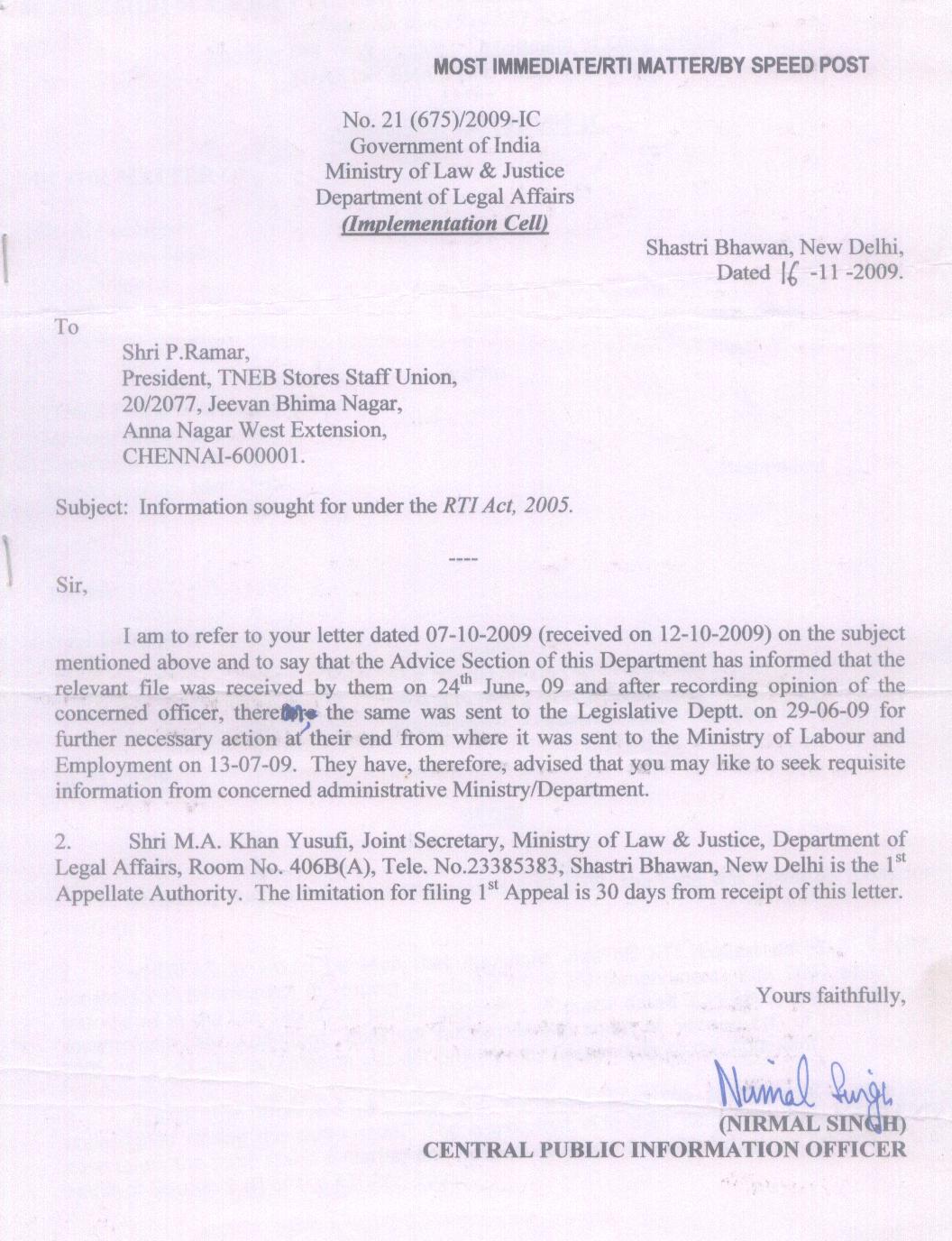
The reply dated 16.11.2009 received from the Ministry of Law is given below:

wpid-ramar-letter-scan-2013-03-28-11-17.jpg

One can see the enlarged version of this image by clicking on it


An appeal was, thereafter, filed before the First Appellate Authority of the Ministry of Law on 22.11.2009. The text of the same is given below:

From
P. Ramar,
President, TNEB Stores Staff Union,
20/2077, Jeevan Bhima Nagar,
Anna Nagar West Extension,
Chennai – 600001

To
Shri. M. A.Khan Yusufi,
Joint Secretary,
First Appellate Authority,
Ministry of Law & Justice,
Department of Legal Affairs,
Room No. 406 B- A, 4th Floor, “A” wing,
Shastri Bhawan, New Delhi-110001
Tel No.: 23385383

Sub:
Employees’ State Insurance (Amendment) Bill, 2009 – indifferent attitude of the CPIO in a matter of national importance – Appeal under Sec.19 (1) of the RTI Act, 2005
Ref:
  1. 1.Bill No.66 of 2009 tabled in the Parliament.
  2. 2.My Application dated Nil received by you on 25.9.2009.
  3. 3.Letter No. 21 (675) 2009 – IC dated 16.11.2009 of the CPIO, Ministry of Law & Justice.

Sir,

I invite your kind attention to the references cited.

2. I had, in the reference second cited, asked for certain information under Sec. 6 of the RTI Act, 2005, with reference to the Employees’ State Insurance (Amendment) Bill, 2009. The information that I had requested was with reference to what would have, normally, been available as per the files of your Ministry.

3. But, the CPIO has, in the reference third cited, informed that no file is available in your Ministry as the Advice Section of your department had recorded its opinion in the concerned file of the Ministry of Labour & Employment and sent it to the Legislative Department which, in turn, sent the file back to the Ministry of Labour & Employment.

4. The CPIO had also informed me that the Ministry of Labour & Employment may provide the information requested by me. This, he has done after more than thirty days, when he could have transferred the application to the concerned Ministry. As per Sec. 6(3) of the RTI Act, 2005, he should have done so within five days from the date of receipt of the application. The action of the CPIO is in patent violation of Rule 6 (3) of the Right to Information Act, 2005 notified by none other than your Ministry’s Legislative Department.

5. It becomes clear from the said reply of your CPIO that neither the Advice Section nor the Legislative Department of the Ministry of Law & Justice considered it necessary to retain even the copies of the file-notings for their reference and record, in spite of the fact that the issue under their consideration was the amendment to the Principal Act.

6. If the single file system is the reason for non-maintenance of record, the CPIO should, in all fairness, have transferred the Application to the Ministry of Labour & Employment, on his own, for supplying the information requested by me, as both departments are part of the same secretariat.

7. Or, if the Ministry of Labour & Employment is considered to be some other department, your Ministry should have kept a record of the work done by your officials.

8. But, neither was done in this case.

9. The issue under consideration is the very serious amendments proposed to be made in the ESI Act, 1948. The way in which your Advice Department, which has the duty to examine the proposed amendments “from legal and Constitutional angle”, had dealt with so many amendments within five days from 24.6.2009 to 29.6.2009 *** shows very clearly that your officials had either not understood the significance of various clauses, especially the Clauses 5, 9, 15, 17, of the Bill very clearly or had been under undue pressure to clear the Bill fast without proper scrutiny.

10. The reply also shows that the Ministry of Law & Justice is not concerned about the implications of the amendments endorsed by them, even after the facts brought out in my Application had been read by them. I am aggrieved by the decision of the CPIO.

11. The implications of the amendment being very serious having wider ramifications on the society, the issue is proposed to be taken up through other legitimate fora. I, therefore, request you to kindly advise your CPIO to act, at least, as per Sec. 6 (3) of the RTI Act, 2005. Precious time has been wasted in a matter of national importance, because of the indifferent attitude of your CPIO to the provisions of Sec. 6(3).

Yours faithfully,

22.11.2009

(P.Ramar)

***

N.B: It turned out later that the Ministry of Law Advice Department did not take five days but only two days. The details in this regard have alreay been given in a separate post in the following link:

The Ministry of Law created a record on 26.6.2009

Leave a comment

Filed under Amendments 2010

Test Inspections in the ESIC: A charade!

(This article deals only with the theory of checks and balances in the functioning of an organization and not the practice in Test Inspections, which will be dealt with separately. The theories must always be correct and take into account the problems that would be encountered in the field when it is enforced).

======================================================

Every system in a democracy must have checks and balances. As far as the ESIC is concerned, a provision for inspection of factories and establishments was incorporated in the ESI Act to facilitate monitoring proper compliance by the employers. Inspecting the records of the past periods helps the ESIC Administration detect (a) the occasions and (b) the manner in which the employers had, in the past, concealed the concealment of employment of persons and payment of wages. Such inspections help the Administration to find remedial measures to ensure that such concealments do not recur in future. The ESI Act is a labour-welfare legislation and the provision for inspections in the Act are, obviously, intended to advance the purpose of labour and their welfare. Such advancement can be achieved only when the inspections are done in a qualitative manner with adequate depth and substance. This being the importance of inspections under the ESI Act, as a natural corollary, the Administration must provide a system to monitor the performance of the Inspectors, the way there is a need to police the police.

The only way in which such monitoring can be done is to conduct Test inspections by higher officers. This system of checks and balances is there in the EPF Organisation also where it is called Supervisory Inspection.

Test Inspection is only an Administrative action

Test Inspection is only an Administrative action. It does not require any statutory provision. Reg. 102 of the ESI (General) Regulations, 1950 was found adequate for conducting Test Inspections. There was no problem on this issue until some employer went to court and got an interpretation that there was no provision for test inspection in the ESI Act. But, there were many Courts, which did not find fault with the system of such test-inspection. Moreover, the matter was not taken up with higher judiciary for any final verdict on the issue. The legitimacy of test inspections can be explained and justified by the ESIC by citing the practice followed in other departments. That would have protected the interests of the organization. However, it was not considered so essential at that time as the test inspections were continued to be done everywhere by calling them only as inspections (although they were done by the officers who were superior in rank to that of the inspectors).

But, all of a sudden Test Inspections were stopped describing them, strangely, as ‘harassment of employers’. This kind of phraseology in official communication puzzled the readers, as the test inspection was intended to monitor the quality of inspections conducted by the inspectors. That the employer had to pay, sometimes, additional contribution was only a consequential effect. Continue reading

4 Comments

Filed under Amendments 2010, Inspections

Action Against Defaulters: Quo vadis, the ESIC?

Excerpts from a news item from the Times of India dated 07.12.2012:

“It has been observed that open-ended assessment, inquiries and investigations serve no real purpose. Moreover, such inquiries often do not result in the identification of beneficiaries and only tend to harass the employers and establishments. It is accordingly directed that no inquiry or probe shall ordinarily go beyond seven years that is, it shall cover the period of default not exceeding preceding seven financial years. It is to be ensured that compliance actions are initiated in time and there is normally no reason for extending the scope of investigation and assessment inquiry beyond previous seven financial years,” Central PF commissioner R C Mishra said in a circular issued on November 30, the day he superannuated.

“This circular is anti-worker. The law of limitation does not apply on us and does not stand the test of law as there are several Supreme Court rulings on the issue,” said A D Nagpal, Hind Mazdoor Sabha secretary and a trustee on the EPFO board.

“Nagpal said that fearing action, employees often do not complain against their employer till they leave service and the new provision will make it impossible for them to claim what is due to them.”

“It is not proper to have a time limit for what is an employee’s right,” added CITU president A K Padmanabhan, who is also on the EPFO board. He said the EPF statement usually does not reach employees on time and very few actually check the balance and deposits carefully.

Even before the circular was issued, there were protests within EPFO over the move. Sources said some of the members of a committee of officers on judicial proceedings had opted out from giving their recommendations as they recognized that the move was not employee-friendly. Yet, Mishra went ahead and issued the directive.

TIMES VIEW

“In a country which has precious little by way of a social safety net, the provident fund is one of the few such fallback options, even if only for those in the organized labour force. Any change in the rules governing this scheme must therefore be tested on the touchstone of whether it enhances the safety net or weakens it. Imposing a time limitation on when defaults can be investigated clearly weakens it. Most of those whose savings lie in the EPF do not regularly track whether money is being deposited in it by their employers and, if so, whether it is as much as it should be. They may well discover a default well after it happens. Clearly, they cannot be left with no scope for redress due to a time limitation clause.”

What happened in the ESIC? The ESIC had, silently, restricted the duration to five years (and not seven as in the EPFO) and got the Act amended too. The cut-off date for determining the five years period is not with reference to the financial years but with reference to the 21st of every month. The cut-off date was just left to float, so fast.

Continue reading

Leave a comment

Filed under Amendments 2010

Interviews: ESIC on the reverse journey?


I. There were vacancies in the cadre of medical officers in the ESI Corporation and a proposal was mooted to recruit them. A political heavyweight who came to know about it, pressured the Head of the Department to select people as per his choice. He wanted the selection process to have only the mode, i.e.,  interview,  to facilitate his nefarious designs. But, the pressure was resisted, very courageously, by the Head of the Department. Yet, the politician won the day and the Head of the Department was shifted out abruptly and prematurely. Same pressure was brought on the next incumbent also. But, he also resisted the pressure, admirably, and did not agree to dispense with the Written Test. Interview was only for those who came through the Written Test, he said. Now, it was the turn of the politician to lose. Advertisement was issued, applications were processed and written tests were held in a transparent manner and the evaluation was a computerized one. But, that was not the end of the story. Presidential_Dollars_Madison_Coin

II. The process of interview was the next part of selection. It was, now, attempted to be hijacked by the political leader. An elaborate net was woven in the political circles to hijack the interview process. Action was taken to frame even a new Recruitment Regulations for that purpose, i.e., to hijack the interview board. But, the Head of the Department was so clever that he just kept watching the game (played by the people within and outside the ESIC) and very simply and effectively checkmated the game ultimately. The end result was least interference in the recruitment process. Besides,  the ESIC came to have a Recruitment Regulation which had not been used at all. The incident proved that clever and honest bureaucrats could always stop the corrupt politicians.

Organised mischief by the interview board

III. There was an advertisement inviting applications for the post of para-medical personnel in Group-D in a hospital. More than 7000 applications were received. Appointment was to be made on the basis of the performance of the candidates in the interview. That was the only mode of selection. Continue reading

1 Comment

Filed under Amendments 2010