Category Archives: Uncategorized

Framing the Innocents – Part III

These cases deal with criminal procedure. But, they have some relevance for general administration side also.
I.

Mr.Sarbjeet was picked up by the police, detained for several days and finally gunned down near the Indo-Pak border. It was, later on, found that the deceased had nothing to do with terrorist activities and was completely innocent. The Supreme Court has in this case ordered the CBI to conduct an inquiry.

-The Hindustan Times – 6.4.1993.

II.

A British man who has spent nearly 15 years in jail for the rape of a student nurse was cleared and freed on Friday after an appeal court ruled that the crime “almost certainly never happened at all”. Roy Burnett (56), a gardener from Kent, was jailed for life in 1986 after a jury accepted evidence from the 20 year old nurse that she had been raped and seriously assaulted. Burnett consistently said he was innocent, but had no grounds for an appeal until 1998 when the same woman made a false complaint of rape to Devon police. The police were informed and Burnett’s case was re-opened. But for the action of the police he “might have continued to be incarcerated for many years yet”, the appeal judge said. –DPA.

– The Hindu – 9.4.2000

III.

On a Sunday all the inmates of the house went to the church leaving a maidservant alone in the house. When they returned, they found that some precious jewellery was missing from the house. The maidservant was prosecuted for theft and convicted on the ground that she alone had exclusive opportunity.

After serving the sentence, the maidservant was walking in a street one day. A butcher tapped her on her back and remarked, “Oh, what a beautiful creature I am when I look in the mirror!” She immediately remembered that on the day of theft this butcher visited the house to supply minced meat, and she took the meat and went inside to store it. She had then shut the doors, went up stairs and stood before a mirror. She then dressed herself and remarked looking at her body in the mirror:” Oh, what a beautiful creature I am when I look in the mirror!” The butcher had obviously not gone out in the meanwhile but had hidden himself in the house and had heard this remark and now repeated it to the maidservant in the street. It was found he was responsible for the theft.

-Cited in Batuklal’s Law of Evidence.

IV.

“In another case a maid servant was tried for murder of her mistress. On the day of the murder the accused and the deceased were in the house and all the doors and windows were shut from inside. The maidservant was convicted for the murder and sentenced to death on the ground that she alone had the exclusive opportunity to commit the murder. The maidservant was executed but later truth came to the light from the confession made by the real offenders. They said that they entered the house of the deceased by putting a wooden plank from the window of the adjacent house to the window of the deceased house, across the street, which was narrow. They committed the murder and went back the same way without leaving any clue.”

  • Cited in Law of Evidence- Pages 38 &39 These instances prove that “it is highly dangerous to rely on the evidence of opportunity alone in the absence of substantial evidence to convict a person”,

Says Dr. V. Krishnamachari.

V.

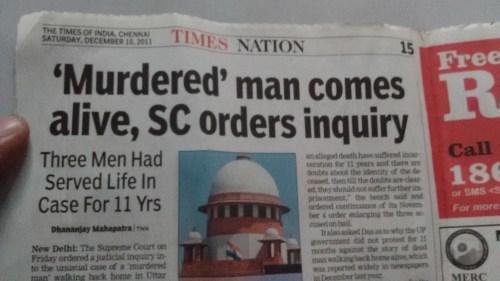
In Pandiammal case, her husband was fixed for the murder of Pandiammal and was tried in the court of law. When the punishment was to be inflicted, his wife Pandiammal herself turned up in the court and said that she had not been murdered by anybody but had gone to Kerala because of marital discord and came back after hearing from someone that her husband was in jail for having murdered her. It later turned out that the husband of Pandiammal had been tortured by the Police and had been made to confess that he had indeed murdered his wife. The police was investigating into a death of a woman whose decomposed body was found near the village. People said that it might be Pandiammal as she was not seen for a few days and that there would always be quarrel between her and her husband. So, the Police fixed her husband. Now, when the facts were out, the police was wondering who the murdered woman was and who had killed her.

But for the torture method, the Police would at least have gone in search of the real killer and the real victim.

VI.

Update on 31.12.2017
Framing the innocents 2

Framing the innocents

Leave a comment

Filed under Uncategorized

Framing the innocents: Part II

1720 A.D. Rama Komathi, a man of great wealth and influence, enjoyed a very high reputation in Bombay, not only for his wealth, but also for his philanthropy, benefactions and public spirit. He enjoyed remarkable respect and confidence of the East India Company for over 30 years. He was the only Indian citizen of Bombay invited to attend the inauguration of the St. Thomas’s Cathedral.

“But such is the perversity and malignity of human nature, that, at times, a virtuous man makes more enviers and enemies than an unscrupulous and unprincipled timeserver and opportunist.”

When he became old and infirm, he was charged as a traitor and a dangerous conspirator. His position, his character and his past record might have persuaded any sensible law court that such a charge in relation to such a man was incredible. But, that did not happen in his case.

Trial was conducted. The witness was one of Rama Komathi’s servants. This witness testified during the trial that that there was interaction and correspondence between Rama Komathi and the pirate chief Kanhoji Angare to kidnap the Governor Boone. In regard to the source of his information, this witness said that he came to know about it from a dancing girl and that she told that Angare had told her that Rama Komathi had written a letter to him. That dancing girl was not examined. Letters written by Rama Komathi to Kanhoji Angare were produced during the trial. They were in his handwriting and carried his seal too.

The Governor in Council drew the charge. His trial was held before an adhoc tribunal, which was presided over by Governor Boone and consisted of members of the Council and Parker, the Chief Justice of the Court.

During the trial, the Chief Justice Parker came to know of the torture of the witness and objected to it. The witness had been subjected to “cruel and inhuman torture” and the evidence was fabricated with forged documents and even that evidence was only a hearsay evidence. That servant was tortured by cutting off his thumb to extract evidence and a statement implicating Komathi.

Parker came to know also the fact that such a torture was inflicted at the instance of Boone. But, the result of showing this judicial independence was his dismissal from office, by the Governor. This is what happens when the Executive has so much say over Judiciary.

Rama Komathi was convicted and sentenced to imprisonment for life with confiscation of all his property. For eight long years he languished in gaol until death came to deliver him in 1728.

In pursuance of the sentence, Rama Komathi’s property was pillaged, and sold by public auction. A commodious warehouse in Mumbai Fort belonging to him was taken over by the Company itself for Rs. 20,000.

“It was of course only appropriate that a property plundered out of the estate of a tragic victim of judicial error and malicious machinations of a gang of miscreants, should become the inspiring venue of law and justice.”

It was proved later, after Rama’s death, that the incriminating letters were all forgeries, that the seal was fictitious, fabricated by a soni who was an expert forger.

His immense wealth had excited the envy and cupidity of a clever gang of cheats and forgers and the Governor too became involved in it at a later stage. All that the subsequent Government could do then was to repair the wrong was to give some monetary compensation to Rama’s son.

His conduct of the trial was dubious. He subjected a witness, a servant of Rama, to torture to extract a confession from him, notwithstanding the protest of Parker that judicial torture was illegal under English law.

There is no suggestion that, barring Boone, the other members of the tribunal had any inkling of the plot against the prisoner.

There is also no evidence that Boone was the brain or even the originator of the conspiracy.

After the sentence, Governor Boone invited claims against the property of the condemned criminal; and promptly put in a claim of his own to the tune of Rs. 12,791, a very large sum in those days.

From and For more, with courtesy:

http://bombayhighcourt.nic.in/libweb/historicalcases/cases/THE_TRIAL_OF_RAMA_KOMATHI-1720.html

Cited by Kautilya in The Legal History of India and by V.D. Kulshreshta in Landmarks in Indian Legal and Constitutional

Leave a comment

Filed under Uncategorized

Framing the innocents: Part I

(The present one and the next few threads would show how the bureaucrats book the innocents and harass them by abusing the authority vested in them for public purpose. The serving employees can get a lot of clues from these threads to protect themselves against victimisation)

Mr. B.K. Subbarao stood first in Electrical Engineering in the A.P. University in 1963 and joined the Indian Navy the same year. He received many awards and citations in the Navy. He was the recipient of the Herbert Lott Memorial Award “for his inventiveness in improving the existing fighting devices of the Navy” and Lieutenant V.K.Jain Memorial Gold Medal “for his achievements in the field of computer technology, electrical engineering and control engineering.” He got doctorate too.

Meanwhile, in the BARC, the scientists had been working on the first design of a nuclear submarine propulsion plant since 1971.

In June 1976, Subba Rao was asked to work with BARC scientists for developing a nuclear sub-marine plant. He was made the second-in-command for a team of 20 Naval officers and 85 BARC scientists. On the basis of Subbarao’s technical findings, this design had to be dropped in 1976.

The second design was also dropped in January 1978 after Subbarao showed that it was not viable for naval application.

The BARC authorities were sore at Subbarao picking holes in their work. They, therefore, decided to bypass the Naval team. Their third design was, therefore, directly submitted by the BARC in 1980 to the Prime Minister Indira Gandhi. The scientists also wanted Rs. 150 crore to build a prototype of their third design. But, Indira Gandhi, wanted to have the technical opinion from Subbarao. Subbarao’s report rejected BARC’s third design also. He specified that the design failed to meet the basic standards, such as safety, followed by the nuclear navies of the USA, Russia, Britain, France and China. He gave 14 reasons whythe third design would also not work. Mrs. Gandhi did not sanction the Rs. 150 crores.

Consequently, Indira Gandhi returned BARC’S proposal. However, she also said that she would reconsider her decision if the BARC scientists could disprove Subbarao’s claim. But, the BARC did not dare to do so. The observations of Subba Rao were so sharp and correct.

The BARC started work on the fourth design towards the end of 1980. Meanwhile, the Indian Navy instructed Subbarao to develop a design of his own. Subbarao’sdesign was ready by November 1982 and submitted to the Prime Minister’s office.

Official Secrets Act Tavleen Singh

Conspiracy by the officers who were egoists

Meanwhile, Navy asked Subbarao to prepare his own design. Indira Gandhi asked the BARC scientists to examine the issue based on Subbarao’s nuclear submarine design. Dr Raja Ramanna, the BARC director (also scientific advisor to the defence minister) was more egoistic. He declined to consider Subbarao’s design. He said to Subbarao, “You are a naval officer and we cannot accept the work of a naval officer. I will send my comments on your design but you will not see them in your lifetime. You should go back to the navy and work in electronics and computers which is your field”. Within a week Subbarao was taken off the submarine project by the Naval authorities. Continue reading

4 Comments

Filed under Uncategorized