Moving the Court of Law; Inviting ideas and opinions from the public !

Democracy means having the right to say what one wants and leaving the decision to others*. But, what one says must be right and true. This website makes every attempt to present the ‘right’s and the ‘truths’. And, this website never claims that what it presents alone is right. It is for the reader to discern what is right and what is wrong, as the website is open for different viewpoints and has hosted articles received by it with contrary views.

This website reiterates that it serves only as a forum to bring out the opinion of the public so that the authorities are able to traverse beyond their immediate circle and take informed decisions. The website would also enable the Ministers and Prime Minister to realize the seriousness of their mistake in forcing the bureaucrats to put up convenient notes to justify the pro-rich decision already taken by them, ignoring the pain that would be inflicted on the society by such improper political decision.

 Wrong decisions by Elected Bodies

 Now that the ESI Corporation, as a body, has realised, in its 163rd meeting, that running the medical colleges is not its core activity (and that too, after the amendment of 2010 which made the medical colleges, part of the ESIC) the issue becomes how and why the same ESI Corporation, as a body, considered, in the years 2008 and 2009, that running the medical college was essential for it, “to improve the quality of services provided under the ESI Scheme” and permitted spending the surplus funds running into more than Rs. 9000 crores, in a tearing hurry, and hundreds of crores were sanctioned first and placed later for approval ex-post facto by the Standing Committee, for construction of medical college buildings, even before the formal amendment was made to the ESI Act to empower the ESIC to “establish” medical colleges.

The fact, therefore, is that the ESIC, as a body, took a wrong decision either before the amendment or, now, after the amendment. The indisputable fact is that the ESIC, as a body, has demonstrated that it could and would take wrong decisions.

 Failure of Members to play their legitimate role

 But, the concept of having a multi-faceted body for decision-making is that there should, normally, be informed discussions in the meetings so that there would be no scope for such patently wrong decisions. But that was not to be in the case of ESIC when it came to spending thousands of crores of rupees for construction of buildings for medical colleges, even before the enactment of law. The ESI Corporation, is a Body in which there are, among others,

  • 10 employers’ representatives,
  • 10 employees’ representatives,
  • 3 MPs, and
  • 25 IAS Officers representing various State Governments.

Yet, such wrong decision had been taken in the ESIC meetings, only because of the failure of the employers’ representatives and employees’ representatives (except Mr. Kali Ghose) to examine the proposal with the seriousness it deserved. The representatives of the State Governments used to remain silent spectators in almost all the ESIC meetings, except when the issue involved their States. But, their presence had always lent credibility to the claim of their consent to the decision in the Body by showing them as part of the affirming majority. In essence, majority of the members of the ESIC did not show active interest, in the years 2008 and 2009, in examining the proposal tabled for their consideration, for insertion of Sec. 59-B. Hence the present predicament.

 Failure of the media to prevent the catastrophe

 Yet, even in those years of origin of the present problem, there had been some activists who had been working hard to prevent the catastrophe and to enlighten the MPs about such a wrong decision and the unlawful action in spending crores of rupees for construction of buildings for medical colleges, even before the Parliament amended the Act. But, the MPs did not care. Those activists wrote to various newspapers too, including the “National”ones. But, no editor cared. The Parliamentary Standing Committee was cheated. And, in the last leg, the Parliamentarians chose to be busy with creating pandemonium over Mr. Sibu Soren issue while Mr. Mallikarjun Kharge could present the amendment, amidst interruptions and interruptions, and get it through. The result was a puzzling proposal for amendment became law with an ‘amazing’ and improper Validation Clause. That was how the ESI Corporation, as a Body, the Parliamentary Standing Committee, as a Body, and the House of the People, as a Body, had erred and failed to live up to the purpose for which they were there. They had failed to analyse the present and foresee even the easily foreseeable future.

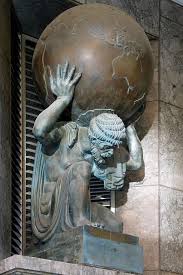
 Atlas is looking for another shoulder

 And, the burden of that error and failure, has been passed on by the earlier Administration to the shoulders of the present Administration, which is searching desperately for other shoulders to shift its burden. Atlas who got the burden of the globe shifted to his shoulders is still trying to find someone else to shift it off. The issue now is whether Atlas can continue to shoulder the burden or should shift it to someone else or whether he can make use of it, in any other manner, without shouldering it as a burden.Atlas 4 The decision in the 163rd meeting of the ESI Corporation that running the medical colleges is not its core activity is right. But, handing over the buildings to the State Governments or private players does not appear to be right. The members of the ESIC do not seem to have discussed the issue in-depth. They appear to have remained silent and endorsed the already made up bureaucratic stand on the issue. It is a clear failure of the present ESI Corporation, as a body. Its decision to shift the burden to the State Governments or to the private players do not seem to be correct and right. But, what are the other options open for the ESIC to make the best out of the present quandary? Are there ways to come out of the quagmire?
Of course, people come up with a variety of ideas. Some may be right. Some may be wrong. Some may be legal. Some may be unlawful. It is felt appropriate to examine all the options in an open forum so that the best comes out of it to facilitate the Administrators to consider those options.

 Thankfully, many are public-spirited

 Some well-intentioned activists believe in taking up the issue to the Court of Law. The relevant questions on the issue are, therefore, brought to the attention of the public, seeking their opinions on them. The questions and the replies given by the public would be presented before the judiciary as a document in the Typeset when the Writ is filed.

Every single citizen has a say in the matter and a stake in the well-being of the ESIC, as an organisation meant to take care of complex life problems. The website, therefore, invites readers to record their viewpoints on the crucial issues so that the best solution emerges out of such brainstorming event for the common good.

“I am only one; I cannot do everything.

Still, I am one; I can do something.

Because I cannot do everything,

I will not desist from doing something that I can do”,

-Helen Keller.

===========================================

The first case to be filed in the Court will focus on the manner in which the ESIC proposes to utilise the buildings which are constructed for running medical colleges. Hon’ble Minister for Labour has made the stand of the Government public in the Press Release dated 23.03.2015. That Press Release will be the impugned document.

 Press Release 23. 03.2015

 The Press Release dated 23.03.2015 says that the ESI Corporation is going to hand over 8 medical colleges, at Faridabad, Sanatnagar, Coimbatore, Gulbarga, Mandi, Alwar, Paripally and Bihta to State Governments as per its revised terms and conditions. It has been mentioned that if the State Governments do not come forward to send any reply within 15 days, it would be presumed by the ESI Corporation that they were not interested in taking over those projects and, thereafter, efforts would be made to run these medical colleges under PPP model etc.,

It has also been specified therein that “the core function of the ESIC is to provide social security i.e., cash benefit and medical benefit to the Insured Persons under the ESI Scheme. It was felt it would help the ESIC in concentrating at its core function if the ESIC exited from the field of Medical Education”.

 White elephants, so many!

 It is apparent from the said Press Release that the present ESI Administration finds it difficult to run the Medical Colleges and does not know how to get rid of so many white elephants. It says it is trying to hand over the “Medical Colleges” to the State Governments, on its own terms and conditions.

The Ministry of Labour is also ready ( Or, eager?) to hand over those “Medical Colleges” to private players, as could be seen from the Press Release dated 23.03.2015. It uses the term ‘PPP model’. It also uses, significantly, the word “etc” to indicate that it does have more options too.

The Press Release gives raise to various questions, some of which are enumerated below:

  1. Where is the provision in Sec. 59-B to empower the ESIC to run the “medical colleges” through private players or even through State Governments? Such third party participation is permitted by Sec. 59 (3) only to run the ESI Hospitals and not Medical Colleges. How can the ESIC mix up Sec. 59(3) with Sec. 59 (B)?
  2. Besides, the basic issue is, where is the continued need for the ESIC to run medical colleges and also to seek PPP for that purpose, when it has found out that it is not its core activity, at least, now?
  3. When the Administration has admitted that the buildings of 8 more medical colleges are only “under construction”, why should it not forget about medical colleges but use the infrastructure created, for some other purposes, in such a manner that it generates permanent rental income to the ESIC to add to the ESI Fund, to offset the money lost during the last six years?
  4. Is it obligatory for the ESIC to run those medical colleges through proxies, either through the State Government or through PPP or through other methods (as implied from the world ‘etc’), just because buildings have been constructed or just because the MCI is going to give permission to it?
  5. When the Private Players are allowed to run the medical colleges, will they be running it as per their own licence or by using the licence obtained by the ESIC from the Medical Council of India?
  6. If the ESIC is using the licence obtained by it for running the medical colleges and allowing that licence to be used by the private players, will it be legal, when the ESIC has gone on record saying repeatedly that running the medical colleges is not its core activity?
  7. Would those private players be able to get permission from the Medical Council of India to run medical colleges on their own? Are these private players permitted to be the beneficiaries of the misadventure and discomfiture of the ESIC in having illegally started construction of buildings spending thousands of crores of rupees from the year 2008?
  8. How is it that some private players like Reliance, SRM and others are reported to have already entered the premises of various (proposed) medical colleges at Coimbatore, Joka and other places, officially and inspected the infrastructure under construction?
  9. Is it true that those private players would admit students under Management Quota to make money, using the licence granted to the ESIC for starting medical colleges?
  10. What is the significance of giving only 15 days’ time to the State Governments to accept the Terms and Conditions framed by the ESIC before and for inviting the private players to have a role in running the medical colleges on behalf of the ESI Corporation?

Helen Keller, all

Everyone is, can be and has to be a Helen Keller. Everyone’s ideas count. Actions of individuals count. During the early 1940s there had been many social activists, impartial scientific authorities, in England who had conducted many social surveys of the conditions of life of the people in principal towns in Britain including London, Liverpool, Sheffield, Plymouth, Southampton, York and Bristol.

Helen Keller

Helen Keller

That alerted Winston Churchill to entrust the work of formal study of the issues of Social Security to Sir William Beveridge. The website, therefore, invites all the readers to come up with their ideas and opinions on the issues affecting the working population.

If emerging facts prove what the PMO, Ministry of Labour and the ESIC are going really in right direction in public interest, it will not be necessary to move the court of law on this score. Otherwise, we will have to seek the intersession of the Judiciary to save the nation from the organised attempts of the rich businessmen and pro-rich-politicians to dismantle the finest Social Security of the nation.

(*with due apologies to H.D.Thoreau).

7 Comments

Filed under Medical College Bond

Passing urine for the third time? Fine Rs. 20 !

The UK is not a democracy. People are not sovereign there, till date ! The UK remains only a Constitutional Monarchy. The UK joined the EEC on 01.01.1973. Conservative Party which was in power was in favour of remaining in the EEC while the Labour was against it. In the general elections of 1974, Labour won the elections. Just because Labour captured the Parliament, it did not use ‘that’ power to withdraw the UK from the EEC. Harold Wilson, the Labour Prime Minister and his party MPs did not choose to arrogate to themselves the authority to decide the issue as they pleased.

When an issue that was going to affect the people of the nation economically in a far-reaching way and when the forecasts of economists were based on the theory of probability and not certainty, the MPs of the ruling party in Britain acted with caution and concern. They did not want to play with the lives of the people. They did not want to demonstrate self-righteousness, by acting overwise and assuming responsibility, if the predictions and speculations of the economic pundits went wrong, later, on economic front. Parliament decided to consult the electorate on the question whether the UK should remain or not in the EEC. A Referendum was held, in 1975. And, the people voted for it. That vote was against the stand taken by the ruling Labour Party before it contested and won the elections in 1974.

Click on the image to go to the Text of the Referendum

Click on the image to go to the Text of the Referendum

The Grace and the Disgrace

Was it obligatory for the M.Ps of the U.K. to refer the matter to the people to be decided through referendum? No. They could have learnt a lesson or two from the political leaders of India and could have done whatever they liked. Because, once elected, the MPs, practically, constitute an oligarchy and could join together and range themselves against the people of the nation. They have been given the law-making power with which they could make any law on economic matters. Still, the MPs in the UK did not abuse the power vested in them by the people in trust. They knew the concept of moderation in wielding political power as representatives of the people. They acted graciously as the representatives of the people and wanted the people themselves to decide the issue of being part of mini-globalisation process called European Common Market. The people of the UK were sovereign in that Constitutional Monarchy.

But, Indian politicians who inherited the British pattern of Parliamentary system never exhibited such grace or maturity to work that Parliamentary System in India. They demonstrated time and again that they cared two hoots to adhere to the well-established British conventions that pave way for a civilised public life. They had, long back, given a go-by to the admirable British conventions in electing Speakers, allowing the MPs to exercise Conscience Votes, using the Parliament forum for real discussion without creating pandemonium, etc., It is plain disgrace to jettison the Conventions that accompanied the Constitution. The Constitution is the letter while the Convention is its spirit.

Conventions are invisible part of the Constitution

“A complete account of the Constitution, therefore, involves a statement of central custom as well as of central law” – Sir John Salmond). But, Indian politicians have cultivated a habit of acquiring power by resorting to all foul means and retaining that power by resorting to all questionable means and using that power to do all kinds of unholy activities. Instances are too numerous to cite. All because the Indian politicians do not care for the Conventions go along with the Constitutional provisions. When the issues pertaining to such Conventions were discussed in the Constituent Assembly, there was demand from some members for reducing those conventions in writing. But, the majority of the Founding Fathers considered that it was not necessary to do so.

They believed that their descendants would also be honest in public life. They, therefore, believed that those unwritten conventions would be followed in India, even if they remained unwritten. Clauses like “I think we would trust”, “ I hope”, etc., had been used to pacify the members, who raised doubts whether the relevant provisions would be abused in future. “(… Of the democratic systems which are prevalent in the world) we have adopted largely the British model…..what I feel is this, that in this country, we should develop the conventions which go with the democracy in England and those conventions govern not only the Government – but also the people” – From the address of the President Rajendra Prasad to the people of Chennai on 15.08.1950), But, the descendants have betrayed the Founding Fathers.

Rules of Morality

Conventions under British Parliamentary procedure are called as Rules of Morality. But, the Indian political leaders do not care for those Conventions because they do not, actually, care for Morality in public life. The nation has seen it on numerous occasions. “The rules of Parliamentary procedures in India are modelled on the practice of conventions that obtain in the Mother of Parliaments – The House of Commons” ( Parliamentary Procedure in India – A.R. Mukherjea, Former Secretary to West Bengal Assembly – Oxford University Press)

‘Say anything to please the masses to occupy the power-centre and do everything that pleases you after occupying the power-centre’ is the Convention invented by the Indian politicians. They keep their manifesto unenforceable by law. They believe that once they get majority they can do anything and everything they like, in the belief that the nation has been given on unconditional lease to them by the people for five years. And that kind of belief gives them courage to bring in laws to suit the convenience of their financiers, the business-magnates, without bothering themselves about the state of society in the long run.

Such political leaders choose to keep their MPs as ignoramus. They are happy to have only ignorant and inefficient MPs who would be just loyal to the leader and would not have any opinion on any issue. That, they see as their power. These leaders do not have any inhibition when their nation itself is ridiculed by others in the international arena.

Ignorance and greed makes them easy victims to Shylocks

The MPs, on their part, are happy about their status as MP and the privileges and pelf that accompany that status. They do not bother about acquiring knowledge on the issues that affects the people. They do not talk of the people’s problems in the Parliament by analysing the issues. But, they boast of their ability to shout in the Parliament to stall the proceedings. They want money to ask questions in the Parliament on public issues, when people approach them and apprise them on the issues that must be taken to the knowledge of the rulers through the House.

Such a situation is tailor-made for business magnates to get anything done through such government. purchase anything from and through that Government. In the year 1985 itself, Swiss Government had declared that it had no intention to be a haven for any ill-gotten money, when the issues pertaining to black money on foreign soil was discussed in Parliament. Yet, the politicians in power drew the blank for the past 29 years while, at the same time, they kept pretending that they were against black money. As long as the political parties are run on black money, the nation’s future will continue to be bleak. Every political party that gets scared and runs for cover when asked about transparency of its sources of funds is, actually, anti-poor and pro-rich in its activities, and its leaders cannot claim and do not have the right to claim that that party would usher in an honest society.

Because, the political parties that make ‘collections’ for elections are not able to resist the Moneybags. Offer of large sums of money is so attractive to these politicians that they are not able to resist the pressure from the businessmen. They are, therefore, willing to betray the people and make them slaves who could be used, disposed of and dispensed with by the rich. They use their ‘power’ to advance the purpose of the ‘rich’. Corporates actually pay money to the political leaders to purchase them. Such a collection is, really, not a donation but payment for certain quid-pro-quo, for which they pressure the political leaders at the opportune moment. And, the political leaders do not blink an eye before yielding to such pressures with money. The eagerness and appetency exhibited by the rulers in pressing on with the Land Acquisition Bill, Small Factories Bill, and the present proposal to dilute the provisions of the ESI Act, 1948 are symptomatic of their willingness to yield to the money-pressure from the Shylockian business world.

Sky-high powers of Indian politicians

The politicians in India wield more powers than permissible in a mature democracy. That must be reduced. There must be more checks and balances in the interest of the nation. When the 123 agreement was signed, the USA did not accept it at once. It was placed before the Congress and Senate where amendments were suggested. Indian PM agreed to that amendment. But, that agreement was given by him without the formal knowledge of the Indian Parliament. Thus, in practice, Mr. Manmohan could do whatever he wanted while Mr.Bush could not.

In the case of Sri Lankan agreement the then Prime MInister Rajiv Gandhi had, without any sense of restraint, signed an agreement with Jayawardane for placing the sovereign Indian Army at the disposal of a foreign head of state. That agreement was not placed before the Parliament before making it enforceable. But, In Sri Lanka, that agreement had to be placed before the Parliament for approval before enforcement. Moreover, as a result of the misguided filenotings of the bureaucrats of the MEA, the improper agreement that had been signed, resulted in India witnessing the ignominy of seeing its sovereign army sent packing by the subsequent President of Sri Lanka unilaterally on 15.06.1989.

IPKF sent back In India, the Indian politicians have demonstrated time and again that they would to to any extent to use and abuse their power and were not bound to follow any British conventions like Referendum. So much power in them is not in the interest of the nation, at all.

The healthiest nations

The society cannot expect such political leaders to stand up to the might of the corporate moneybags. There will, therefore, be wide gap between the rich and the poor and the gap will continue to widen in India with every passing day. A Canadian study suggests that the wealthiest nations do not have the healthiest people; instead, it is countries with the smallest economic gap between the rich and poor. (Mark Bourrie – Inter Press Service -23.7.1999). But, the Indian politicians, who rely upon Corporates for their own survival, do not have the intention or, even, desire to usher in such a healthiest society in our nation.

Presentation 1

The Voice of Reason and Justice

In Samatha vs. State of AP (1997), Hon’ble Apex Court has held, “The core constitutional objective of “social and economic democracy” in other words, just social order, cannot be established without removing the inequalities in income and making endeavour to eliminate inequalities in status through the rule of law. The mandate for social and economic retransformation requires that the material resources or their ownership and control should be so distributed as to subserve the common good. A new social order, therefore, would emerge, out of the old unequal or hierarchical social order. The legislative or executive measures, therefore, should be necessary for the reconstruction of the unequal social order by corrective and distributive justice through the rule of law”. 

✓ ESI Act, 1948, and the other labour laws aim at ensuring distributive justice. ✓ Social and economic democracy can be achieved best only through ESI Act, 1948. ✓ And that is what the Scandinavian countries and Germany, the cradle of Social Security, have taught us, in spite of our not being ready to learn from them.

Slide1

But, that is Not Enough

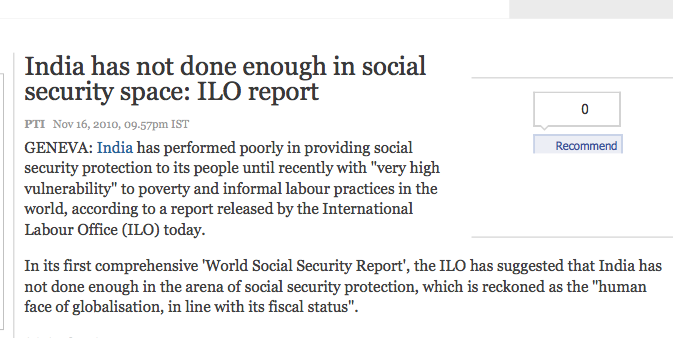
Although the benefits under the ESI Act, 1948 are par excellence, we have not travelled the entire distance in providing social security to the people, by taking the Act forward to various sectors as mandated by its Sec. 1(4). Diluting the provisions of ESI Act, 1948 would result in perpetuation of unequal and hierarchical social order, which must be shunned away. When the rulers advocate globalisation in everything except their area, I.e.. politics, they must spare a few moments for the working population too and improve the social security measures which is considered as the “human face of globalisation”. Because, the assessment of the ILO, in the year 2010, is that India has not done enough in Social Security space.

India ILO on Social Security16.11.2010, Times of India.

It is, therefore, time to improve upon social security measures instead of doing the opposite as is being done by the present rulers.

Do not widen the gap between rich and poor

Hon’ble Supreme Court referred to the following statement of Dr. Ambedkar too, in the aforesaid judgment:

“…On the economic plan, we have a society in which there are some who have immense wealth as against many who live in abject poverty. We cannot afford to have equality in political life and inequality in economic life. How long shall we continue to live this life of contradiction? How long shall we continue to deny equality in our social and economic life? We must remove this contradiction at the earliest possible moment or else those who suffered from inequality will blow up the structure of political democracy which this Assembly has laboriously built up.”

Willing participation of Labour

Privatisation of the ESIC is not a panacea for any evil that is afflicting the society. It would make the life of the working population even more miserable. Let the rulers not hurry into misadventures, just because they have the power, now, and send the society into disarray. Taking action to run the organisation corruption-free would ensure that the working population feels secure ensuring, thereby, willing participation of labour in the making of the nation.

Hold Referendum

It would only be proper if the rulers are made by the people to come to them with a Referendum on the major policy matters like the

◆ Land Acquisition Bill.

◆ Small Factories (Regulation of Employment and Conditions of Services) Bill, 2014,

◆ Privatisation of ESIC by diluting the provisions of the ESI Act or simple dilution of the provisions of the ESI Act, etc.,

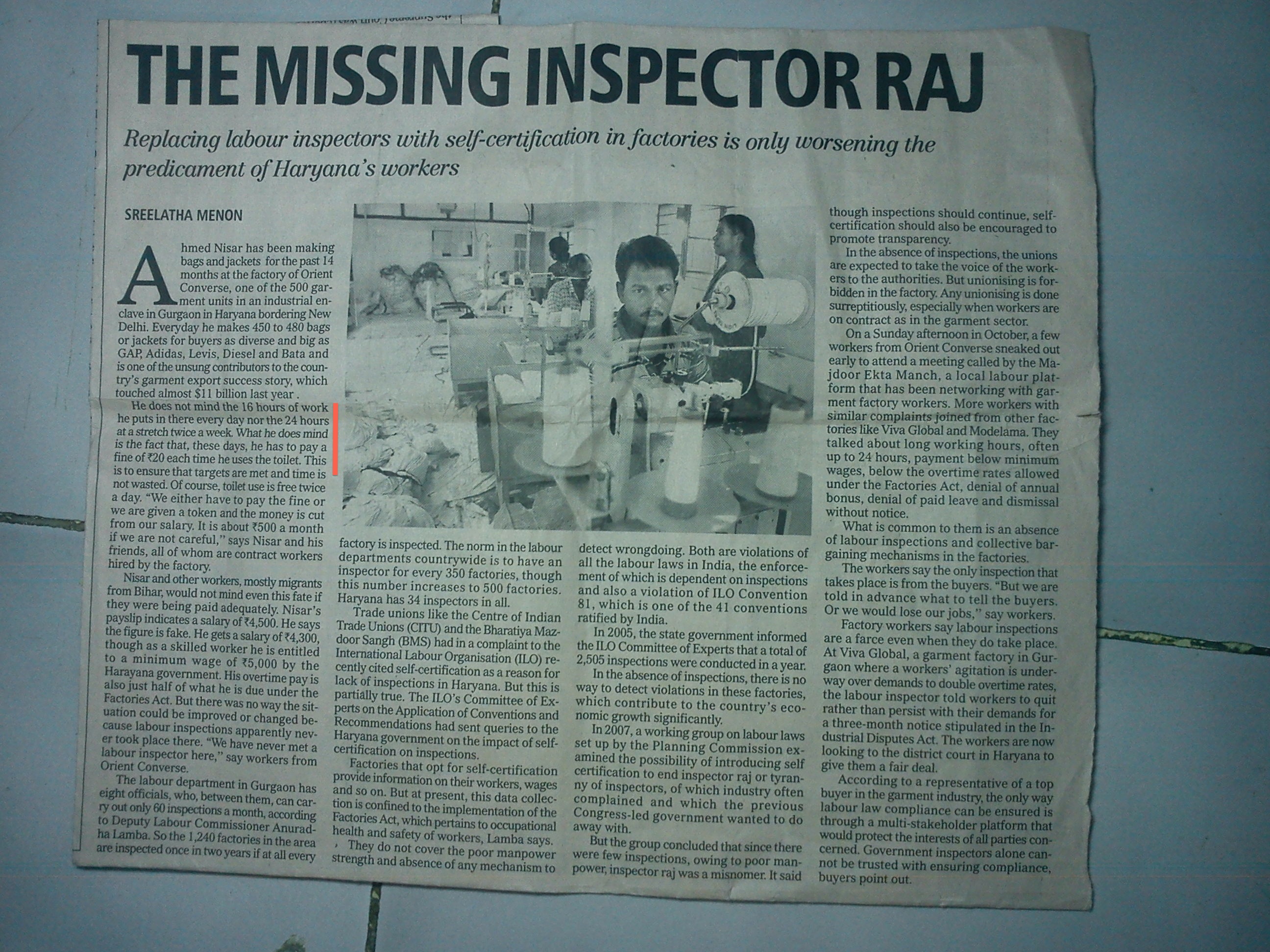
Already, when the requirement of formal inspections by the Department of Labour had been relaxed, the employers at Vellore imposed a fine of Rs. 20, if the workers visited the urinal for the third time in a day.

Business Standard, November, 2010

Business Standard, November, 2010

The workers who earn only Rs. 4300/- p.m, but sign the records for Rs. 4500/- learnt to be ‘careful’ to go for urinal only for two times a day. (Business Standard, November 2010). They control themselves not to go for the third time, except when they are desperate. Because, they find that such wage-cuts because of the third and subsequent visits cost around Rs. 500/- per month. That was none of the botherations of Mr. Manmohan Singh who was working overtime to spread red-carpet to Walmart. Mr. Narendra Modi is walking the same path and more concerned about Adanis. With the abdication of responsibility of the Government in providing social security, the conditions of service would worsen and the Indian labour market would be converted into Slave Labour market. Our freedom struggle was not to free ourselves from being slaves to British traders to become slaves to Indian traders.

It is Distributive justice which ushers in a Just society through Social and Economic Democracy. Neither the Communist Parties which demand and accept funds from the Corporates nor the Trade Unions of other political parties which are funded by the Corporates can rescue the working population from slavery, as long as these political parties shy away from being transparent about their source of finance.

In the circumstances, in India, among other labour laws, it is only the government machinery like the ESIC which makes it best achievable !

Forward in 1919 & Backward in 2015

The ILO Charter of 1919 diagnosed that peace and harmony of the world got imperilled because the conditions of labour that existed earlier involved such injustice, hardship and privation to large numbers of people as to produce unrest. The Charter wanted the nations to adopt humane conditions of labour. The High Contracting Parties went by the sentiments of justice and humanity and said that they were constituting the ILO to secure “permanent peace of the world”.

There is such a close connection between the social security measures and peace and harmony in the world.

The ILO Charter read: “The High Contracting Parties, recognising the well-being, physical, moral and intellectual of industrial wage earners is of supreme international importance, have framed, in order to further this great end, the permanent machinery” called the ILO. With employers imposing fine for the calls of nature, and with Governments ignoring these cruelties and refusing to inspect the factories through Labour Departments,in the name of liberalisation and globalisation, India is going back to the pre-1919 era.

Leave a comment

Filed under Amendments 2010

Beware of the Demolition Squad, Mr. Prime Minister! ESIC is the symbol of Civilisation!!

During a meeting of the ILO in the year 1922, When many other countries had introduced various social security measures the Indian Government was wavering. So one member said that among the civilised countries, India was the only country where there was no social security measure. That was an indication that the world considered social security measures as an index of civilisation. The nature of benefits provided in every country under the Social Security Scheme is the indicator of the degree of civilisation achieved by the people of that county.

When Mr. Joshi, the Indian member heard the aforesaid comment in the world body, he got provoked and said that India would bring in legislation for compensation for employment injury. The Workman’s Compensation Act, came into existence next year in 1923 only because of that promise of Mr. Joshi, the Indian representative, in that world body. That was how India took her first step to enter into the civilised world.

The Royal Commission of Labour which toured India for two years from 1929 to 1931 submitted its report stating that the incidence of sickness was more in India than in any other country and the need for sickness insurance was more in India than in any other nation.

The Beveridge Report

The Committee headed by Sir William Beveridge examined the issues pertaining to labour  for one and a half years and submitted, in November 1942, an exhaustive report which paved way for a civilised society. His report aimed at ‘shaping the economy to serve the people’, while the rich and powerful had vested interest in ‘shaping the people to serve the economy’.

Sir William Beveridge in 1944. He became hero overnight when his report was tabled in the House of Commons in December, 1942. Photo Courtesy: The Guardian, U.K.

Sir William Beveridge in 1944. He became hero overnight when his report was tabled in the House of Commons in December, 1942. Photo Courtesy: The Guardian, U.K.

ESI Corporation was not born in a day. It took more than a year and half for Prof. Adharkar to go through the report of Sir William Beveridge to adapt it to Indian conditions. Comprehensive analysis was made on the issues relevant to our nation. The report was submitted by him on 15.08.1944. Consequently, when the ESI Act was enacted in 1948, the responsibility of running the Scheme was vested in the Government.

Art. 41 insists on “Public” Assistance

The founding fathers had rightly entrusted the responsibility of running the Social Security Scheme to the Government only. That was why Art. 41 of the Constitution directs, as under:

“The State shall, within the limits of its economic capacity and development, make effective provision for securing the right
◦ to ……,
◦ to …………,
◦ to public assistance in cases of unemployment, old age, sickness and disablement, and in other cases of undeserved want”.
The Art. 41, thus, gives direction to the State that in cases of Sickness, disablement and in other cases of undeserved want, the State is to provide “PUBLIC ASSISTANCE” . The State cannot, therefore, make provisions for “private assistance” and wash its hands of the affairs. The responsibility for Maternity relief was placed on the shoulders of the Government only as per Art. 42.

ESIC reviewed repeatedly

The scheme was made operational in 1952. Many Committees had reviewed the ESI Scheme periodically. They were: The ESIS Review Committee (1966), the Estimates Committee of Parliament (1969-70), the Committee on Perspective Planning (1972), the High Powered Committee on Amendments to the ESI Act (1978), the ESIS Review Committee (1982), Committee on Perspective Planning (1993) and The Report of the Working Group on Social Security for the Tenth Five Year Plan (2002-2007). The meeting of this Working Group said, as under in its Minutes dated 03.07.2001:

“There is need to take new initiatives to extend the spread and reach of the existing social security schemes being administered by the Employees’ State Insurance Corporation and Employees’ Provident Fund Organisation.“

Six Principles of Beveridge

Beveridge had codified Six Principles of Social Insurance. Two among them were the element of compulsory contribution from each insured person and his employer and the “Unification of Administrative Responsibility” through a single Social Insurance Fund. The report of Prof. Adharkar also emphasised the same. The Scheme in India is run by the Government to assure the insured population and the employers that the funds would be managed as per rules, the scheme would be run corruption-free and the defaulting employers and erring employers would be penalised by the State itself. That was a guarantee to other employers and employees that there would be equality in applying law. The grievance redress mechanism under any Government would be open and transparent.

Best financial management in ESIC

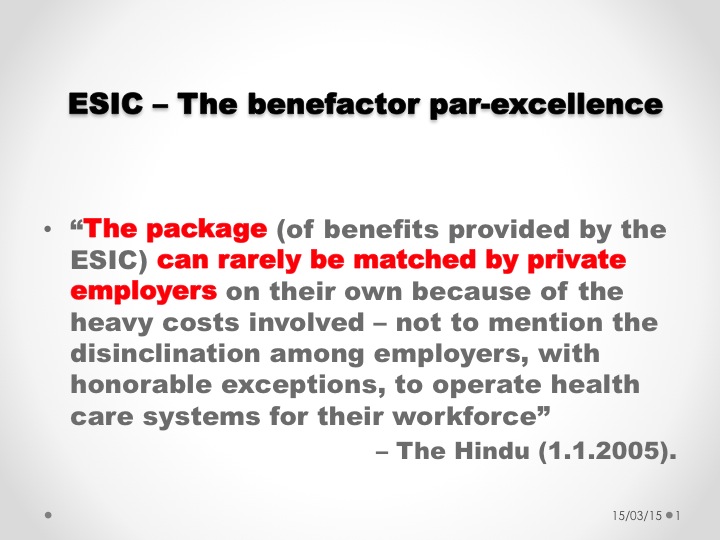
The Scheme had been run in a satisfactory manner, in spite of many negative actions of the corrupts and zombies, within the organisation and in the enforcing machinery of various State Governments. If the political leaders had been more committed in the welfare of the people, the Scheme could have done much better. Even in spite of all the pitfalls, the Scheme had been better managed financially than any other public sector autonomous body until the year 2007. Better than private units. The Economic times 05.02.2003 would testify to it.

Economic Times 5 2 2003 copy

Overbearing and misguiding bureaucracy

Any dilution of the the scheme would be challengeable successfully in Court of Law and would expose the Government having fallen victims to the misleading notes of the bureaucrats. Politicians falling victims to the bureaucracy had been brought out very clearly in the famous serial ‘Yes, Minister’. Indian scenario is not different in any manner. Occasions are numerous when the elected Ministers just sign on files as desired by the bureaucrats. India has seen many bureaucrats becoming Ministers and Prime Ministers too, only because the elected politicians could neither understand nor cope with the tactics used by the bureaucrats to bend them to the will of the latter.

During the discussion in the House of the People on 23.03.1992, Mr. A. B. Vajpayee blamed that the bureaucrats were more responsible for creating economic crisis than the political leadership. His statement is one of the many evidences available to prove that the Ministers are led and are not obeyed by the bureaucrats.

The following are the excerpts from the Indian Express dated 24.03.1992:
“Mr. Vajpayee hit out at the bureaucrats, five or six of them, who kept shuttling between the Prime Minister’s office, the North Block and the Planning Commission, and also the IMF, and said they were more responsible for creating the current economic crisis than the political leadership. These officers should not be entrusted with negotiating the Dunkel proposals at the GATT meetings, he cautioned”.

Intention is only to “reduce” benefits 

Private players are free to provide any kind of benefit that matches and surpasses the ones provided under the ESI Act. There is no need for any adventurous dilution of the provisions of ESI Act. There must be proper in-depth study before embarking on any such adventures. If needed, even a pilot project can be formulated and tested. The international experience on such privatisation must be examined. The information already received by the ILO on this issue was only in the negative about such privatisation. There should, therefore, be no reliance only on the filenotings of the bureaucrats to tamper with the existing system just in order to facilitate private players in social insurance. That would result in the private players playing havoc with the living conditions of the working population.

They enter into this field to make money, to prepare profit and loss account while the ESIC as a State machinery prepares Income and Expenditure account. Any hasty measure to allow private players by diluting the provisions of Exemptions under Sec. 87-91 would, clearly, prove that the intention of the rulers is only to reduce the quantum of benefits that are made available now to the working population in the organised sector.

Customer Satisfaction Survey

The Government of Gujarat had conducted a Customer Sastisfaction Survey among the public when Mr. Narendra Modi was Chief Minister of Gujarat in the early 2000s about the services rendered by various departments, as informed by Shri Hasmukh Adhia, IAS, Secretary, Administrative Reforms & training and Director General, SPIPA, Government of Gujarat, during his lecture in the Indian Institute of Managment, Ahmedabad.

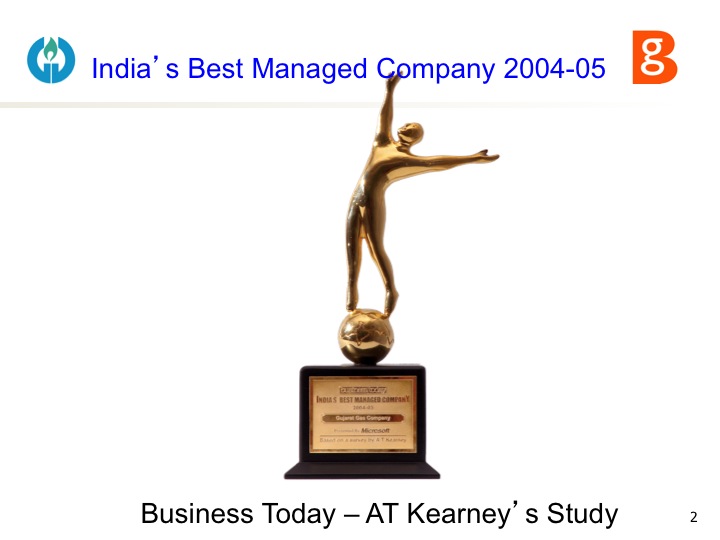
Similar survey proposed in the year 2006 in the ESIC had not materialised. One such survey among the beneficiaries of the ESI Scheme would not be out of place, now, before venturing on misadventures. Gujarat Gas Company Limited conducted Customer Satisfaction Survey to understands its own strength and weaknesses.

Slide1

It was adjudged the best managed company of the year 2004-05 by the Business Today.

Slide2

Beveridge worked hard and conducted extensive study on various issues for one and a half years to prepar his monumental document and when it was made public,  he became a national hero overnight in the United Kingdom. In India, the bureaucrats do not show any intention to study the issues and impacts by conducting any study but work hard to demolish the scheme overnight.

A cursory survey had been conducted in Mumbai once in the 1990s. It showed that 85% of the employers wanted the scheme while 85% of the employers did not want it. The Regional Directors of Maharashtra would testify to it. So, any radical change in the concept and structue must be preceded, necessarily, by proper study and analysis from all angles.

ESIC can work wonders

We reiterate that as far as the ESIC is concerned the System is correct but the men need to change their attitude. That can be done, when the political leadership is committed to run the Scheme corruption-free. When done, ESIC can work wonders for the improvement of the nation’s economy and prove to the world that our nation is really a civilised nation.

What is more, India can even surpass many nations and reach the top in the Human Development Index. The Scandinavian countries top the Index at present, only because of social security measures which are run corruption-free. That is civilisation.

For more, read ‘Barbarism and Civilisation: History of Europe in our time – Bernard Wasserstein. 

Leave a comment

Filed under Administration, Amendment 2015, Benefits, For Trainees, International

E.S.I.C’s employees and Hannibal’s soldiers !

It was 1990. A woman employee of the Bureau of Indian Standards reached the bus stop at about 7.45 am in Noida Sector 22. Her neighbour, a Section Officer of the ESIC, was standing there already, waiting for bus to go to his office. The offices of both were and are in the same locality, in New Delhi-2.

That ESIC officer, a man from Orissa, was a very sincere and punctual officer. He was very surprised to see that woman employee of the BIS at that time of the day there. He asked her where she was going. She replied that she was going to her office. That reply stumped the ESIC officer. “Madam, how come, so early? You used to move for office only at about 11 am everyday!”. That woman poured out her grievance. “What to do, Sir? One man has come to our office as DG. He is from military. Totally merciless. He is marking our absence and debiting our leave accounts everyday. How much can I lose? It is very difficult for me to go to office so early. Still, I have to go…..”. She went on justifying her priorities and scolding the new unsympathetic Director General stating that he did not understand the problem of womenfolk who had to look after all the house-hold chores.

Yes. The BIS got Lt. Gen. H. Lal, a Param Vishisht Seva Medalist, as its Director General. On joining the BIS, he studied, for a few days, the situation prevailing in the BIS and diagnosed the problem. He chalked out his own plan to bring standard to the Bureau of Indian Standards.

The PVSM with perseverance

He did not announce anything to anyone. He simply went around the office one morning, 15 minutes after the commencement of office hours, and collected all the attendance registers from every section in person. He marked the absence of everyone very coolly and sent the attendance register back. The first day there was shock, utter shock among the members on the Staff. The second day their shock continued. The third day, the Union represented, through other officers, for ignoring this ‘minor issue’. But, the military man said that it was not a minor issue. He said, “You are paid for your presence as well as work, here in this organisation. I am not asking you to work. I just ask you to be present during the working hours. There is no concession on this score”. He was very firm. He demonstrated his firmness even more when the Union chose to demonstrate its own power. He did not relent.

Attendance Registers were continued to be seen by him without any let up. He demonstrated his perseverance in a remarkable manner. By the end of the first month, the staff members realised that they could not change the attitude of their DG. They had no other option but to change their own attitude. The second and third month, they tried to change their attitude. They took steps to manage their personal affairs in such a manner that they would be on time for office. The DG pressed on with the monitoring of attendance register for a continuous period of six months. Yes, it was true. By then, it became the habit for the employees of the BIS to reach the office in time, and to remain in the office upto 5.30 pm.

It was on the first day of his seventh month in office that Mr. Lal convened a meeting of officers and staff of every section separately and reviewed the work done by them. As sitting in the office had, already, been made a habit for the officials, it naturally showed up in their performance too. A remarkable attitudinal change, made possible in every employee, because of pressure not from within but from outside – from the boss.

Mr. Lal, a PVS Medalist, redeemed the BIS, really. He brought the BIS back on track, within a period of six months.

Mr. Sahib Singh Verma’s surprise visits

When Mr. Sahib Singh Verma was the Minister for Labour, he visited the offices under his Ministry at the commencement of office hours and closed the entrance door before verifying attendance. This had a dramatic effect on the punctuality in offices in New Delhi, including the offices of the ESIC. But, that is not the case with the other offices of the ESIC in the Regions. The need not only for punctuality and but also for service with a sense of compassion, devotion and outreach is felt more in the field offices and medical institutions of the ESIC.

The incident in the BIS does, therefore, have close relevance to the offices of the ESIC.

The employees of the ESIC grumble and assemble and resolve to agitate. But, they must know that they have to rise up and fight not against the rulers but against the impression prevailing among the insured population about the nature of service provided by the officers and staff members. Because, if someone like the Finance Minister could point out fingers against the ESIC and try to convince the public that the ESIC could be dispensed with, these employees cannot just blame the Minister for it. They have to blame themselves too. That there happened many things at the top in 2009 and 2010 might be true. But, the ignorance and arrogance of many employees of the ESIC at various other levels including the lower levels of the organisation were and are also the contributing factors to create a sense of apathy and antipathy among the beneficiaries against the ESIC.

When things went wrong in the BSNL, the employees’ unions and the officers associations assumed ownership of the organisation and started questioning the decision-making process. A new sense of commitment could be seen among the employees there. But, the employees unions and the officers associations of the ESIC choose to remain indifferent, although there is more reason for them to fight for the organisation and save it from the predators.

Beveridge, needed forever

ESIC is a well-conceived concept to reach out to the masses. The need for the ESIC , the social security measures provided by it, would be felt by the society as long as the world exists. A cursory reading of the report of Sir William Beveridge would testify to this fact. That is the reason his report, a charter to protect the humanity from the pains caused by undeserved wants, is called as a monumental document. Social Security has, throughout the world, achieved successfully what Communism could not achieve.

It gives an opportunity to the employees of the ESIC to make themselves useful to the humanity. But, the imperious behaviour demonstrated by the employees, coupled with their indifference, indolence and ignorance, when approached by the beneficiaries would result in creating very serious antagonism among the public. That situation is tailor-made to make it easier for the people like Mr. Manmohan Singh and Mr. Modi to dump the ESIC and give noble impressions to their ignoble intentions to sell the nation to private players.

The employees of the ESIC stand warned. A precedent has already been created by the BJP regime by selling a government department to a rich businessman. VSNL, a profit-making body, was sold to Tatas. The rulers would, therefore, not wink an eye if the situation created by the employees of the ESIC help them to dump the ESIC in favour of private players by diluting its provisions.

If the role of ESIC in the nation-making is thus diluted, it will not be only because of the pro-rich attitude of Mr.Manmohan Singh and Mr. Modi but also because of the incorrigible attitude of many employees of the ESIC. It will be of no use to cry later without cultivating a little sense of happiness in doing real service to the people.

The Good and the Bad

There are many honest officers, sincere staff members at all levels, empathic doctors and nurses in the ESIC who provide yeoman service to the beneficiaries. But, the effect of their services pales into oblivion when contrasted with the multitude of self-seeking officials who do not care to be there in the organisation for rendering service to the public.

Yet, it becomes the duty of the honest officials also to fight against their colleagues who bring disrepute to the organisation. Because, the attitude of such blacksheep does affect, ultimately, the honest officials too. The sincere officials are required to hang their head in shame when the organisation is criticised for the wrongs committed by the mischievous.

The utterances of the Finance Minister on the day of Budget must awaken the blacksheep, at least now, to change their attitude. The honest employees of the ESIC at every level must fight against the dishonest among them with all seriousness it deserves.

ESIC employees must emulate Hannibal’s soldiers

When Hannibal had to fight his first battle with the fearsome Roman legions, multifold stronger in number, in Northern Italy, he had to bring his worn-out men alive. He told his frightened and diffident soldiers that they were many miles away from home, on hostile territory with nowhere to go. “It is either freedom or slavery; victory or death”. He advised his soldier to fight with all intensity and ferocity that they would win the mightier and stronger Roman army. Hannibal’s soldiers did so and won the Romans. (33 Strategies of War – Robert Greene).

Similar is the case today with the ESIC employees. Here is the opportunity for them to turn a new leaf and emulate the soldiers of Hannibal and work with devotion and compassion towards the beneficiaries that the beneficiaries themselves would realise the importance of the ESIC as a public organisation and resist the attempts of the rulers to dilute the beneficial provisos of the ESIC.

It is time for the ESIC employees to demonstrate their potentials. It is an opportunity for them to vindicate themselves. Will the ESIC employees sit up, take notice and rise up?

4 Comments

Filed under Administration

Attachment of Immovable Property by ESIC & EPFO !

The procedure followed for the recovery of arrears from the defaulters is common for both the ESIC and the EPFO. The provisions of the Second Schedule to the Income Tax Act, 1961 and the Income Tax (Certificate Proceedings) Rules, 1962 as were in force as on 01.04.1989 are followed by both the organisations. The procedure followed by the Recovery Officers and the rights of the defaulters and the general public are brought out in the Power Point Presentation given below.

Click on the slide below to reach the Presentation
 

Slide1

Leave a comment

Filed under For Trainees, Powerpoints, Recovery

Wages: The foresightful Sec. 2 (22) !

It was 1989-90. An employer, a well-known business magnate, having many business interests in many fields, had paid Rs. 10 as Attendance Bonus to his employees who attended factory on all the 26 working days in a month. The Insurance Inspector (Now, SSO) reported that the employer had not paid contribution on that amount. Notice in Form C-18 (Ad hoc) was issued in 1991-92. The amount claimed as contribution on omitted wages was around Rs. 1600/-.

The employer’s representatives attended hearing and explained their stand. They said that it was not an amount paid as per any settlement between the employees’ union and the management. It was not a bilateral decision. It was an unilateral one and could be withdrawn at any time. It was paid quarterly and not monthly. The employer was, therefore, not required to pay contribution to the ESIC on this expenditure, they said. When asked, pointedly, how the employees were made to understand that they would be paid Attendance Bonus if they had attended factory on all the 26 days, the representatives said that the management had put up a notice in the canteen to that effect, wherein it had also been mentioned that it was unilateral, that it could be withdrawn at any time and that it would be paid once in a quarter.

Final orders were issued under Sec. 45-A, after the hearing was over, determining the contribution payable. Employer’s contentions were recorded and reasons given.

It was explained in the order issued under Sec. 45-A that

  • the very fact that the employer had displayed a notice in the canteen proved that the Attendance Bonus had been paid as per specific terms of contract.
  • there was an express contract, and that it was not unilateral, because there had been clear communication of mind, the consensus ad idem, and the ingredients of offer and acceptance were there.
  • the amount was ‘payable’ every month but was postponed and paid once in three months.
  • the amount being ‘payable’ every month, this case fell within the first portion of the definition of the term wages and not within the third portion of it.

Contribution was, therefore, claimed on the entire amount. After a few months, the employer’s representative who came to the Regional Office for some other purpose, said that the CEO had ordered the issue to be challenged in the court of law.

When asked how the CEO expected to win the case, the representative said that the CEO referred the matter to court, because he was paying a standing counsel every month without getting any work done by him. He therefore, wanted to give some work to the standing counsel. The employer paid the dues later with further interest, after the court verdict.

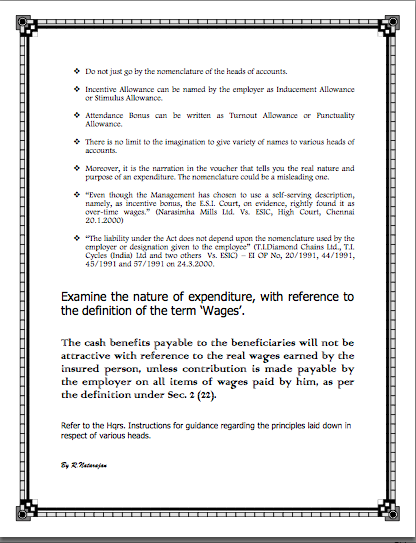
What are those different parts of the definition of the term ‘wages’? Wages Page 1 Another major employer did not pay contribution on Conveyance Allowance. When the ESIC asked for contribution, the employer went to court, where his stand was upheld. The judge had reasoned that the ESIC would not have claimed contribution if the employer had given season-tickets to his employees or reimbursed the expenditure. As the employees actually incurred expenditure on conveyance, it was not wages, the Court reasoned.

But, the fact was that it was not a case of reimbursement. The payment was not in kind. It was an amount paid in cash. The court had traversed the extra mile arguing that the ESIC would not have demanded contribution, if the employer had reimbursed it or had given season tickets. The court had overlooked the fact that the employer had, actually, paid in cash. This fact on record had been ignored by the court. The argument could also be that the employer could have given to his employees grocery, cloth and other domestic requirements too and then paid less contribution only on the remaining carry home pay.

What happened in this case was that our counsel had failed to bring it to the knowledge of the court the first part of the definition of the term ‘wages’ which refers to the payment in ‘cash’. When an amount is paid in cash, the liability to pay contribution arises automatically, unless exempted under the fourth part of the definition of the term ‘wages’. Because, there is no system to ensure that the employee spends a particular allowance only for that purpose.

The Act, therefore, does not lay stress on the nomenclature used by the employers to pay remuneration to his employees. ESIC is not obliged to give cognizance to the terminology used by the employer in this regard. Wages Page 2 ESIC officers would see only whether the payment fell within the parameters specified in the definition. Many such attempts at evasion to pay contribution had been resisted successfully, only because of the great definition of the term ‘wages’ under Sec. 2 (22). Otherwise, the contribution would have been very less resulting in meager amount of cash benefits to the working population, making it difficult for them to sustain themselves during the period of sickness and disability.

The term ‘wages’ had, thus, been defined in a very thoughtful and foresightful manner in the year 1948. It has withstood numerous onslaughts from various minds with fertile imagination.

Compare this with the contents of Sec. 45 AA which had been drafted very loosely and rushed through as an Amendment in the year 2010 making one wonder whether law-making process in the nation had become so ineffective and inefficient in the nation.

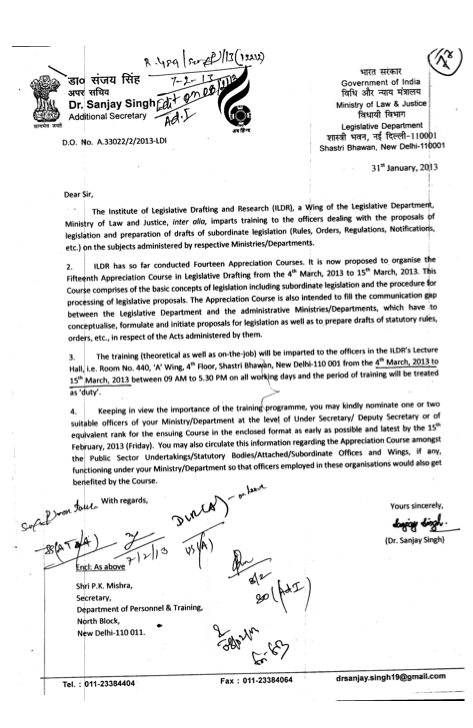
It is time the ESIC turned a new leaf and sent its young officers for training on Legislative Drafting conducted by the ILDR of the Ministry of Law & Justice, to prevent recurrence of such anomalous situations. Legislative drafting NB: The Note in Pdf is available in the following link:

Training Note Wages

Leave a comment

Filed under Amendments 2010, Benefits, For Trainees, Inspections

Sorry! No ‘hostages’ there, Mr. Finance Minister!

The following are the excerpts from the speech of the Finance Minister, Mr. Arun Jaitely while presenting the Budget of the Government on 28.02.2015:

“61. Madam Speaker the situation with regard to the dormant Employees Provident Fund (EPF) accounts and the claim ratios of ESIs is too well known to be repeated here. It has been remarked that both EPF and ESI have hostages, rather than clients. Further, the low paid worker suffers deductions greater than the better paid workers, in percentage terms.

62With respect to the Employees Provident Fund (EPF), the employee needs to be provided two options. Firstly, the employee may opt for EPF or the New Pension Scheme (NPS). Secondly, for employees below a certain threshold of monthly income, contribution to EPF should be optional, without affecting or reducing the employer’s contribution. With respect to ESI, the employee should have the option of choosing either ESI or a Health Insurance product, recognized by the Insurance Regulatory Development Authority (IRDA). We intend to bring amending legislation in this regard, after stakeholder consultation.”

(http://www.thehindu.com/news/resources/full-text-of-budget-201516-speech/article6945026.ece)


We, first of all, thank Mr. Arun Jaitely that he has chosen to consult the stakeholders before making amendments to further his observations on ESI Scheme.

In regard to his proposal to allow option to the employees to choose either ESI or a Health Insurance product, recognized by the IRDA, we have already brought out the well-known fact the medical benefit provided by the ESIC is just one of the many benefits and that it has close connection with important cash benefits like Sickness Benefit, Extended Sickness Benefit and also Sickness arising out of pregnancy and Sickness arising out of Confinement, Sickness arising out of premature birth of child or miscarriage.

In the present write-up we would like to remind the Minister just one fact which might not have been brought to his notice by the overzealous bureaucrats who wanted to please him so that he could, in turn, please the private players who would be pleased if the ESIC, which affects their area of operation, is not there.

The Minister has gone on record having said that the ESIC does “have hostages, rather than clients”.

The fact is that the ESI Scheme is run by government. Mr. Arun Jaitely belongs to that Government now. And his statement implies that he is of the opinion that the Government of India does have hostages through its ESI Scheme and not clients.

But, the employers through whom and with whose  active co-operation the scheme is run, would not and cannot say that they are held hostages. The ESI Act is not a compulsory provision. Because, the employers are free to get themselves and their employees totally exempted from ESI coverage.

Sections from 87 to 91-AA deal with exemptions. If the employers are able to provide benefits which are ‘substantially similar’ or ‘superior’ to those provided by the ESI Corporation, they can, as a matter of right, demand exemption from coverage under the ESI Scheme.

It is so simple. There is a format in the ESIC offices for this purpose. There are three columns in it. The first one lists out the benefits provided by the ESI Scheme. The next column is to be filled in by the employer recording the benefits that he provides. The third column is intended to be filled by the employer wherein he would say whether, in his own assessment, the benefits provided by him are ‘substantially similar’ or ‘superior’. Let them assess themselves first that way, before coming to the Minister and saying that the ESIC is holding them and their employees hostages.

The ESIC had successfully challenged all the employers, on many an occasion, whether they were ready to provide benefits on par with those provided by the ESIC. But, none came forward.

The Private Players do not want to provide all the benefits provided by the ESIC. Their intention is not to provide ‘social security’ but to ‘earn profit and throw a portion of it to all the political parties’.

But, ESI Act is for the welfare of humanity. It has kindness in-built. The deficiencies in providing service were and are only man-made and they can be set right by committed leadership backed by the Labour Ministry committed for honesty and transparency in running the organization. “Cleaning corruption is like cleaning the stair-case. It must start from the top”. There had been many an illustrious era that the ESIC has seen in its 63 years of existence, although it had seen many dark spells too.

ESIC has the capacity and can make the nation strong economically, if it is well-run.

We, therefore, request the Hon’ble Finance Minister not to rely only upon the convenient filenoting submitted by his pliant bureaucrats without studying the 210 years-old poignant and heart-rending history behind the ESIC.

 Slide1

The Finance Minister may better advise the employers to give all kinds of cash and medical benefits to their employees in a better manner than what is provided by the ESIC and seek proper exemptions as per the existing law itself. There is no need for amendments of any kind to the ESI Act, 1948, if the advice given to him by the bureaucrats was to free the ‘hostages’. For ready reference, we provide, in the following link, a presentation on the provisions in the ESI Act, 1948 that govern Exemptions:

 Exemptions

Leave a comment

Filed under Amendment 2015, Benefits, For Trainees, Inspections, Powerpoints

The CAG Report: the facts we do not know!

CAG’s Audit Report on ESIC

CAG’s Performance Audit Report on ESI Corporation for the period from 2008-09 to 2012-13 has been presented to the Parliament in December 2014.

I. Some of the important observations of the CAG are:

  1. Substantial difference of Rs.556.59 crore was observed between challans generated towards contribution to be paid by the employers and actual receipts.
  2. While opening two 500 bed hospitals at Gulbarga and Mandi, the norms for existence of minimum number of insured persons were not followed and the locations were incorrectly selected.

Facts, as we know:

  • The manner in which the IT Roll-Out was rushed through without proper spade work, was the reason for the first observation.
  • The manner in which the politicians in power managed to hijack the ESI Scheme for narrow personal ends was the reason for the second observation. That the ESIC authorities could not do anything in such cases earlier too, like the locations of the hospitals at Nagda (instead of Indore) and at a village near Salem (instead of the town of Salem) shows that the ESIC had been pawn in the hands of self-serving politicians.

II. Some of the CAG’s observations based on superficial understanding are:

  1. Approximately 12000 ESIC employees had been irregularly availing medical benefits from ESIC dispensaries/hospitals without paying, though the facilities were meant for only insured persons paying contributions.
  2. Non-initiation of timely action to determine the dues resulted in cases becoming time-barred and consequent loss of revenue amounting to Rs.48.31 crore. Advances of Rs. 20.31 crore given to hospitals as of March 2013 were lying unadjusted in eight States.

Facts, as we know:

  • The conditions of service of the employees of the ESIC are similar to those of the Central Government servants drawing corresponding scales of pay, as per Sec. 17 (2) (a) of the ESI Act, 1948. In the early 1960s, the ESIC employees were getting medical facilities through ESI medical institutions but it was switched to CGHS later. The employees of the ESIC in Delhi were, in the 1980s, getting medical facilities through the CGHS. The decision to enable them to take medical facilities through ESI medical institutions was intended to replace that CGHS facility. The employees are entitled either to CGHS or the ESI facilities. The CAG did not consider these facts.
  • It is not non-initiation of timely action which resulted in the loss alleged. It was the unseemly hurry with which Sec. 45 was amended to insert the limitation clause of five years, without any steps taken by the Revenue Division of the Hqrs. to ascertain the extent of pending claims at the time of amendment. It was not just that. The amended clause was enforced with immediate effect from 01.06.2010 in a hurry, in spite of the fact that there was executive power to examine the issues in house and enforce the amendments at later dates too, as was done in the case of various amendments of the year 1989. The CAG would have done a great service to the nation, if he had examined whether any preliminary study was done and reports obtained from Regions on this issue before embarking on such amendment and before bringing it to force on 01.06.2010. The loss is a recurring phenomenon, every month now.

III. Absence of observations of the CAG on the following vital issues:

  1. Construction matters from 2008.
  2. Alienation of ESIC’s land to Municipalities for permission to construct buildings.
  3. Certifications regarding the progress in the construction of buildings.
  4. Proposal to commence the construction of buildings for medical colleges in a tearing hurry even before the ESI Act  was amended to facilitate setting up medical colleges. 

Facts, as we know:

The CAG was supposed to detect on his own. But, in this case, he was deemed to be aware of these issues. We get information that he had, specifically, been made to be aware of these issues. But, his report is silent on these issues.

Facts we do not know:

We do not know whether such silence implies that there was nothing wrong in the aforesaid four areas or whether that silence implies the attempt at the cover-up.

=============================================

Note:

(This article has been prepared with reference to the report in Outlook (http://www.outlookindia.com/news/article/CAG-Finds-Irregular-Expenditure-By-ESIC/872374)

and the contents in the website

(http://www.millenniumpost.in/NewsContent.aspx?NID=89561)

and the PDF format report available in

http://www.saiindia.gov.in/english/home/Public/In%20_Media/30of2014.pdf. )

Leave a comment

Filed under Administration, Amendments 2010

Run the ESIC corruption-free! Do not run down the ESIC!!

“What ideas individuals may attach to the term “Millennium” I know not; but I know that society may be formed so as to exist without crime, without poverty, with health greatly improved, with little, if any misery, and with intelligence and happiness increased a hundredfold; and no obstacle whatsoever intervenes at this moment except ignorance to prevent such a state of society from becoming universal.”


Robert Owen, 1.1.1816 when he opened the

Institute for the Formation of Character.


The ideal of all matured human beings would only be to see a society that is free from poverty, ill-health and crime so that human potential is allowed to develop in a positive manner increasing the happiness of the living beings all around. In this backdrop, the organisations that provide variety of social security measures to the humanity play a pivotal role. In the Indian context, the ESIC provides and is intended to provide an unmatched security-net to the insured population.

But, with the assumption of power by the BJP, there are many forces acting from within the ESIC and the Ministry of Labour to sabotage the noble scheme. While there can be no arguments for status quo, or to justify the status quo, the steps taken to bring changes must be to improve the social security measures and not to expose the ordinary people to money-sharks in the medical insurance sector. But, the politicians find it irresistible to yield to the moneybags. So, acton is being taken by some people in power to dilute the benefits provided by the ESIC and make it easier for the moneybags to poach into the territory of the ESIC to make money for themselves and for the politicians who yield to their pressure.

Private sharks are compelling the persons in power to introduce exemption clause for pre-existing diseases in the ESI Act too so that they can loot the common people easily.

Are the politicians in power going to yield? Will the bureaucrats sit up, take notice of the evil designs of those private sharks and stand up agains the politicians who work for the welfare of those sharks?

Politicians and Bureaucrats nexus

The simple question is that what is better for the well-being of the humanity must be allowed and encouraged to prevail. And that decision should not be left to a few ministers and bureaucrats only. There must be proper discussion beforehand with all the stakeholders. Our experience shows that the MPs who were required to analyse the issues deep had abdicated their responsibility when the Amendments to the ESI Act were brought in, in the year 2009 / 2010. They did not, simply, care. They did not want to know. The Ministry of Law had behaved in a peculiar manner by clearing the proposal for large scale amendments with scanty analysis. The Parliamentary Standing Committee of Labour had allowed itself to be hoodwinked by the bureacrats. What is more, the CAG who comes in after everything is over has also not done his work properly, when he presented his report of 2014. He did not probe into the construction matters.

Private players are welcome even now

There is no law which denies private players enter into the field of Social Security even now. Already, in the year 1980 itself, the NIIC started certain schemes to introduce PTDB, PPDB, etc., Even they wanted to be housed near ESIC office in Maharashtra so that they could canvass the insured persons covered under the ESI Act. But, they could not find their attempts attractive.

When we talk of privatisation of social security, we must, first of all, know whether it is a service or business.

  1. If this is considered as service, the private players have, practically, no role in it.
  2. If it is considered as a business, there is no need for any new legislation to permit or prevent them.

Corruption of private players in Life Insurance Sector

LIC was not brought into existence, in the year 1956, to do business. It was brought into existence to prevent the private players from continuing with their malpractices. The main intention of nationalisation was to provide “Complete security to policyholders” and to “Conduct the business with the utmost economy and with the full realization that the money belonged to the policyholders.” Because, the mismanagement and malpractice by the private players “had lead to liquidation of as many as 25 life insurance companies in the decade after independence. Another 25 insurance companies had during the same period so frittered away their resources that their business had to be transferred to other companies. All these cost financial losses and consequent suffering to several policyholders who had entrusted their hard earned saving to the care of the company management. This misuse of power, position and privilege by these companies in the private sector was one of the most compelling reasons that influenced the decision of the government of India to nationalize the life insurance industry in 1956.”

Our experience with private corporate service providers

 The issue is whether we have any intention to learn anything from history, both past and contemporary. The ESI Corporation is meant to provide security-net to the lower strata of the society.

Private Bus transports

What is the experience of the common people with the long distance private bus transporters? Do they have any intention to serve villages? Do they not concentrate only on connecting cities?

Even within Delhi, do we not find that. It is left only to the public sector DTC to ply buses during the off-peak hours in the early mornings and nights, while the peak hour is the only preferred hour for private operators?

Private telecom service providers

It was only for the purpose of favouring the private players in the mobile telephony segment, the BSNL was not allowed to enter into that area for long. It was the strident fight of the employees that enabled the BSNL to enter into Mobile market. What is our experience with the BSNL and the private telecom service providers? What is our experience with the grievance redressal system of the private service providers who are invisible when you want to talk to them? One-sided phone calls which can ask you for money and other details but you cannot talk back. Once you complain to somebody, even if you talk back after one minute, you will talk to somebody else and not the same person. They choose to remain invisible when receiving complaints. There is no scope for meeting any person who has some authority at least to deal with the issue. But, you have RTI weapon when it comes to BSNL.

RTI only for BSNL and not for other private players

Is there any private telephone service provider who is governed by the provisions of the Right to Information Act, 2005? (More on the role of politicians and top level bureaucrats to corrode the BSNL from within can be seen in the article: https://flourishingesic.info/2013/09/30/when-the-bsnl-employees-lost-their-ltc/ )

Private Hospitals vis-a-vis Leprosy and TB

How many private corporate hospitals treat patients suffering from T.B or Leprosy?

ESI Corporation can honestly throw a challenge to the private operators, if need be. No private corporate player can afford to provide the cash benefits that are extended by the ESIC. Moreover, the proprietary interests of the private players and the resultant harassment faced by the working population are on record as could be seen from the “Oxford Book of Legal Anecdotes – Michael Gilbert”. No common man in India can afford to fight against such injustices inflicted by the private operators. ESIC is kindness inbuilt. This is a public trust with no proprietary interest. If the ESIC is allowed to co-exist with the private players, if anybody’s ideology necessitates allowing such private players, it can be proved within a short time that nobody can surpass ESIC then too.

Social Security and the USA

Franklin D Roosevelt, in his message to the Congress in 1934, felt that the first objective of any nation would be the security of its men, women and children. That this security is provided mainly through the Social Security measures implies that the governments have the primary role in providing that security and it cannot be subjected to the commercial interests. Franklin D. Roosevelt said, while signing the Social Security Act, on 14th August, 1935, that Act was, “in short, a law that will take care of human needs and at the same time provide the United States an economic structure of vastly greater soundness.”

“The threat to stability of Social Security has been apparent for decades. For years, political leaders have agreed that something must be done… We can postpone action no longer. Social Security is a challenge now; if we fail to act, it will become a crisis. We must save Social Security and now have the opportunity to do so.” – President George W. Bush – May 2, 2001.


In India, the Centre has not so far given any amount as Grant to the ESIC. The experience of Peru, the only country that ventured to privatise social security was not an example to be emulated but a warning. “Some of the PAYG (Pay As You Go) systems distribute their benefits very inequitably. Since most Latin American countries rely or relied heavily on indirect taxation to subsidize social security benefits, the poor contribute disproportionately to services they probably will never receive.” (Partial) Privatization Social Security: The Chilean Model – A Lesson to Follow?Roland Eisen.

The scheme must be run only by government so that there is a larger base

 The ESI Scheme in India which collects only 1.75% of wages as Employees Contribution is still viable for almost 6 decades without any assistance from Central Government, only because it is compulsory and also because the field of dispersal of benefit load is larger. This is in sharp contrast to the position obtaining in smaller countries where the employees contribution is much more, ranging from 27 in Germany to 69-73% in Scandinavian countries.

 Corruption is the main problem in India

Maintenance of toilets in bus stands has been privatised for long. What is our experience with those toilets under private managements? Can the officials in charge have any control over their activities of these private players, who are the source of ill-gotten money for the politicians. People suffer in silence every day in every bus stand, only because of corruption, both political and bureaucratic. Our nation must demonstrate that it could do, at least, smaller things efficiently in a corruption-free manner.

If the persons in power can ensure a corruption free society, then social security provided by the ESIC need not be privatised.

If they cannot put in place a corruption free society, then social security provided by the ESIC should not be privatised.

Non provision of Primary Care is a real threat

Non-attention to Primary Care in the nation is a real threat to the ESIC in providing even Primary Healthcare. Health services in India are provided through a three-tier setup namely primary, secondary and tertiary. Primary care is the healthcare provided at the primary level of care, which is the first level of contact of the community with the health system. Cases which are more complex and need specialised care are referred to the secondary (District hospital) and tertiary level (Regional and national hospitals).

Primary Health Care was accepted as the best approach to achieve the goal of ‘Health For All’ in the Conference of the World Health Organisation held at Alma Ata in 1978. ‘Health For All’ is defined as an attainment of a level of health that will enable individuals to lead a socially and economically productive life. ‘Health For All’ was envisioned to be attained in the year 2000.

The fundamental focus of this approach is on universality, comprehensiveness and equity in health. There is an intricately intertwined relationship between Primary Care to be provided to all and the Primary Healthcare to be provided by the ESI Corporation to the persons covered under the ESI Act. Non-observance of the medical requirements by the poor affects the rich directly in the long run. It is, therefore, in the self-interest of the rich to care for the poor.

For the success of the ESI Scheme, Prof B. P. Adarkar wanted the certain extra measures to be taken. His stand was that the ESI Scheme should not be “saddled with burdens legitimately belonging to other branches of social insurance”. He made four assumptions for the success of the ESI Scheme. They were

(a) the adoption of a scheme for Unemployment Insurance and creation of new employments in the post war period,

(b) the establishment of a scheme of Old Age Pension,

(c) the adoption of certain pre-medical measures like education in health and improvement in environment hygiene besides regulation of wages and rigorous enforcement of factory laws and finally

(d) a National Health Drive.

So, it is in the interest of the ESIC also to influence the Governments at the Centre and in the States for a National Health Drive to focus attention on Primary Care.

The political costs of inequality are recognized and accepted as being too high. The economic costs of fighting the effects are also high. Citing some research, the BBC also noted that for each dollar spent on poverty causes, seven dollars were saved on consequences.”

Success:

 The intention of the government must be to ensure proper medical care to the public through public sector.


Paul Krugman

The present attempts at weakening the ESIC and diluting its benefits with the aim of enabling the private players to poach into the territory of the ESIC is anti-common man. The ESI Scheme can ensure tremendous success, if only there is intense desire to run the scheme corruption-free.


4 Comments

Filed under Amendments 2010, Benefits

Sickness Benefit and Extended Sickness Benefit: The impact of Budget.

This is the second article in the series, on the announcement of the intention of the Government to free the employees from being held hostage by the Government of India itself, through ESIC. The former one is available at https://flourishingesic.info/2015/02/28/making-esi-medical-facilities-optional-abdication-of-responsibility/

The essential questions now, after the employees choose private operators for medical benefit, are “Who will provide Sickness Benefit? And, on whose certificate? And, what is the monitoring mechanism?”

Or, has the BJP chosen to do away with the Sickness Benefit altogether?

Have the officials who suggested this proposal examined all the issues of various dimensions involved in it?

The people who are farm workers are paid only for the day of actual work. If they fall sick they would not be able to go for work and will be confined to bed to take rest. There would be no income for them for those days of abstention from work. On the other hand, they would have to spend money for medical treatment during that period. That expenditure must be meted out from their savings or by borrowing.

The same was the case with industrial workers before the ESIC came on the scene. It was this kind of situation, the loss of income during certain period coupled with the necessity of incurring medical expenditure during the same period, that was sought to be answered to by the ESI Scheme. Once covered under the ESI Scheme, the employees get medical treatment and medicines from the ESI medical institutions. The period for which they are required to be on abstention from duty is decided by the medical officers of the ESIC who issue certificate to that effect. The employees get around 60-70% of their wages in cash for those periods of abstention as Sickness Benefit for a maximum of 91 days in two consecutive Benefit Periods, which is actually one full year.

Now that the overenthusiastic BJP regime has declared its intention to free the employees from being held hostages by the Government of India (as invented by Mr. Jaitely), will the BJP stalwart explain the consequences of his decision on Sickness Benefit?

Maybe, they would not want to step back for reasons of prestige. They may even declare that the private medical institutions would issue certificates, which must be honoured by the ESIC Branch Offices.

Or, they may say that there will be no Sickness Benefit at all.

Anyway, if the former is the solution given by them, another question arises. The Medical Officers of the ESIC are monitored through a system of Medical Referees of the same organisation. What will be the system to monitor the private agencies that provide treatment and issue certificate to the employees?

Extended Sickness Benefit

Moreover, what will be the fate of the celebrated and important Extended Sickness Benefit?

No certification in the UK for Cash Benefit

Significantly, there is no system of certificates being issued by the medical officers in the UK. They provide only treatment and recommend the period of leave. It is the employees who decide the period of abstention and get cash benefit for those periods from post offices. Can Mr. Jaitely usher in that era? In India, we could not bring it into force for the past 40 years, only because of the general tendency of choosing to remain on leave for the entire period of 91 days. Our society did not become that mature, at least, up to 1989.

That was the reason for the introduction of the words ‘strike’ in Sec. 63 and Sec. 97 (iv-b) of the ESI Act in the year 1989. One would be happy if the Indian society has become so mature that the Government considered it unnecessary to retain these checks and balances.

Or, another method is to make the Sickness Benefit totally unattractive, by reducing the percentage of the benefit. But, as per ILO mandate, it cannot be reduced below 45% of the wages earned.

So, the alternative is to change the beautiful, time-tested and war-withered-veteran, the Sec. 2 (22) and modify the definition of the term ‘wages’.

Wages can, hereafter, be defined as the basic pay only which may be decided only by the employer and it may even, for example, be just 10% of the total wages. So, even if the Sickness Benefit were increased to 100%, the quantum of benefit would not be attractive to the Insured Person.

No need to worry how he would sustain his family during the period of Sickness and Extended Sickness that runs into two years, i.e, 730 days. Mr. Jaitely, the Finance Minister, has now the authority to believe that such people would fend for themselves.

Adharkar was prophetic!

Pity, a Noble scheme of the Government of India has fallen, for quite some time, already, into the feeble hands of the corrupt and inept! Prof. Adharkar was prophetic. He said that the success of the ESI Scheme depended not only on the honest working of the ESI Act by all concerned. But, by introducing some more measures by the Government. He wanted that the ESI Scheme should not be “saddled with burdens legitimately belonging to other branches of social insurance”. Therefore, while formulating the ESI Scheme, he made four assumptions for its success. They are:

  • Adoption of a scheme for Unemployment Insurance and creation of new employments in the post war period,
  • Establishment of a scheme of Old Age Pension,
  • Adoption of certain pre-medical measures like education in health and improvement in environment hygiene besides regulation of wages and rigorous enforcement of factory laws and, finally,
  • National Health Drive.

While some steps had been taken in respect of items 1 and 2 during the past 60 years, the required importance has not been given to items 3 and 4. Consequently, Adharkar’s  dreams which were actually achievable and have been achieved in many countries are becoming distant dreams for Indian common people, with the present Government vying with the former one in diluting labour laws. Moreover, ESIC is blamed when it faces and suffers from the negative impact of the non-performance of the politicians on these four areas.

The root cause of all evils!

The only solution for all the problems is to compel all the political parties to make the source of funds of all these parties totally transparent. That alone will strike at the root cause of all the ills plaguing the nation in various spheres.

1 Comment

Filed under Administration, Benefits, For Trainees