Coverage of Man-Power Supply Agencies!

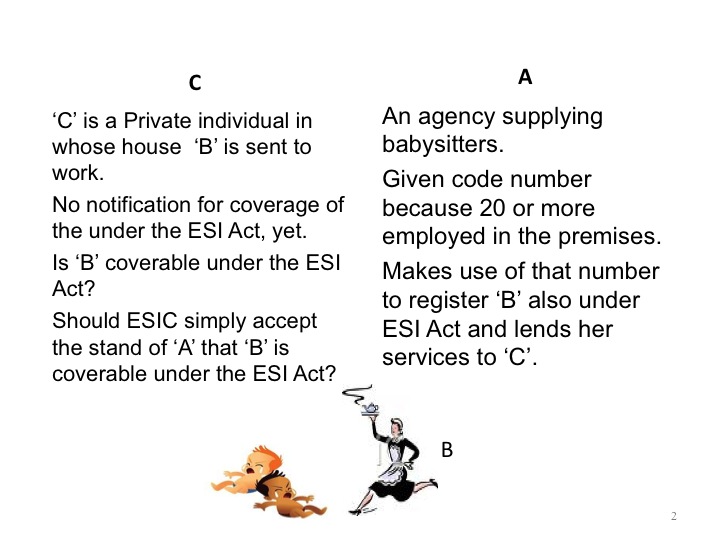
Man-power supply agencies are coverable under the ESI Act as Shops, but only their offices, as the premises in which those offices are functioning are utilised to render service for a price.

The persons supplied by them to do the work of the other factories or establishments cannot be treated as employees of these Man-power supply agencies, just because they got an ESI Employer’s Code Number.

Slide2

A lot of evasion, manipulation and abuse of the benefits of ESI and denial of benefits takes place in the coverage and non-coverage of the employees deputed by these agencies, which use their employer code number to cover the non-coverable employees also.

Sweatshops

The responsibility for their coverge lies only with the ultimate employer who utilizes their services. The Principal Employer for the employees deputed by these agencies to work in other factories or establishments are only those employers who utilize the services of these employees and not the man-power supply agencies which depute them.

Relevant details in this regard are provided in the Powerpoint Presentation available in the following link:

Manpower supply agencies

Leave a comment

Filed under For Trainees, Inspections, Powerpoints

On Amnesty Scheme 2014: Part – III

(This part of the article visualizes the scenario in the Regional Offices, consequent to the directions given in Para A- 2 (iv), (v) and (vi) of the Hqrs. letter dated 03.03.2014 on the Amnesty Scheme-2014. Para 2 (iv) deals with the settlement of cases pertaining to omitted wages on which contribution had been determined by the ESIC authorities.)

An employer approaches the Branch Officer of the Insurance Branch in a Regional Office in the chamber of the latter. The Branch Officer offers the employer a seat and asks him what the matter is.

Employer: My factory remains covered under the ESI Act for a very long time. But, during the last inspection, the Inspector reported that I had not paid contribution on certain items of wages. I had certain doubts. But, you had also issued orders under Sec. 45-A upholding the version of the Inspector and disagreeing with my statements of defence against such assessment, during personal hearings.

Branch Officer: Okay, what did you do then?

Employer: I went to the E.I. Court against your orders. But, he Court had also upheld your orders. I appealed against it. The matter is now pending in the High Court. I am informed that the ESI Corporation is providing a solution, now, through certain Amnesty Scheme. I would like to know whether I could get relief through it.

Brach Officer: Yes, you are welcome. Your case falls within Para A. 2 (iv) of the Hqrs. instructions dated 03.03.2014.

Employer: I have already paid contribution as per the entries in the Reg. 32 Register. This assessment in question has been made on omitted wages which I had not taken into account for calculation of contribution. You have assessed that contribution as Rs. 4,00,000/-. As the E.I. Court has also upheld your order, if I am to pay the contribution now, I must pay Rs. 4 lakhs and interest for the entire period including the period of litigation. In the normal course, the period of litigation is exempted only for calculating the quantum of Damages. How much should I pay now under the Amnesty Scheme?

B.O: You have to pay contribution which “shall not be less than 30% of the assessed amount of contribution”. Secondly, you have to pay the interst in full, of course, only with reference to that 30%. Thirdly, you will not be levied any Damages at all.

Employer: What? Did I hear right? Did you say that I had to pay not less than 30% of the assessed amount? Is it true that the choice is left to me to decide the quantum of contribution payable?

B.O: Yes, the instructions literally mean so.

Employer: Sir, I am very lucky then. I shall pay that amount today itself and get my case settled.

B.O: No, you have to get the permission of the High Court to settle the matter out of court. You have to opt for a solution under the Amnesty Scheme only thereafter.

Employer: Okay, I shall take steps immediately. But, still, I do have certain doubts.

B.O: What are they?

Employer: Will you ask me to produce records maintained under Income Tax Act?

B.O: No, all the relevant records had already been verified, even before I issued orders under Sec. 45-A. There is no question of verifying the records once again.

Employer: But, I am told that you are calling for records.

B.O: No. That is only in respect of cases in which contribution had been determined on Assumed Wages. But, in your case, contribution had been determined on the basis of your records and after hearing you. In fact, your records have been verified twice, once by the SSO and again by me. Besides, the E.I. Court has already given its stamp of approval of the legitimacy and legality of the assessment thus made. There is nothing for us to verify your records once again.

Employer: Oh, Thankyou very much! I shall make use of this Scheme without fail. …. Sir, may I ask you one more thing?

B.O: Yes. You can.

Employer: When will there be the next Amnesty Scheme?

B.O:Why?

Employer: Because, I am not paying contribution on many items of omitted wages, at present, too. I shall keep the issue pending that way, in spite of inspection by the SSO, in spite of your hearings and 45-A orders and in spite of verdicts in your favour by the E.I. Court and even the High Court, so that, at a later date, when you bring out another Scheme for Amnesty, I could pay only 30% of it with Interest and without Damages and finish off the matter. This provision emboldens us to evade the payment of contribution in time on all items of wages under Sec. 2 (22) and escape even normal liability.

The Branch Officer remains silent.

Employer: Oh, what an easy way out! The Amnesty Scheme of 2006 was rightly and only for Sec. 85 cases. But, the Amnesty Scheme of 2008 brought into picture the Sec. 75 cases but said that the entire amount of contribution had to be paid, as per the 45-A orders. Interest had also to be paid in full. There was only some relief in Damages. That way, that circular was also providing relief essentially under Sec. 85 only.

But, your Amnesty Scheme 2010 was a landmark. It introduced the concept of payment of 30% of the assessed dues. And, no penalty in the form of Damages. What a joy! This Scheme opened to the defaulters, the Door of Escape, very wide and the present scheme is also doing the same. This would make the benefit provisions also unattractive to the workforce, as the quantum of cash benefits depends only on the small amount of contribution we pay. There would, therefore, be no malingering and false certification too.

I only pray that every department of the Government of India emulates ESIC and rewards the erring assesses by recovering only 30% of the dues legally payable by the employers who turn out to be defaulters by not paying the dues in time. See you later, Thankyou!

The employer departs. The Branch Officer continues to remain in a pensive mood.


3 Comments

Filed under Amnesty

Sec. 84: Chartered Accountants, beware!

Page 148 of the Revenue Manual of the ESIC says as under:

“Self Certification of Employers in Return of Contributions – To streamline and simplify the process of Revenue enforcement and with a view to lay focus on coverage and registration of all coverable employees to enable them to avail the benefits without hassle, the Corporation in its meeting held on 16.12.2007 resolved to amend Regulation 26 and Form 5 of the ESI (General) Regulation 1950. A notification to this effect has been issued on 11.3.2008 ( Copy enclosed as Annexure 10). Accordingly, Regulation Form 5 ( Return of Contribution) has been modified . The salient features of amendment made in the Return of Contribution are as under :

  1. Self Declaration by employers regarding maintenance of records and registers, submission of Declaration Forms, distribution of Temporary Identification Certificates/Permanent Identity Cards, employees engaged directly or through immediate employers and wages paid to the workers.
  2. All the employers employing 40 and more employees shall have to append a certificate duly certified by a Chartered Accountant in the revised format of Return of Contribution.
  3. Employers employing less than 40 employees will have to provide self-certification without any certification from the Chartered Accountant in Return of Contribution. “

Continue reading

1 Comment

Filed under Inspections

ESIC inspection & Account Books of employers!


Can the ESI Inspector (the SSO) demand the ledger, cash books, balance sheets, Income Tax Assessment Reports, etc., of the employers?

What will happen if the employer says that he has not preserved the records as mandated by the Income Tax Act for six years or as per the Companies Act for eight years?

The Power Point Presentation provides a brief answer to these questions.

Slide


Click on the link below for the Power Point Presentatin

Inspection and Account Books

NB: This presention would also provide answer to the comments of Mr. Jai who said, “If an employer does not preserve records as per the Company Act and the Income Tax Act, that is none of the business of ESIC” under the thread “On Amnesty Scheme 2014: Part -II”.

Leave a comment

Filed under Inspections

On Amnesty Scheme 2014: Part II

It was early morning on a Sunday. Mr. Peter, Mr. Rahim and Mr.Siva who are close friends are sitting on a bench under a tree in a park taking rest after their usual morning walk. They are working as ESIC Consultants. They have built up the reputation of being very sincere, honest and law-abiding in providing service to the employer and thereby to the working population and the ESI Corporation. They are very intelligent and knowledgeable. They never do resort to bribing the officers to get things done. Whenever they come across some problems, they discuss the issues with the officers of the ESIC and set right their records and ensure that their employers comply with the provisions of law.

Rahim, who is garrulous by nature, remains silent today and is looking at the sky for a long time. Amused by his silence, the other two ask him what the problem is. Rahim says, “One employer called me. He was a Managing Partner in a Firm, which he got converted into a Private Limited Company. He said that he had filed a case in the EI Court challenging an order issued under Sec. 45 of the ESI Act. The case remains pending and he asked me whether I could help settle the issue through the Amnesty Scheme”.

Continue reading

5 Comments

Filed under Amnesty

On Amnesty Scheme 2014: Part-I

We find another Amnesty Scheme introduced by the ESIC, as per the Hqrs. communication dated 03.03.2014. The Scheme is in force at present, up to 27.01.2015.

Origin – only for criminal cases

A look at the history of the Amnesty Scheme shows that it was introduced first in the 1990s, to grant amnesty to those employers who had actually committed offences under the ESI Act and were facing prosecution Sec. 85 of the Act. Prosecution was only for the offence committed and was not for recovery of dues, for which there were other provisions. Prosecution of employers was resorted to, in addition to and in spite of the ESIC having recovered all the arrears. ESI Corporation had a provable case against those employers and the evidence was categorical and clear. The employers wanted a reprieve so that they could turn a new leaf. And that was where the Amnesty Scheme provided a relief.

The power to sanction prosecution was vested in the Regional Directors but they had no power to withdraw the cases once filed. The employers took up such cases only with the Hqrs. Threre had, occasionally, been cases where the Hqrs. communicated permission to withdraw the criminal cases filed by the Regional Directors.

It was in those circumstances, the concept of Amnesty came as a relief to the employers, as the Regional Directors had been given powers to withdraw the criminal cases filed against the employers. Corporation granted Amnesty to them, in spite of the fact that the Corporation had produced clear documentary evidence in the Court of Law, in all those cases to prove the offence committed by the employers. Corporation was in a legally stronger position that when it condescended to withdraw those cases, it could call that process as Amnesty. The important aspect of that Amnesty Scheme was that there was no loss of revenue to the ESIC in such cases.

Overstepping

But, the employers saw in the year 2010, a New Amnesty Scheme, which went beyond Sec.85 and extended its scope to Sec. 75 also. That came really as a surprising and shocking news to everyone, at that time itself.

Because, there could be no Amnesty for cases covered under Sec. 75. Employers resort to Sec. 75, when they feel aggrieved by the orders issued by the ESI authorities under Sec.45 determining the contribution due (let alone other issues covered under Sec. 75). The employers appeal to the EI Court under Sec. 75, disputing the coverage or the quantum of contribution determined as due. It becomes the duty of the Corporation, then, to explain its case in such cases, before the EI Court and justify its order with evidence and convincing reasons. The concept of Amnesty does not apply here, at all. It is a misnomer.

Continue reading

5 Comments

Filed under Amnesty

New Inspection Policy – 2014: Another merry playground for Consultants!

(An organisation entrusted with the statutory duty of providing benefits to the voiceless section of the society has to meaningfully activate Sec. 45 and detect the coverable employees and extend them the benefit provisions, in time. It is possible to do so under the existing provisions of the Act. The New Inspection Policy-2014 must be modified accordingly to help advance the purpose of the Act).

Nothing remains constant, including the Inspection Policy in the ESIC. But, when new policies are framed, the elementary requirement in the policy-making division of the authorities is to record the existing procedure and explain how that procedure is wrong, why a change is needed and how it would improve things.

We are not sure whether such exercise had been done in an intensive manner before bringing out the New Inspection Policy. It was a matter of common knowledge that the earlier New Inspection Policy of 2008 was a totally flawed one and was impractical besides inviting ridicule from the employers and staff alike. Details in this regard had been taken to the knowledge of the authorities both from within and from outside. But, nobody was listening. The attitude of self-righteousness had done great damage to the organisation and also to the working population since then. The legal luminary Nani Palkivala once said that the Income Tax Act was the playground for the lawyers and auditors. The consultants who look after the ESIC related work in factories would also say the same thing in respect of the inspection policies of the ESIC.

The details and defects in this inspection policies and procedures had, already, been brought out in the following posts in this website:
1. https://flourishingesic.info/2012/12/28/action-against-defaulters-quo-vadis-the-esic/
2. https://flourishingesic.info/2012/11/22/esic-inspection-procedure-and-its-impact-on-society/
3. https://flourishingesic.info/2013/01/10/towards-objective-test-inspections-in-the-esic/

But, the present New Inspection Policy goes still further in diluting the responsibility cast on the employers to ensure that the coverable employees are covered in time, on their own.

An employer in Rohini had been regularly paying contribution only in respect of 25 employees, but always in time. He took care to see that he was never in the Defaulters List. As the Sub-Region in charge had a doubt about the constancy in the number of employers, for years, he arranged for surprise inspection by a team of officers. They found that there had actually been 400 employees. Now, the present New Inspection Policy would entrust this analysis to the machine which would only see whether there is 30% variation in compliance meriting inspection. Naturally, the employers like the above mentioned one would be chuckling behind their chairs, when they find this peculiar yardstick entrusted to machines.

Continue reading

1 Comment

Filed under Inspections

If innocents must escape being framed…

We had posted three threads on the topic “Framing the Innocents” as Parts I, II and III earlier. The present Post would show from real life example how honest officials can escape from being framed later. An officer must be meticulous in observing the formalities as per Office Procedure. He must obey the command of the higher-ups, as he would, otherwise, be charged with insubordination. But, if he does everything as per the orders of the higher-ups, he may land himself in difficulty, later, when that order from that higher-up happened to be an unlawful one.
Conduct Rules permit the officers to defy the higher-ups when their orders are unlawful. But, in practice, it will be disastrous to the career and life of the officers to plainly refuse to obey such orders. Because, the higher-ups who tend to give unlawful orders, do indulge in unlawful harassment and victimization too, without any qualm of conscience. It is always difficult for honest officers to work under dishonest higher officers.
In the circumstances, a subordinate officer who is committed to remain honest in his public service, can find solution to the dilemma, only in office procedure. The officer concerned should be alert enough to create proper records as per office procedure and ensure that the relevant records are kept safe, to establish his honesty, at a later date too.
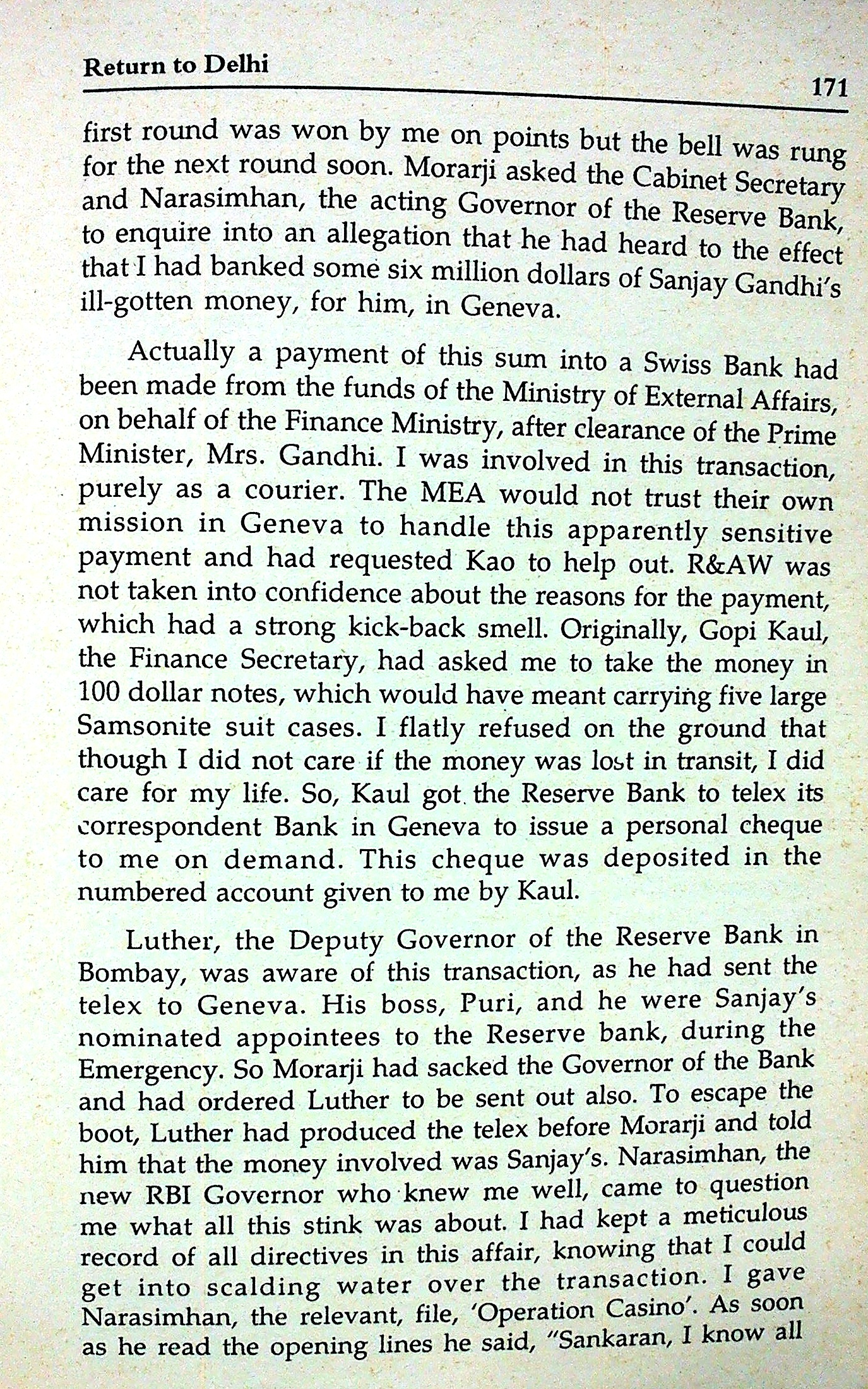
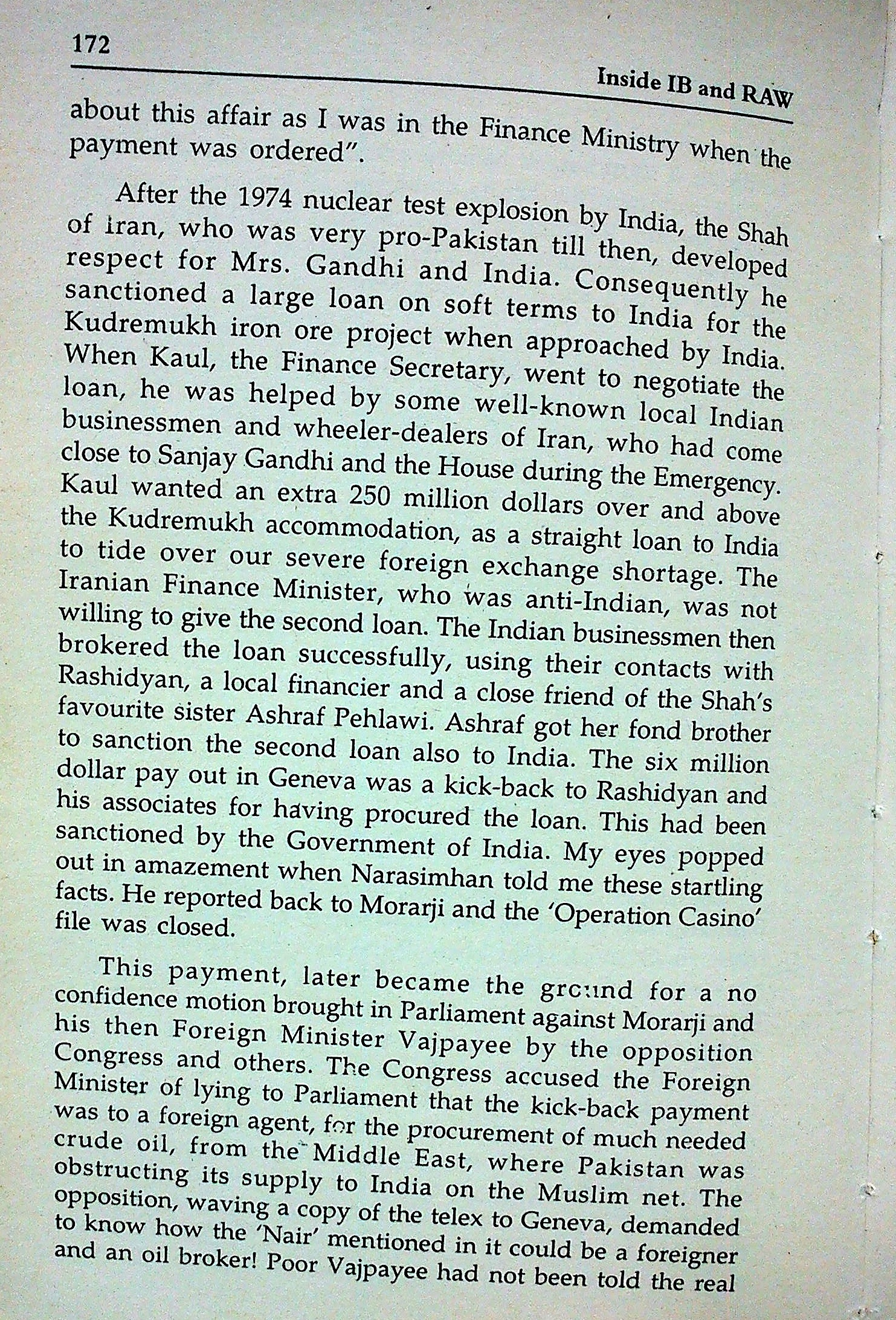
Here is an example from the life and career of Mr. K. Sankaran Nair, when he was, once, such a subordinate officer at the top-level, in the RAW. The incident he narrates in his book ‘Inside IB and RAW’ would guide the honest public servants to prepare proper filenotings and create relevant evidence to prove their honesty later, when they are under pressure to do some questionable actions.

Pages 171, 172 and 173 from the book of Mr. K. Sankaran Nair are posted here for the benefit of the officers who choose to remain honest by choice.

The Book:
DSC02442
Page 171:
DSC02470
Page 172:
DSC02471
Page 173:
DSC02472 copy

Leave a comment

Filed under For Trainees

The Fagin School

A Presentation which is relevant to the Indian bureaucratic scenario is on the website ‘Slideshare.net’. It is posted on our website for the benefit of the readers.
Presentation
Those who are interested, may click on the following link:

Leave a comment

Filed under Administration

ESI Corporation under attack!

ESI Corporation is the backbone of the nation’s economy. The importance of the organization would become known to the ‘ill-informed’  and  the ‘innocents’ only when the organization ceases to exist. The economic miracle of 1945-71 of the West Germany became possible only because of the well-run social security system there.

But, the already-ailing ESIC in India, is under attack from the media, the self-styled ‘national’ media, now, for various commissions and omissions including the impact of having opened many medical colleges. But, these ‘traders in news’ simply forget the fact that it was they who did not care to publish even letters to editors when three retired officers had written to them about those issues in the year 2009 and 2010 itself. If these ‘traders’ had had real devotion to their profession, they would have applied their mind to the issues that had been brought before them and that exposure would have prevented the passage of the Bill bringing in amendments to the Act in the year 2010, by the MPs who did not care to discuss the issues in the floor of the house, in spite of the fact that those retired officers had taken the issues to their knowledge both in person and through email provided in the website of the two houses of Parliament. So much for the depth of knowledge and commitment of these ‘national traders in news’.

But, even while such exposure is being made in the media, the ESIC is under attack from various other quarters also as given below, making it difficult for the honest administrators to set things right even at that this late stage:

  • the corrupt officials who just want to loot and share among themselves the ESIC funds,
  • the association leaders, working overtime, to play power-politics in the postings of officers (by roping in the politicians in power) to bring in pliable officers, at appropriate places, to suit their myopic personal agenda,
  • the indifferent officials who just do their work with honesty and sincerity but do not want to have macro-knowledge about the purpose of their work, the goal of the organization and the goings on in the organisation,
  • the dishonest employers who do not want proper and periodical inspections to ensure correct compliance and payment of the dues legally payable but are conniving to shift the burden to the ESIC with retrospective effect when accidents take place in their factories and
  • the middlemen called ‘Consultants’ who play a major role by assisting such employers, etc.,
  • the inert statutory organisations, like the Central Vigilance Commission and the Office of the CAG which do not want to have proper probe into the issues.
  • the indifferent peoples’ representatives who are in large numbers, who do not feel any ownership to the  nation and do not spare time to understand the impact of the issues.

ESIC can provide medical and cash benefits properly only when its funds are managed in a professional way. ESIC funds can be generated only through proper monitoring mechanism by conducting proper inspection of all the covered and coverable units regularly. Its inspection machinery must be trained on core issues to detect concealment in coverage. The Inspectors (SSOs) and Officers must be equipped with more knowledge than the most knowledgeable but corrupt Consultants, about the  intricacies of the provisions on Revenue. The ESIC must curb corruption and provide quality treatment in the ESIC medical institutions by adopting the caring the manner in which it was done earlier. Otherwise, the ESIC might be in the red, as predicted by its Finance wing.

Endless enhancement of limit for coverage cannot be the solution.

In the circumstances, the only consolation is that there are honest authorities of the ESI Corporation who are really concerned about the issues and are struggling every day to find ways to save the organization by resisting and circumventing the pressures given by these unscrupulous elements.

Should the public remain unconcerned?

Before narrating certain issues with evidence, two articles explaining the importance of the ESI Corporation are published here for information and basic understanding of the importance of the ESIC in the Indian social and economic life.

Please Click on Articles

Leave a comment

Filed under Amendments 2010, Inspections, Transfers