BOOTS or COTS?

An employee of a landlord was found running very fast on the road. He was holding an envelope in his hand. One passerby asked him why he was running so fast and where he was going. The employee replied that he was running fast as he had been ordered to deliver that envelop quickly.  The passerby shouted, “Okay! Where should you deliver that letter?”. The running employee shouted back, “No time to see that. Have to run fast”.

The ESIC has, so far, diverted so much of its own resources. But, the I.T.Roll-out work in the ESIC is still going on without knowing the direction in which it is going.

Cartoon

Click on the image to have the enlarged view.

The process of computerisation started about four years ago in the ESI Corporation. The work assigned originally to one agency was cancelled all of a sudden and diverted to a different agency. Onlookers were puzzled.  But, people wanted computerization of ESIC work to be done somehow that no one was prepared to go into the reasons behind such pre-assignment activities. There were rumours galore that the agreement entered into between the ESIC and the new agency was very loosely drafted containing ambiguous sentences and escape routes in case of non-performance of the work assigned. Yet, nobody cared – or dared –  to look into it.

The work started with a lot of fanfare. Almost entire office machinery of the ESIC was diverted to do the work already assigned to the agency. Regular work of the organisation had, virtually, come to the standstill for months. Social Security Officer, Dealing Assistants and others were diverted to do only  the I.T. Roll out work. Instructions were issued to do many things in one way, in  spite of representations to the contrary. All of them were reversed later. Even new Declaration Forms were collected from the already covered insured persons for reasons not known. Employers and insured persons too bore with many hardships. Camps were arranged on a massive scale throughout the nation for this purpose. The insured persons were directed to attend the camps with all the family members. The practical problems faced by the people were ordered to be ignored. There were strict instructions in this regard but they were modified after some law and  problems were reported.

The plea for computerisation as a pilot project in a few small regions met with scorn and contempt. Trial and error methods were adopted throughout the nation.

Time-tested methods followed successfully in other organisations like Railways, Banks, etc., were deliberately disregarded and discarded.

The Software Requirement Specification is always the core area to be concentrated before computerizing the work of any organization. It requires proper concentration and devotion of time at the initial stage of computerization. But, the ESIC’s priorities were upside down. The SRS for various processes were prepared without adequate depth and content. Even the Input and Output requirements were not spelt out in clear terms to the agency,  for reasons not made known. Yet, the work was started on a very massive scale throughout the nation.

Now, almost four and half years are over. Yet, the software prepared by the agency is not helping the ESIC to go anywhere near the goal of 100% computerization. Defective software has rendered the office work complicated. The staff members find themselves doing the same work twice, both manually and through the System, after waiting for a long time to get access to the System.The reality is that the organization has simply been betrayed. The ESIC looks like a child left alone in the deep woods, knowing no way to come out.

As far as the agency is concerned, the defective SRS handed over to it, has come handy to escape responsibility. ID cards without proper use, highly inflated figures of coverage of insured persons, inaccuracy in monitoring revenue, non-reconciliation of financial figures in the approved way, wrong output regarding the eligibility and rates of benefits for insured persons, wrong and unhelpful outputs while processing the inspection reports in the Regional Offices have become the norm and not exceptions in the day-to-day functioning of the organization.

The state of affairs is such it would be better to discard the entire I.T. Roll-Out and do the work the way it was done before the introduction of the present I.T. Roll-out, manually in some areas and with self-developed or market-purchased software in other areas.  Such Commercial Off-The-Shelf software can be used for hospitals, dispensaries, libraries and in certain wings of the Accounts Division.

The authorities, at present, may hesitate, for bona fide reasons, after having spent so much. But, the field reality necessitates only such a decision.

 The experience of the US Air force cited here as a precedent may help the ESIC authorities to take appropriate decision as deemed fit.

It is time the ESIC moved from BOOTS to COTS!

US Airforce article

Click on the image to have an enlarged view.

***BOOTS – Build, Operate, Own and Transfer the Software.      ***COTS     – Commercial Off-The-Shelf Software.


1 Comment

Filed under Computerisation in ESIC

45 AA – Part V: And, the ire of the British Judges on the law-makers

Law making is always a serious matter. But, it had been done in a casual manner when the Amendments were made in the year 2010 in the ESI Act, 1948. Sec. 45AA of the ESI Act is not an example to be emulated but a warning to be shunned by any organization that wants to have an in-house Appellate Authority. The ESI authorities did not care for the consequences of their proposal. The Advice department of the Ministry of Law, simply, did not pay attention to the subtleties of law. The Parliamentary Standing Committee on Labour which examined the proposal for amendments was cheated. The Members of Parliament, as usual, concentrated on the ‘Sibu Soren issue’ with gusto and created a furore in the House and allowed the ESI Amendment Act to sail through, amidst din,  without any discussion.

No compulsion to explain

We have so far published four posts on Sec. 45 AA alone. Some more analysis is due. This week we deal with the admissibility of new evidence or additional evidence by the Appellate Authority under Sec. 45 AA.  Proper course of action for an Appellant to produce new or additional evidence before any Appellate Authority is to produce evidence before the Appellate Authority as to why the said evidence could not be produced by him, earlier, before the concerned authority which passed the original order.

Such a provision is available in Sec. 7B (4) (b) of the EPF Act, 1952 for entertaining the new or additional evidence on Review. This provision says “no such application shall be granted on the ground of discovery of new matter or evidence which the applicant alleges was not within his knowledge or could not be produced by him when the order was made, without proof of such allegation.” But, in the ESIC there is nothing in the Act, to that effect. Instead of the Regulations referred to in Sec. 45AA, the process of administrative law-making had been resorted to. The administrative instructions issued, thus, on 04.11.2010 in an improper manner, gives a carte blanche to the Appellate Authority in this regard.

Rule 29 of the Income Tax Appellate Tribunal Rules, 1963 says, “The parties to the appeal shall not be entitled to produce additional evidence either oral or
documentary before the Tribunal, but if the Tribunal requires any document to be produced or any witness to be examined or any affidavit to be filed to enable it to pass orders or for any other substantial cause, or, if the Income-tax authorities have decided the case without giving sufficient opportunity to the assessee to adduce evidence either on the points specified by them, or not specified by them, the Tribunal for reasons to be recorded, may allow such document to be produced or witness to be examined or affidavit to be filed or may allow such evidence to be adduced.”

Consequences of the carte blanche

“The appellant may not be permitted to file additional evidence. However, the appellate Authority may at their discretion permit or disallow such additional evidences submitted by the appellant, for the reason recorded in writing”, says Para 7 of the Hqrs. instructions dated 04.11.2010.

This can make the entire proceedings under Sec. 45 A a mockery. An employer need not produce many things before the original quasi-judicial authority. He can produce them later before the 45 AA Appellate Authority. Or, if the order of the 45 A authority was not to his liking, he can plead before the 45AA authority to order re-hearing  the case as he can produce some more documents. The proceedings under Sec. 45 AA need not be taken seriously by the employer and consequently the Branch Officer and his Branch would be wasting their time issuing a 45 A order which would, mostly, be remitted back with directions for considering further evidence. It has been left to the discretion of the Appellate Authority. He is not required even to ask how and why the employer did not produce the new evidence or additional evidence when the hearing took place under Sec. 45 A.

This kind of anomaly is not there in any statute in India that deals with the powers of the Appellate Authority. We have already cited the relevant provisons of EPF Act, 1952  and the I.T. Act in this regard.  The discretion here in the ESI Act is unlimited and arbitrary. Unless the Appellate Authority takes personal care to maintain a system for himself, he will soon find himself drawn before the Courts of Law for exercising his discretion in different ways in different cases. Yet, his arbitrary discretions and contradictory decisions can be impeached only by citing the provisions of equity and equality. There is no safeguard in-built in the ESI Act, 1948.  The amended provision is so loosely worded.

Discretion sky high

  1. “Blanket discretionary power” has been held to be unconstitutional in State of  Bihar Vs. K.K. Mishra 1969 3 SCC 337 and Khwaja Ahmed Abbas Vs. Union of India  1970 2 SCC 780);
  2. “Unguided discretionary power” has been held to be unreasonable in (Himat Lala K Shah Vs. Commissioner of Police 1973  1 SCC 227);
  3. “Wide discretionary power” (State of Madras Vs. V.G. Row 1952 AIR SC 1976) is unconstitutional because it allows the administrative authority to exercise this discretion on subjective satisfaction without permitting the grounds to  be judicially tested;
  4. “Wide discretion without procedural  safeguards” had been held as unconstitutional in State of M.P Vs. Bharat Singh AIR 1967 SC 1170.
    (Page 68- Administrative Law – I.P.  Massey)
  5. “Vague expressions may result in the arbitrary exercise of power”   (Harakchand Ratanchand Banthia Vs. Union of India 1969 2 SCC 166)                                             (Page 69- Administrative Law – I.P.  Massey)
  6. Exercise of discretionary power can be set aside if there is manifest error in the exercise of such power or the exercise of such power is manifestly arbitrary or mala fide or unreasonable. The caste based hierarchic view of administrative responsibility to presume that ‘high’ authority is unlikely to use its discretionary power injudiciously or arbitrarily is a presumption that is certainly conjectural and not tenable.
    (State of Punjab Vs. Dial Chand Gian Chand & Co. – AIR – 1983 referred to in Page 78- Administrative Law – I.P.  Massey)
  7. “While the technique of administrative rule-making is to serve its laudable task, the norms of the jurisprudence of delegation of legislative power must be dutifully observed. These norms include a clear statement of policy, procedural safeguards and control mechanisms”.
    (Page 87- Administrative Law – I.P.  Massey)

But, before uploading further posts on other important aspects on this issue, it is felt appropriate to recall what two famous British jurists have said about the law made by Parliament without adequate analysis of the issues involved.

Impose costs on the draftsmen and the M.Ps.

Lord Justice Scrutton says the following in Roe vs. Russel (1928):

“I regret that I cannot order the costs to be paid by the draftsmen of the Rent Restriction Acts, and the members of the Legislature who passed them, and are responsible for the obscurity of the Acts.” (Page 94- The Closing Chapter – Lord Dennings).

The Act passed by the British Parliament was so ambiguous that Lord Scrutton regretted his inability to impose penalty (cost) on the persons who brought into existence such a loosely drafted law.

Proper analysis before making law

Another Judge Sir Ernest Gowers who said the following in the Plain Words case in the year 1948 as the duty of the draftsmen (Page 95 ibid.):

“…. to try to imagine every possible combination of circumstances to which his words might apply and every conceivable misinterpretation that might be put on them, and to take precaution accordingly. ….All the time he must keep his eyes on the rules of legal interpretation and the case law on the meaning of particular words [and on the previous statutes on the same subject-matter] and choose his phraseology to fit them.”

Indians,  who are  said to have adopted the British system of governance more, have to travel a longer distance, still, to demonstrate that they are capable of framing laws in a proper manner.

1 Comment

Filed under Amendments 2010

Appellate Authority u/s 45 AA: Part IV: A comparison with IT Act and EPF Act!

When the authorities want to add a provision for Appellate Authorities in a statute, they would ensure the following:
The Principal Act would specify the
Constitution of the Appellate Authority and Powers of the Appellate Authority very clearly. It would, generally, leave the Procedure to be codified through subordinate legislation.

  1. The provisions pertaining to the E.I. Court fulfill this requirement.
  2. The Income Tax Act and the EPF Act also fulfill this requirement.
  3. But, the hastily prepared, loosely worded Sec. 45 AA pertaining to the creation of the Appellate Authority under the ESI Act does not fulfil this requirement.

This Section is totally flawed and there was no one to care for even when the matter had been taken to their knowledge even during the pre-amendment period. The role of the bureaucrats of the Ministry of Law was shocking. The manner in which the Parliamentary Committee and the Members of Parliament approached the issue makes one wonder whether law-making process in the nation had become so ineffective and inefficient in the nation.


The ESI Act, Sec. 45 AA has left all the three aspects of law-making, the Constitution of the Authority, its Powers and the Procedure to be followed by it, to be done by subordinate legislation. But, even without any such legislation in the form of notified Rules by the Central Government or notified Regulations by the Corporation, the Hqrs. Office had issued administrative instructions on 04.11.2010 pertaining to all the aforesaid three aspects.


Was this action proper?


This, when the Sub-Committee of ESI Corporation to examine the need for amendments recommended appointment of Appellate Authority said, “
Similar provisions exist in case of Income Tax and EPF Act”. One wonders whether the Sub-Committee had really seen those Acts.

Excerpts from Item No. 11 of the Report of the Sub-Committee of ESI  Corporation on Amendments to the ESI Act, 1948

Excerpts from Item No. 11 of the Report of the Sub-Committee of ESI Corporation on Amendments to the ESI Act, 1948


It is a pity that the Parliament has been used for vesting arbitrary and unlimited powers to the authorities to appoint and regulate the Appointing Authorities under Sec. 45 AA.


Such vestiture is patently unlawful and the amendment itself was ultra vires of the Parliament.


Readers may compare Sec. 45 AA of the ESI Act with Sec. 7D to 7Q (especially 7D and 7E) of the EPF & MP Act. These two sections are reproduced here for the convenience of the readers:


EPF & MP Act:
7D. Employees’ Provident Funds Appellate Tribunal. – (1) The Central Government may, by notification in the Official Gazette, constitute one or more Appellate Tribunals to be known as the Employees‟ Provident Funds Appellate Tribunal to exercise the powers and discharge the functions conferred on such Tribunal by this Act and every such Tribunal shall have jurisdiction in respect of establishments situated in such area as may be specified in the notification constituting the Tribunal.
(2) A Tribunal shall consist of one person only to be appointed by the Central Government.
(3) A person shall not be qualified for appointment as a Presiding Officer of a Tribunal hereinafter referred to as the Presiding Officer, unless he is, or has been, or is qualified to be, –
(i) a Judge of a High Court; or (ii) a District Judge.
7E. Term of office. – The Presiding Officer of a Tribunal shall hold office for a term of five years from the date on which he enters upon his office or until he attains the age of sixty-two years, whichever is earlier.
The readers may compare Sec. 252 , Sec. 253 and from Sec. 254 to Sec. 260 of the Income Tax Act with Sec. 45 AA of the ESI Act.

Income Tax Act:

252. (1) The Central Government shall constitute an Appellate Tribunal consisting of as many judicial and accountant members as it thinks fit to exercise the powers and discharge the functions conferred on the Appellate Tribunal by this Act.

 95[(2) A judicial member shall be a person who has for at least ten years held a judicial office in the territory of India or who has been a member of the 96[Indian] Legal Service and has held a post in Grade 97[II] of that Service or any equivalent or higher post for at least three years or who has been an advocate for at least ten years.

Explanation.—For the purposes of this sub-section,—

           (i)  in computing the period during which a person has held judicial office in the territory of India, there shall be included any period, after he has held any judicial office, during which the person has been an advocate or has held the office of a member of a Tribunal or any post, under the Union or a State, requiring special knowledge of law;

          (ii)  in computing the period during which a person has been an advocate, there shall be included any period during which the person has held judicial office or the office of a member of a Tribunal or any post, under the Union or a State, requiring special knowledge of law after he became an advocate.

(2A) An accountant member shall be a person who has for at least ten years been in the practice of accountancy as a chartered accountant under the Chartered Accountants Act, 1949 (38 of 1949), or as a registered accountant under any law formerly in force or partly as a registered accountant and partly as a chartered accountant, or who has been a member of the Indian Income-tax Service, Group A and has held the post of [Additional] Commissioner of Income-tax or any equivalent or higher post for at least three years.]

 [(3) The Central Government shall appoint the Senior Vice-President or one of the Vice-Presidents of the Appellate Tribunal to be the President thereof.]

 [(4) The Central Government may appoint one or more members of the Appellate Tribunal to be the Vice-President or, as the case may be, Vice-Presidents thereof.]

 [(4A) The Central Government may appoint one of the Vice-Presidents of the Appellate Tribunal to be the Senior Vice-President thereof.]

 (5) [The Senior Vice-President or a Vice-President] shall exercise such of the powers and perform such of the functions of the President as may be delegated to him by the President by a general or special order in writing.
So much for the lawmaking process, when it came to Sec. 45 AA!

1 Comment

Filed under Amendments 2010

Appellate Authority u/s 45 AA – Part III – The unlawful instructions

The ESIC Hqrs Office had issued instructions to all the Regional Directors long back advising them that the quasi-judicial authorities who issued orders under Sec. 45 A and under Sec. 85 B should not be included as witnesses in E.I.Court cases to defend the order. It was also instructed that if the employer wanted the quasi judicial officer to be produced as a witness, it must be strongly objected to, as it was not a practice to call any judicial or quasi judicial authority to defend his own order.

But, after the insertion of Sec. 45 AA in the ESI Act, in the year 2010, instructions were issued on 04.11.2010, that the quasi judicial authority which issued the order under Sec. 45 A should appear as a party during the course of proceedings before the Appellate Authority under Sec. 45 AA.

The Hon’ble Supreme Court has, in Union Of India Vs Orient Engg. & Commercial Co. Ltd. on 7 October, 1977, said:

“Indeed, it will be a very embarrassing and, in many cases, objectionable if every quasi-judicial authority or tribunal were put to the necessity of greeting into the witness box and testify as to what weighed in his mind in reaching his verdict. We agree with the observations of Walsh, A.C.J. in Khub Lal v. Bishambhar Sahai where the learned Judge has pointed out that the slightest attempt to get to the materials of his decision,, to get back to his mind and to examine him as to why and how he arrived at a particular decision should be immediately and ruthlessly excluded as undesirable.”……….“We do not think that every Munsif and every Judge, every Commissioner and, every arbitrator has to undergo a cross-examination before his judgment or award can be upheld by the appellate court, How vicious such an approach would be is apparent on the slightest reflection. Of course, if a party has a case of mala fides and makes out prima facie that it is not a frivolous charge or has other reasonably relevant matters to be brought out the court may., in given circumstances, exercise its power to summon even an arbitrator, because nobody is beyond the reach of truth or trial by Court. In the present case, after having heard counsel on both sides, we are not satisfied that on the present material there is justification for the examination of the arbitrator. We therefore set aside the order.”

The Revenue Manual does not take into account the earlier instructions which were correct.

The instructions issued by the Hqrs on 04.11.2010 were incorrect and unlawful. The Appellate Authority under Sec. 45 AA is not superior to the E.I. Court, as the E.I.Court can entertain appeal against the orders of the authority under Sec. 45 AA. Yet, the Hqrs instructions say that the quasi judicial officer should appear before the authority under Sec. 45 AA but not before the E.I. Court. What will happen if the employers cite this provision and convince the E.I.Courts to summon the officers who issued orders under Sec. 45 A to appear before the E.I.Court too to stand the test of cross examination? Was this aspect examined in the file before the instructions were issued on 04.11.2010? Was the issue set right, at least, after the anomaly was brought to the notice of the Hqrs.? No. The instructions still hold.

In Pradip Kumar Sarawgi & Sons Vs. Commissioner Of Taxes, on 26 June, 2003, the Hon’ble Supreme Court has held as under:

“No authority, superior to an assessing authority, can interfere with the quasi-judicial functions of an assessing authority by issuing administrative directions. The Apex Court has in Orient Paper Mills Ltd. v. Union of India, (1969) SC 48, made the position of law in this regard clear in the following words :

“If the power exercised by the Collector was a quasi-judicial power as we hold it to be that power cannot be controlled by the directions issued by the Board. No authority however, high placed can control the decision of a judicial or a quasi-judicial authority. That is the essence of our judicial system. There is no provision in the Act empowering the Board to issue directions to the assessing authorities or the appellate authorities in the matter of deciding disputes between the persons who are called upon to pay duty and the department. It is true that the assessing authorities as well as the appellate authorities are Judge in their own cause; yet when they are called upon to decide disputes arising under Act they must act independently and impartially. They cannot be said to act independently if their judgment is controlled by the directions given by others”.

We hope the aforesaid anomalies created by the unwarranted instructions dated 04.11.2010  and the  numerous other inconsistencies and inadequacies in the Revenue Manual would be set right in the new dispensation in the interest of the organization.

Leave a comment

Filed under Amendments 2010

Appellate Authority u/s 45 AA – Part II

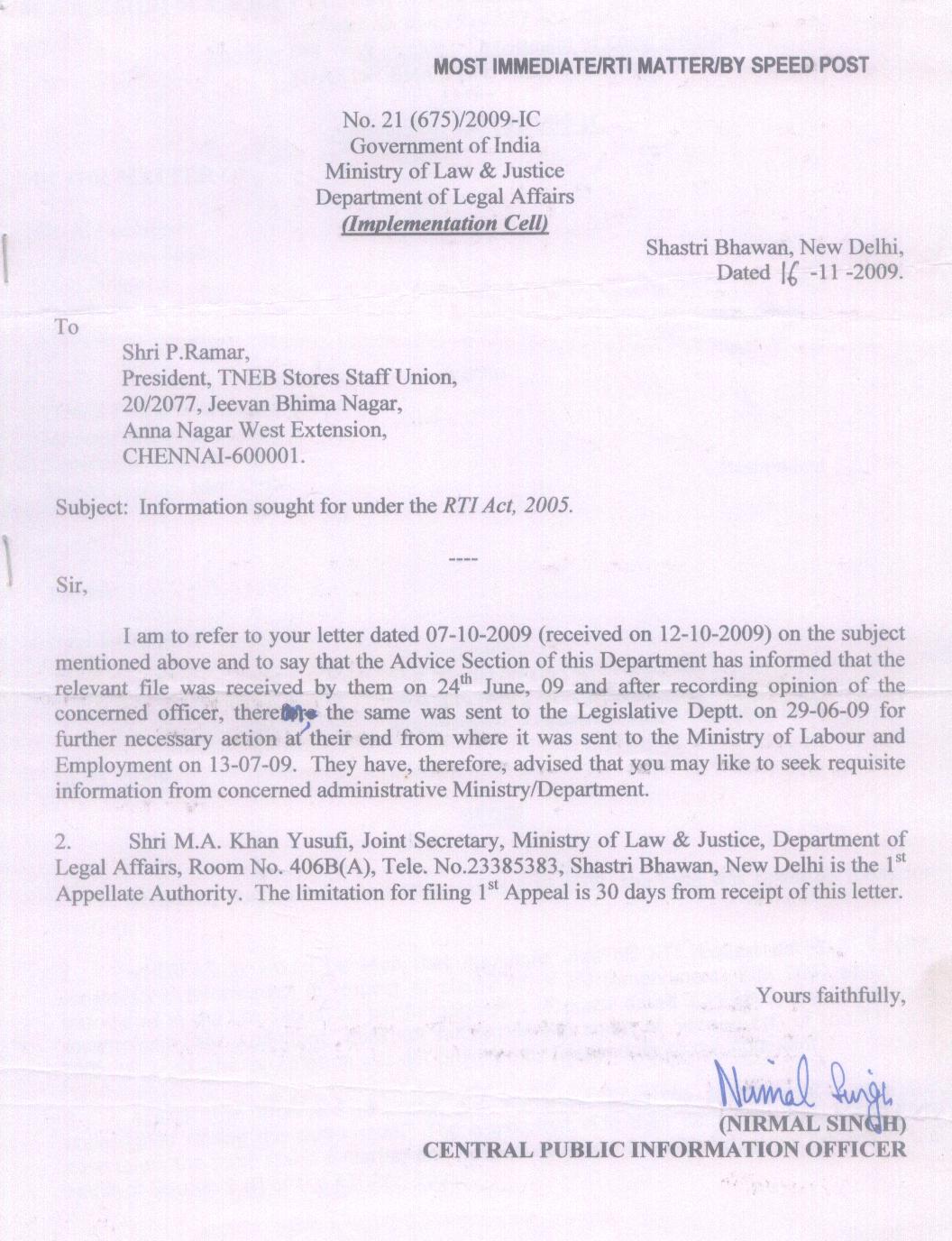
The application sent to the Ministry of Law was published last week. This week we publish the reply received from the Ministry of Law and the Appeal made to the FAA against it.

The reply dated 16.11.2009 received from the Ministry of Law is given below:

wpid-ramar-letter-scan-2013-03-28-11-17.jpg

One can see the enlarged version of this image by clicking on it


An appeal was, thereafter, filed before the First Appellate Authority of the Ministry of Law on 22.11.2009. The text of the same is given below:

From
P. Ramar,
President, TNEB Stores Staff Union,
20/2077, Jeevan Bhima Nagar,
Anna Nagar West Extension,
Chennai – 600001

To
Shri. M. A.Khan Yusufi,
Joint Secretary,
First Appellate Authority,
Ministry of Law & Justice,
Department of Legal Affairs,
Room No. 406 B- A, 4th Floor, “A” wing,
Shastri Bhawan, New Delhi-110001
Tel No.: 23385383

Sub:
Employees’ State Insurance (Amendment) Bill, 2009 – indifferent attitude of the CPIO in a matter of national importance – Appeal under Sec.19 (1) of the RTI Act, 2005
Ref:
  1. 1.Bill No.66 of 2009 tabled in the Parliament.
  2. 2.My Application dated Nil received by you on 25.9.2009.
  3. 3.Letter No. 21 (675) 2009 – IC dated 16.11.2009 of the CPIO, Ministry of Law & Justice.

Sir,

I invite your kind attention to the references cited.

2. I had, in the reference second cited, asked for certain information under Sec. 6 of the RTI Act, 2005, with reference to the Employees’ State Insurance (Amendment) Bill, 2009. The information that I had requested was with reference to what would have, normally, been available as per the files of your Ministry.

3. But, the CPIO has, in the reference third cited, informed that no file is available in your Ministry as the Advice Section of your department had recorded its opinion in the concerned file of the Ministry of Labour & Employment and sent it to the Legislative Department which, in turn, sent the file back to the Ministry of Labour & Employment.

4. The CPIO had also informed me that the Ministry of Labour & Employment may provide the information requested by me. This, he has done after more than thirty days, when he could have transferred the application to the concerned Ministry. As per Sec. 6(3) of the RTI Act, 2005, he should have done so within five days from the date of receipt of the application. The action of the CPIO is in patent violation of Rule 6 (3) of the Right to Information Act, 2005 notified by none other than your Ministry’s Legislative Department.

5. It becomes clear from the said reply of your CPIO that neither the Advice Section nor the Legislative Department of the Ministry of Law & Justice considered it necessary to retain even the copies of the file-notings for their reference and record, in spite of the fact that the issue under their consideration was the amendment to the Principal Act.

6. If the single file system is the reason for non-maintenance of record, the CPIO should, in all fairness, have transferred the Application to the Ministry of Labour & Employment, on his own, for supplying the information requested by me, as both departments are part of the same secretariat.

7. Or, if the Ministry of Labour & Employment is considered to be some other department, your Ministry should have kept a record of the work done by your officials.

8. But, neither was done in this case.

9. The issue under consideration is the very serious amendments proposed to be made in the ESI Act, 1948. The way in which your Advice Department, which has the duty to examine the proposed amendments “from legal and Constitutional angle”, had dealt with so many amendments within five days from 24.6.2009 to 29.6.2009 *** shows very clearly that your officials had either not understood the significance of various clauses, especially the Clauses 5, 9, 15, 17, of the Bill very clearly or had been under undue pressure to clear the Bill fast without proper scrutiny.

10. The reply also shows that the Ministry of Law & Justice is not concerned about the implications of the amendments endorsed by them, even after the facts brought out in my Application had been read by them. I am aggrieved by the decision of the CPIO.

11. The implications of the amendment being very serious having wider ramifications on the society, the issue is proposed to be taken up through other legitimate fora. I, therefore, request you to kindly advise your CPIO to act, at least, as per Sec. 6 (3) of the RTI Act, 2005. Precious time has been wasted in a matter of national importance, because of the indifferent attitude of your CPIO to the provisions of Sec. 6(3).

Yours faithfully,

22.11.2009

(P.Ramar)

***

N.B: It turned out later that the Ministry of Law Advice Department did not take five days but only two days. The details in this regard have alreay been given in a separate post in the following link:

The Ministry of Law created a record on 26.6.2009

Leave a comment

Filed under Amendments 2010

Appellate Authority u/s 45 AA of the ESI Act – Part I

The following are excerpts from the application sent by Mr. P. Ramar on 10.10.2009 to the Ministry of Law on the amendment then proposed for having an Appellate Authority under the ESI Act:

  1. Sec. 74 of the Principal Act provides for a full-time domestic tribunal as part of the ESI Corporation exclusively for deciding the cases pertaining to the ESI Corporation. The expenditure pertaining to that Tribunal was intended to be met from the ESI Fund as per Sec. 28 (vii) of the ESI Act, 1948 which authorises that the ESI Fund shall be expended for “defraying the cost (including all expenses) of the Employees’ Insurance Courts set up under this Act”. Accordingly, full time E.I.Courts had been set-up and were functioning upto the mid-seventies, although the expenditure of such E.I.Courts had been met only by the concerned State Governments. At that time, the disposal of the cases was fast and the E.I.Courts functioned as specialized institutions on matters pertaining to the ESI Act.

2. Now, all of a sudden a provision is attempted to be made for having an Appellate Authority with reference to the orders issued under Sec. 45-A pertaining to Contribution. The Statement of Objects and Reasons for the Bill do not explain the problems, if any, faced by the organization for want of such an Appellate Authority and the necessity for such an amendment.

3. The Bill is totally silent with reference to Sec. 85-B under which the same ESI Authorities issue orders regarding Damages by exercising the same powers and extending the same opportunity to the employers as per the principles of natural justice.

4. The fact is that there is no need for an internal appellate authority under Sec. 45 and the present proposal as per Clause 9 is only intended to preclude the E.I.Courts from playing their legitimate role.

5. All that the ESIC has to do, under Sec. 74 is

  1. a)to ask the State Governments to make the E.I. Courts as full-time courts to attend only to the cases pertaining to the ESI matters;
  2. b)to ask the State Governments to nominate judges for these courts with reference to the EI Court rules already framed by them,
  3. c)to inform the State Governments that the ESI Corporation would meet the entire cost of running the courts from the ESI Fund.

6. But, the ESI Corporation had, over a period of time, simply left it to the concerned State Governments to do whatever they pleased. No money has been spent from the ESI Fund for running the E.I. Courts. So, the State Governments have, instead of appointing full-time EI Courts simply allotted the work to the Labour Courts. The judges of the Labour Courts, overloaded already with their main work, began to consider the ESI work as a part of their other works. Because of this overload, there is significant delay in the disposal of cases.

7. The prime factor for consideration is that the authors of the Principal Act had very wisely understood the need for having an appellate authority who will not be a civil court but in-house tribunal. But, later, because of the ignorance and inaction of the ESI Authorities of the nuances of the subject-matter, the State Governments had not been informed of the financial assistance available to them as per Sec. 28 (viii). As a result, the ESI Corporation had been suffering all along because of the delay in the disposal of cases.

8. Delay in the disposal of cases cannot, therefore, be a reason for moving an amendment as per Clause 9 of the ESI (Amendment) Bill, 2009. Proper understanding of the significance behind Sec. 74 and Sec. 28 would help set-up full-time EI Courts and clear the arrears. The present amendment is an attempt to make things chaotic without enforcing Sec. 28.

The Clause 9 of the ESI (Amendment) Bill, 2009 introduced in the Lok Sabha is reproduced below:
9. After section 45A of the principal Act, the following section shall be inserted, namely:—

“45AA. If an employer is not satisfied with the order referred to in section 45A, he may prefer an appeal to an appellate authority as may be provided by regulation, within sixty days of the date of such order after depositing twenty-five per cent. of the contribution so ordered or the contribution as per his own calculation, whichever is higher, with the Corporation:

Provided that if the employer finally succeeds in the appeal, the Corporation shall refund such deposit to the employer together with such interest as may be specified in the regulation.”.

Para 2 of the Memorandum Regarding Delegated Legislation is reproduced below:

2. Clause 9 of the Bill seeks to empower the Employees’ State Insurance Corporation to provide an appellate authority by regulation for hearing appeal from an employer against the determination of contribution payable in respect of employees and to specify the interest on the deposit made by the employer in case the employer is finally succeeds in the appeal.

Para 5 of the Memorandum Regarding Delegated Legislation is reproduced below:

5. The matters in respect of which the rules or regulations, as the case may be, to be made, are of administrative and procedural details and it is not practicable to provide for them in the Bill itself. The delegation of legislative power is, therefore, of a normal character.

9. There is no provision in the Bill to provide for a Section similar to Sec. 45 – A (2) to make the orders of the Appellate Authority enforceable.

10. Moreover, the Amendment Bill seeks to vest the power in the ESI Corporation to decide the (a) Constitution and appointment of Appellate Authority, (b) Powers and (c) procedure to be followed by the said authority. These matters have been left to the purview of delegated legislation.

11. If the ESI Authorities had moved the proposal by giving the impression that the EI Court is a Civil Court and that there is a requirement for an intra-departmental remedy for reviewing the orders issued under Sec. 45 A, their contention is wrong.

  1. a)“The E.I. Court is not a Civil Court but a domestic tribunal specially constituted for the purposes of deciding any controversy that may arise and the matters enumerable in Sec. 73 A”. (ESIC Vs. Zeckra 1969 (36) FJR 110.).
  2. b)Punjab High Court has held that the E.I. Court is not an ordinary civil court but a domestic tribunal specially constituted for the purpose of deciding any controversy that may arise in the matters enumerated in Sec. 75 of the Act.(ESIC Vs. Ram Lakhan, AIR 1960 Punj.559). The Bombay High Court has described the E.I.Court as a persona designate.
  3. c)In Virendra Kumar Vs. State of Punjab (AIR 1956 SC 153), the Supreme Court has made the following observations: “It is a familiar feature of modern legislation to set up bodies and tribunals and entrust them with the work of judicial character, but they are not courts in the accepted sense of that term though they may possess some of the trappings of a Court.”
  4. d)The mere fact that a judicial officer presiding over a Civil Court is appointed a judge would not, while he is performing his functions as a judge of the E.I. court, make him a civil court. “All the powers of a Civil Court cannot be exercised by an E.I. Court and only such power has been conferred by sub-section 1 of Section 78 upon it as are common with the powers of a civil court.” (ESIC vs. Shashi Kant Arc Khandi and another 1983 (47) FLR 269). There are only deeming premises made by Sec.78 (4) for the enforcement of orders of the EI Court in the same manner as done for the orders of Civil Court.

12. The “Commentaries on ESI Act, 1948” by M.R. Mallick published by the Eastern Law House, Kolkata in the year 1974 analyses the issue in depth and you could find more references in that book. It would thus become clear that the Principal Act has already placed a Domestic Tribunal for immediate remedy with reference to any issue that may arise between the employers and the ESI Corporation.

13. There is, therefore, no need for an additional departmental authority to become an appellate authority to decide any issue that may arise between the employers and the ESI Corporation under Sec. 45A. Yet, the Ministry of Law has become a party to the decision to vest some arbitrary powers in the ESI authorities to nominate the Appellate Authorities even without examining the fact that the ESI Corporation is not utilizing the powers vested in it to establish a full-time Tribunal under Sec. 74 meeting the required expenditure for it under Sec. 28.

14. The present bill aims at obtaining the approval of the Hon’ble Members of the Parliament to appoint an Appellate Authority in the ESI Corporation for the purpose of revising and reconsidering the orders under Sec. 45-A without informing the Hon’ble Members the manner in which such Appellate Authority is going to be appointed. The Bill aims at delegating arbitrary power to the Corporation to do as it pleases in such an important quasi-judicial matter.

  1. 1.Please, therefore, intimate, with reference to your office records, the details of the difficulties faced by the ESI Corporation, at present, because of the absence of any departmental officer to function as an Appellate Authority.
  2. 2.Please intimate whether the Ministry of Law had actually examined beforehand the manner in which the ESI Corporation is going to frame the delegated legislation regarding the appointment and powers of the proposed Appellate Authority.
  3. 3.Please intimate whether an Appellate Authority can be appointed and vested with powers as per Delegated Legislation when the Inspector and the Quasi-Judicial Authority and the E.I. Courts are appointed under Sec. 45 and Sec. 74 respectively and are deriving powers as per the Principal Act.
  4. 4.Please intimate whether the Ministry of Law is aware that the same officers who pass the orders under Sec.45-A regarding contribution happen to pass orders under Sec. 85-B regarding damages also following the same principles of affording the opportunity of principles of natural justice. In that case, please intimate whether you had examined the reason behind the fact that the ESI Authorities did not bother themselves about having the same Appellate Machinery regarding the Damages ordered under Sec. 85-B of the ESI Act, 1948.
  1. 5.Please intimate whether the orders of the proposed Appellate Authority under Sec. 45 AA are enforceable without there being any provision under the said Sec. 45 AA, corresponding to the Sec. 45-A (2) available under Sec. 45 A.

A sum of Rs.10 towards fee under the Right to Information Act,2005 has been paid in the form of Indian Postal Order for Rs.10/- drawn in favour of Secretary, Ministry of Law payable at New Delhi the details of which are asunder:


2 Comments

Filed under Administration, Benefits, E I courts, For Trainees, Inspections

ESIC must monitor ESIS in the States

The ESIC provides five main benefits to the insured population. There are many other additional facilities provided. The Medical Benefit is provided mainly through the State Governments. Adequate funds are provided to the State Governments in advance every quarter.

As the ESI Corporation collects the contribution from the workforce and the employers, the beneficiaries make only on the ESI Corporation answerable for the proper administration of Medical Benefits. But, the ESIC does not, practically, have any monitoring mechanism to oversee the exact manner in which the funds released by it are spent by the State Governments.

There are many dispensaries where even the essential medicines are not available, when the procedure demands that the medicines must be indented for in advance to meet the requirements of subsequent quarter and the funds are released in advance.

The ESI Corporation must, therefore, arrange to have a Monitoring Committee of four officers, two from the State Government concerned and two from the ESIC, one of them being the Deputy Director (Finance) of the concerned Regional Office. That system will ensure that the funds released are utilized only as per the ESI norms. Releasing the advance must be with reference to the clearance given by this Monitoring Committee.


3 Comments

Filed under Benefits

Executive Powers of the Chairman, Standing Committee of ESIC

Episode-1:

The ESI Corporation had constructed a hospital and staff quarters at Rajkot in Gujarat in the year 1991. The Rajkot Municipal Corporation wanted an area of land admeasuring 394.8 sq. mts. from the abovesaid land at Rajkot for widening the road for public purpose.

The Director General accorded permission to transfer the land subject to the following conditions:

  1. The Rajkot Municipal Corporation will pay compensation for the transferred land at the existing value.
  2. The ESI Corporation will not pay any demolition charges for demolition of the boundary wall.
  3. The Rajkot Municipal Corporation will undertake to reconstruct the boundary wall with the same specifications as in the existing wall.

But, the Municipal Corporation did not agree to these terms. The ESI Corporation, therefore, referred the matter for legal opinion from the Government Pleader which ran as under:

  • The ESI Corporation must demand compensation before handing over possession of the land to the Municipal Corporation.
  • The boundary wall has to be demolished as well as reconstructed only at the cost of the ESI Corporation.
  • The ESIC can ask for alternate land / F.S.I. but it is for the Municipal Corporation to consider whether to give alternative land / F.S.I or not.

The matter was, therefore, placed before the Standing Committee and then to the ESIC on 21.02.2006 to hand over possession of the land without prejudice to the right of the Corporation to raise objection and claim compensation in the appropriate legal forum.

Episode-2:

The ESI Corporation had constructed a hospital and staff quarters at Sanat Nagar in Hyderabad in the year 1964 on a land admeasuring more than 33 acres. The Hyderabad Municipal Corporation wanted land admeasuring 1260.66 sq. yards from the above land at Sanat Nagar for widening the road public purpose. They had started demolishing the Boundary wall too.

Since acquisition of land was for a public purpose, the Director General had accorded permission to transfer the land of 1260.66 sq.yards to the Hyderabad Municipal Corporation, but, subject to the following conditions and also subject to the approval of the Standing Committee:

  1. The Hyderabad Municipal Corporation will pay compensation for the transferred land at existing value;
  2. The Corporation will not pay any charges to the Municipal Corporation for demolishing the boundary wall;
  3. The Hyderabad Municipal Corporation should reconstruct the boundary wall before taking over the transferred land with the same specification as in the existing boundary wall.

The ex-post facto approval of the Standing Committee was sought during the meeting of the Standing Committee on 6.12.2006 as the Standing Committee alone was empowered to transfer the land belonging to the Corporation under Rule 26 of the ESI (Central) Rules, 1950.

Episode-3:

Proposal is made by the ESI Corporation to construct Medical College Building at Ayanavaram. The Municipal Corporation of Chennai insists on the gift of land admeasuring around 1100 sq. mts. for public purpose, i.e., to widen the road. The matter is decided at the level of the Chairman, Standing Committee who was the Secretary, Ministry of Labour. He takes decision in the capacity of the Chairman, Standing Committee.

No such decision can, lawfully, be taken by him as no executive power is vested in him. Moreover, no compensation is claimed unlike the cases of Rajkot or Hyderabad.

Besides, a simple assurance by the ESIC that it would give land to the Municipality when such situation arises would have satisfied the requirement of the Municipal Corporation/ CMDA. Now, as things stand, whether the Medical College comes into existence or not, the land has already been ceded to the Corporation, in spite of the fact that the landowners on either side have not given their land for road widening. Such road widening may or may not even become a reality.

Moreover, the land was just gifted away in a hurry. And, the then existing and occupied residential accommodation meant for the Medical Superintendent of the ESI Hospital, situated in the land gifted away, was also undertaken to be demolished at the cost of the ESI Corporation. In addition, the ESIC had also undertaken to relocate, at the cost of the ESIC, the EB transformer far away from the re-aligned boundary wall, losing thereby substantial portion of the ESIC land.

All this, in spite of the fact, that there is a well-set precedent in Chennai that the State Highways Department used to pay considerable amount of compensation when they acquired the land for road-widening purposes. Such compensations, including the cost of reconstruction of realigned compound walls, had been paid when the land of the ESIS Dispensary at Pallavaram and Tambaram were acquired for road widening.

The unseemly hurry shown on the part of the ESIC in this regard raised a lot of eyebrows.

The Analysis:

In the first two cases of Rajkot and Hyderabad, approval was given by the Director General, the head of office, and ratification was obtained later from the Standing Committee/ ESIC.

In the third case pertaining to Chennai, the Standing Committee’s Chairman approves it first and the matter goes to the SC later.

In the first two cases the ESI Corporation insisted on claiming compensation. In the third case, no compensation was claimed. Such a decision was taken at the lower level itself and not at the level of the ESI Corporation.

  1. The SC Chairman has been vested with only one executive power, i.e., to act as the Appellate Authority as per the ESIC (S&CS) Regulations, 1959.
  2. Otherwise, the SC Chairman has control over only the Meetings of the Standing Committee. He can approve the Agenda points, decide who gets to speak during the meetings, and approve the minutes of the meetings of the Standing Committee.
  3. The Standing Committee Chairman does not have any other executive powers. No such powers have been specified anywhere in the ESI Act, 1948 or in the ESI (Central) Rules, 1950, unlike the powers of the Director General or the Financial Commissioner enumerated in the Central Rules.
  4. The Chairman of the Standing Committee cannot be equated with the whole Standing Committee. He cannot substitute himself in the place of the Standing Committee. Similarly, the Chairman of the ESI Corporation can also not be equated with the ESI Corporation.
  5. “Committees are essential to the effective operation of legislative bodies. Committee membership enables members to develop specialized knowledge of the matters under their jurisdiction. As ‘little legislatures’, committees monitor on-going governmental operations, identify issues suitable for legislative review, gather and evaluate information; and recommend courses of action to their parent body.” Thus, committees are necessarily different from the heads of those committees.
  6. Even all the members of the ESI Corporation or the Standing Committee cannot abdicate their responsibility to decide the matters in hand and pass a unanimous resolution delegating the powers of the Body to an individual who acts as the Chairman of that Body, on the issues in which that Body concerned has to take a decision in a formal meeting. If the Standing Committee delegates such a power , it would amount to sub-delegation and would become ultra vires and unlawful. 
  7. There is, therefore, no such administrative power vested in the Chairman of the Standing Committee to decide on the issue of transfer of land as a gift, as has been exercised in the case of the land at Ayanavaram to the Chennai Metropolitan Development Authority, Government of Tamil Nadu. There was no reason for the file to go to the Chairman, Standing Committee at that stage.

The Questions:

  • How did the Standing Committee approve this Chennai transaction later? Did it examine the issue in its entirety keeping in view the past precedents?
  • What was the differentiating issue between the Chennai transaction in which the land was gifted away and the earlier two transactions in which compensation was insisted upon by the SC/ ESIC?
  • When the Standing Committee cannot even pass resolutions vesting its powers on its Chairman, how can the administrative matter by decided at the level of the Secretary, Ministry of Labour in his capacity as the Chairman, Standing Committee?
  • Where is the power vested in him for that purpose? Under what provisions?

The relevant facts:

The Ministry of Labour has, in past, made many attempts to restrict the autonomy of the ESI Corporation by taking away the powers of the Director General in administrative matters and also by exercising powers not vested in the Chairman of the Standing Committee and in the Chairman of the ESI Corporation. These actions, were strictly, not lawful.

Just because of respect, courtesy or fear the ESI authorities yield to many a subtle pressure from the Ministry of Labour. But, there had been legitimate resistance too to such pressures in the past. The success of such efforts of the Ministry of Labour, therefore, depended upon the nature of reaction of the authorities of the ESIC. If the latter feels vulnerable for various reasons, such vulnerable feeling is taken advantage of by the Ministry of Labour and they extend their authority, without corresponding responsibility, to the administrative matters of the ESIC.

They want to treat the ESIC as part of their office by extending their authority thus, while at the same time denying the corresponding benefits that would accrue to the ESIC Officers and staff, as government servants belonging to the same Ministry.

Except for such overbearing attitude, there is no authority lawfully vested in the Ministry of Labour to overshadow the Director General in the day-to-day functioning of the ESI Corporation.

The core issues:

The main points now are

  • whether the Standing Committee and the ESI Corporation had, before ratifying the action of gifting away the land at Ayanavaram to the CMDA at Chennai without any compensation, examined the issue comprehensively and taken a conscious decision to forgo any compensation, keeping in view the earlier episodes of Rajkot and Hyderabad in which decisions had been taken to the contrary;
  • whether the Chairman, Standing Committee has executive powers to entertain a file from the Hqrs. Office of the ESI Corporation in the manner in which it has been done in Episode-3.
  • whether there was any need for the file to go the Chairman, Standing Committee for a decision in respect of Episode-3, when the files did not go, earlier, to him in respect of Episodes 1 & 2, in which cases, the decisions had been taken only at the level of the Director General, in a right way.

P.S: Another important dimension gets added to this episode, if  the unconfirmed information that the proposal to set up the Medical College at Ayanavaram has been dropped, is true. In that event, where was the need for gifting away the land and demolishing the building in it?


1 Comment

Filed under For Trainees

Civil Servants Vs. Rude Masters

Civil servants turn out to be rude masters” 

– Lloyd George, Prime Minister of the U.K. – 1916-1922

A transparent Transfer Policy was brought into existence in the ESI Corporation on 17.03.2005 which ensured fairness and struck a balance  between public interest and private needs of the public servants. But, for quite some time, this Policy had been thrown to the winds and transfers are ordered as per the arbitrary decisions of the persons who have power or role to influence the decision. The Rule of Law is not allowed to prevail.

As a result, the officers have again developed the tendency to do anything to please the persons who matter. The consequential victim is the office work. Some officers are subjected to frequent transfers and the all-India transfer liability is held out against them to justify those  transfers. Many others are not transferred for a long time in violation of the principles of transfers and in  violation of the same transfer policy and all-India transfer liability. Many sub-regions are without administrative heads and many important posts in many regions are vacant, because of non-enforcement of transfer policy.

If a person is posted to a place there must be reason for it. If a person is transferred from that place within a short while, there must be a reason for that too and the Administration must explain why, at all, in the first place the original posting was made. The rights of an individual cannot be pooh-poohed by people who exercise the powers vested in them in an arbitrary manner while at them same time manage to avoid transfers for themselves. Every transfer is watched by the other officers and they would get negative signals if the apparent and the hidden reasons differ from each other. It would be better for the Administration to put in place only the transparent Transfer Policy which is applicable to all the officers without any exception.

Otherwise, the suspicion of the public that the internal Administrative Procedure of the ESI Corporation abets only favouritism and corruption will get confirmed.  A civil servant posted in the Administration Branch  or is vested with examining the cases of transfers will find it difficult to submit proper proposals in the absence of  transfer policy. Creating situation to exercise arbitrary powers or to condone the exercise of such arbitrary powers would convert the civil servants into rude masters.  The Fairness Committees, when they functioned, did not render justice because there were no guidelines for them too in the matters of proposal for transfers.

Absence of uniformity, predictability and universality in transfers in public services will make the people in the Administration Wing feel that they are supreme and above law and above their own colleagues. They would develop the tendency to violate law and make other public servants who are not working in the Administration Wing suffer. The dark side of the Administration in every public organisation is removed only when a transparent transfer policy is enforced. Hope the ESIC will take a turn for the better, at least, henceforth. There must be some assurance to the officers about the period of stay in a particular place of posting so that they can plan their personal life accordingly.

In Mohambaram vs. Jayavelu , reported in AIR 1970 Mad 63 at page 73, the Hon’ble High Court of Madras had made the following remarks:

There is no such thing as absolute or untrammeled discretion, the nursery of despotic power, in a democracy based on the rule of law.

More on it in : https://flourishingesic.info/2012/12/14/transfers-discretion-vs-arbitrariness/#more-359

“Government servants shall … also be transferred from one work to another, so that they cannot either misappropriate government money or vomit what they had eaten up”.

– Chanakya  (Page 71 – Arthasasthra – Dr. Shama Sastry -Mysore Printing and Publishing House).

Leave a comment

Filed under Transfers

Framing the Innocents – Part III

These cases deal with criminal procedure. But, they have some relevance for general administration side also.
I.

Mr.Sarbjeet was picked up by the police, detained for several days and finally gunned down near the Indo-Pak border. It was, later on, found that the deceased had nothing to do with terrorist activities and was completely innocent. The Supreme Court has in this case ordered the CBI to conduct an inquiry.

-The Hindustan Times – 6.4.1993.

II.

A British man who has spent nearly 15 years in jail for the rape of a student nurse was cleared and freed on Friday after an appeal court ruled that the crime “almost certainly never happened at all”. Roy Burnett (56), a gardener from Kent, was jailed for life in 1986 after a jury accepted evidence from the 20 year old nurse that she had been raped and seriously assaulted. Burnett consistently said he was innocent, but had no grounds for an appeal until 1998 when the same woman made a false complaint of rape to Devon police. The police were informed and Burnett’s case was re-opened. But for the action of the police he “might have continued to be incarcerated for many years yet”, the appeal judge said. –DPA.

– The Hindu – 9.4.2000

III.

On a Sunday all the inmates of the house went to the church leaving a maidservant alone in the house. When they returned, they found that some precious jewellery was missing from the house. The maidservant was prosecuted for theft and convicted on the ground that she alone had exclusive opportunity.

After serving the sentence, the maidservant was walking in a street one day. A butcher tapped her on her back and remarked, “Oh, what a beautiful creature I am when I look in the mirror!” She immediately remembered that on the day of theft this butcher visited the house to supply minced meat, and she took the meat and went inside to store it. She had then shut the doors, went up stairs and stood before a mirror. She then dressed herself and remarked looking at her body in the mirror:” Oh, what a beautiful creature I am when I look in the mirror!” The butcher had obviously not gone out in the meanwhile but had hidden himself in the house and had heard this remark and now repeated it to the maidservant in the street. It was found he was responsible for the theft.

-Cited in Batuklal’s Law of Evidence.

IV.

“In another case a maid servant was tried for murder of her mistress. On the day of the murder the accused and the deceased were in the house and all the doors and windows were shut from inside. The maidservant was convicted for the murder and sentenced to death on the ground that she alone had the exclusive opportunity to commit the murder. The maidservant was executed but later truth came to the light from the confession made by the real offenders. They said that they entered the house of the deceased by putting a wooden plank from the window of the adjacent house to the window of the deceased house, across the street, which was narrow. They committed the murder and went back the same way without leaving any clue.”

  • Cited in Law of Evidence- Pages 38 &39 These instances prove that “it is highly dangerous to rely on the evidence of opportunity alone in the absence of substantial evidence to convict a person”,

Says Dr. V. Krishnamachari.

V.

In Pandiammal case, her husband was fixed for the murder of Pandiammal and was tried in the court of law. When the punishment was to be inflicted, his wife Pandiammal herself turned up in the court and said that she had not been murdered by anybody but had gone to Kerala because of marital discord and came back after hearing from someone that her husband was in jail for having murdered her. It later turned out that the husband of Pandiammal had been tortured by the Police and had been made to confess that he had indeed murdered his wife. The police was investigating into a death of a woman whose decomposed body was found near the village. People said that it might be Pandiammal as she was not seen for a few days and that there would always be quarrel between her and her husband. So, the Police fixed her husband. Now, when the facts were out, the police was wondering who the murdered woman was and who had killed her.

But for the torture method, the Police would at least have gone in search of the real killer and the real victim.

VI.

Update on 31.12.2017

Framing the innocents 2

Framing the innocents

Leave a comment

Filed under Uncategorized