When the E.I. Courts grant stay…

(1) The E I Court is not the appropriate forum to challenge the action taken for recovery under the Second Schedule to the Income Tax Act, 1961. If a defaulter is aggrieved over the action of the Recovery Officer, he must, first of all, seek remedy as per the provisions contained in the Second Schedule to the Income Tax Act, 1961 and not resort to Chapter VI of the ESI Act, 1948.

(2) The employers who did not approach the E.I. Courts, in time, to challenge the decisions of the Insurance Branch officers should not be allowed to cite the recovery action as the cause of action for the purposes of Sec. 77 of the ESI Act, 1948.

===

One finds that the Employees’ Insurance Courts are approached by the employers not only against the decision regarding coverage, assessment of contribution or levy of damages but also against the action taken by the Recovery Officer under the Second Schedule to the Income Tax Act, 1961.

There are employers who cite the recovery action as the cause of action to challenge the assessment under Sec.45-A of the said Act although they had failed to appeal, in time, to the E.I. Courts as per Sec. 77 of the ESI Act, 1948. There is a vital difference between the “appeal against assessment” and the “appeal against recovery action”. Any mix- up of the two would result in misrepresentation of facts and misinterpretation of law. But, such misrepresentations are entertained in the E.I. Courts and, consequently, the orders of the Insurance Branch Officer could not be enforced in time and action taken by the Recovery Officer gets affected.

The powers of the Recovery Officer to recover arrears from the defaulters and the procedure for recovery are codified in (1) the Second Schedule to the Income Tax Act, 1961 and (2) the Income Tax (Certificate Proceedings) Rules, 1962. The Recovery Officer of the ESI Corporation is able to enforce these provisions by virtue of Section 45- H of the E. S. I. Act, 1948.

The Recovery Team spends a lot of man- days collecting information regarding the source of income of the defaulter, details of property, etc., by taking various actions like measuring the land and building, contacting the revenue authorities for information regarding survey numbers, patta details , etc., approaching the police authorities more than once for each and every case of attachment, attaching the business by sealing the premises for appointment of Receiver, freezing the bank accounts under Rule 26(1) of the Second Schedule to the Income Tax Act, 1961 and Section 45-G of the ESI Act, 1948, etc.,

It is only when the employers ultimately realise that they cannot escape the coercive process anymore, they go to court and obtain stay. There are many cases in which stay orders had been served on the Recovery Officer exactly on the day notified for public auction. Thus, the sustained efforts taken by the Recovery Team to recover the dues are brought to naught at the last moment, by the stay orders issued by the Courts.

The Supreme Court has observed that “normally, the High Court should not, as a rule, in proceeding under Article 226, grant stay of recovery of tax, save under very exceptional circumstances. The grant of stay in such matters should be an exception and not the rule [Siliguri Municipality Vs. Amalendu Das – 1984 – 146 – ITR – 624-626 (SC) ]. Also, R. Laxmichand & Co. Vs. Union of India [1990 – ITR – 376 – (Guj.)].

The Chennai High Court is also of the view that the jurisdiction of the High Court under Article 226 of the Constitution cannot be invoked for the sole purpose of obtaining an interlocutory order to stay the sale of properties in proceedings for realisation of Income Tax. {S. Km. Sathappa Chettiar Vs. ITO {1960 – 40 – ITR – 338 (Madras)}.

Thus, the Supreme Court and the High Courts have been averse to interfere with the acts and actions of the statutory authorities unless their actions are beyond jurisdiction or in excess of jurisdiction. But, even while the Supreme Court and the High Courts have, thus, been and are wary of staying the actions of the Recovery Officer except for some specific reasons as mentioned earlier, many of the E.I Courts are not found to exercise any such restraint in granting stay.

E I courts and Recovery Officers

Under Rule 83, the Recovery officer has all the powers of the Civil Court while trying a suit, for the purpose of

(1) receiving evidence,
(2) administering oaths,
(3) enforcing attendance of witnesses and

(4) compelling production of documents.

The Recovery Officer, in the discharge of his functions under the aforesaid provisions, is deemed to be “acting judicially” within the meaning of the Judicial Officers Protection Act, 1850 (18 of 1850), as specifically mentioned in Rule 82 of the Second Schedule to the Income Tax Act, 1961. The Judicial Officers Protection Act seeks to confer protection to persons performing judicial functions. “By a layman, it may be taken as denoting only persons belonging to the lower judicial cadre of the State, but the Act is not confined to them. It extends to all persons who act judicially – broadly speaking ‘Judges”. (Para 4.1 – 104th Report of the Law Commission of India). The term “Judge” has been defined in Sec. 19 of the Indian Penal Code. The concept of “acting judicially” has been expressed more comprehensively under Sec. 77 of the Indian Penal Code.

Sec. 82 of the Second Schedule to the Income Tax Act, 1961 is a special provision intended to provide statutory protection to Recovery Officers. All the elements, which are essential for a judicial tribunal to adjudicate on a subject matter which is brought before it, are present in a proceeding before the Recovery Officer.

“The tribunal as distinguished from the court, exercises judicial power and decides matters brought before it judicially or quasi-judicially, but does not constitute a court in the technical sense.”( Engineering Mazdoor Sabha Vs. Hind Cycles Ltd. -AIR 1963 SC 874, 978 ). Tribunals can, thus, be quasi- judicial ones too.

“According to the doctrines of constitutional and administrative law, these (quasi-judicial) authorities are regarded as bound by the rules of natural justice” (Para 5. 5 – 104th Report of the Law Commission of India -1984). “Natural justice is based upon the innate moral feeling of mankind”. “Particular form of legal procedure may not be necessary”. But, the “decision must be in accordance with the principles of substantial justice”. (Rulings under Sec. 10 (1), Industrial Disputes Act, 1947). The Recovery Officer must ensure that his action falls within these parameters.

The recovery procedure enunciated in (a) the Second Schedule to the Income Tax Act, 1961 and (b) the Income Tax (Certificate Proceedings) Rules, 1962 is complete enough and comprehensive in itself. These provisions clearly specify the fora for the defaulters to seek remedy against the actions taken by the Recovery Officer. The Rule 9, Rule 11 (6) and Rule 16 (1) are relevant in the context.

Specific appellate provisions to seek remedy against the actions taken by the Recovery Officers under the Second Schedule to the Income Tax Act, 1961 are incorporated in the same Schedule under Rule 86 read with Rule 55-A and 55-B of the Income Tax (Certificate Proceedings) Rules, 1962. “When a statute gives a special and particular remedy to the aggrieved party, the remedy provided by that statute must be followed”. (Page 709 – Employees’ State Insurance Act, 1948 – K.D. Srivastava – Fifth Edition) These appellate provisions can neither be ignored nor be made redundant by projecting only Sec. 74 – 83 of the ESI Act, 1948.

The issue whether the E.I. Courts, which are “domestic Tribunals” (ESIC Vs. Ram Lakhan, AIR 1960 Punjab 559) constituted under Section 74 of the E.S.I. Act, can stay the action taken by the Recovery Officer is not dealt with here. Nor is the fact that the E I Courts are not civil courts but have only a trapping of civil courts elaborated here. But, the E.I. Courts are not made aware of these appellate provisions. Nor are they informed that the jurisdiction of even the Civil Courts must be

deemed to have been excluded to the extent indicated in Rule 9, Rule 11(6), Rule 16(1) of the Second Schedule to the Income Tax Act, 1961 and also in Rule 47 of the I.T. (Certificate proceedings) Rules, 1962. [Malabar Produce and Rubber Co. Ltd. Vs. TRO [1990 – 184 – ITR – 275, 282, (Ker.)].

Bar on civil courts

Rule 9 of the Second Schedule to the I.T. Act makes it very clear that every question arising between the Recovery Officer and the defaulter relating to

(a)  theexecutionofacertificate;

(b)  thedischargeofacertificate;

©  the satisfaction of a certificate;

(d)  the confirmation of a sale held in the execution of such certificates; and

(e)  setting aside a sale held in the execution of such certificates

shall be determined not by suit, but by order of the Recovery officer before whom such question arises.

The provision, does not, however, preclude a Civil Court in respect of any such question upon the ground of fraud. It implies that the Civil Court is not expected to interfere in the recovery of ESI dues, when there is no allegation of fraud. A suit can be filed in a Civil Court only if fraud is alleged. [Hari Prasad Vs. TRO (1984) 145-ITR-48, 54 (All.); Ayesha Khatoon Vs. Union of India (1980) 126 – ITR 489 (Cal.); Shamboo Prasad Bajraria Vs. Union of India (1979) 120 ITR 782 (Cal.); Milan Kumar Mukherjee Vs. Union of India (1984) 149 ITR 730 (Cal.)]. The word ‘suit’ means a proceeding instituted in a civil court by the presentation of a plaint.

In Radha Kishan Vs. Ludhiana Municipal Council, the Supreme Court observed: “Under Sec. 9 of the Code of Civil Procedure, the court shall have jurisdiction to try all suits of civil nature excepting suits of which cognizance is expressly or impliedly barred” (AIR – 1963 –SC- 1547). “Where there is an express bar of jurisdiction of the court, an examination of the scheme of the particular Act to find the adequacy of the sufficiency of the remedies provided may be relevant but is not decisive to sustain the jurisdiction of civil court” (Dhulabhai Vs. State – AIR-1969-SC -78)

In spite of the existence of the bar under Rule 9 in the Second Schedule to the Income Tax Act, 1961 and in spite of the abovementioned rulings by the higher Courts, the E.I. Courts grant ex-parte stay in an indiscriminate manner. As a result the recovery process gets scuttled.

Stay orders for the mere asking

The Supreme Court has, in Assistant Collector of Central Excise Vs. Dunlop India Ltd., and others (SLP (Civil) No.s – 12312-13, dated 30.11.1984) observed thus: “It is indeed a great pity and, we wish we did not have to say it but we are afraid we will be signally failing in our duty if we do not do so. Some courts, of late, appear to have developed an unwarranted tendency to grant interim orders – interim orders with a great potential for public mischief – for mere asking. We feel greatly disturbed. We find it more distressing that such interim orders, often ex-parte and non-speaking, are made even by the High Courts while entertaining writ petitions under Art. 226 of the Constitution and in the Calcutta High Court, on oral application too. In several cases, Siliguri Municipalilty Vs. Amalendu Dass, Paper Mills Co. Ltd. Vs. State of Orissa, Union of India Vs. Oswal Woollen Mills Ltd., Union of India Vs. Jain Shudh Vanaspathi Ltd., this Court was forced to point out how wrong it was to make interim orders as soon as an application was presented……. We have come across cases where the collection of public revenue has been seriously jeopardised and budgets of Governments, and Local Authorities affirmatively prejudiced to the point of precariousness consequent upon interim orders made by Courts”.

In this case, the learned single judge of the High Court had taken the view that a prima facie case had been made out in favour of the company and, therefore, by an interim order, allowed the benefit of the exemption and directed the goods to be released on the Bank Guarantee being furnished. The Division Bench of the Calcutta High Court had also confirmed the order of the learned single judge. But, the Supreme Court allowed the appeal with costs saying, “ We do not have the slightest doubt that the orders of the learned single judge as well as Division Bench are wholly unsustainable and should never have been made”.

Take these facts to the notice of the courts

These facts must be brought to the notice of the relevant courts, in an appropriate manner, by the Recovery Officers or the Insurance Branch Officers, as the case may be, whenever the defaulters seek the intercession of the Courts, especially the E. I. Courts and obtain stay.

2 Comments

Filed under E I courts, Recovery

Mr. O. Abdul Hameed, former AC on ‘Clubbing different units together’ !

Mr. O. Abdul Hameed, former Additional Commissioner of the ESI Corporation, has written the following with reference to the post https://flourishingesic.info/2015/08/06/clubbing-different-units-together/  Considering the depth of the comment, the write-up is hosted here as a separate post:

===========================

At a time when the service of the scheme was poor or less known, the misuse was also less. As the medical service, particularly the superficiality facilities from non-ESI hospital became available and got publicity, misuse also started. I know of a case of a medium size hotel whose owner added his wife to the muster as a clerk to get herself operated in AIIMS within one month and MD of a company who got his domestic cook into muster when he needed a major operation. There is lots of potential for misuse.

Coming to the issue of clubbing the principle is “Geographical proximity is not essential but functional integrity should be established”. Was the peanut an item of the menu, was it sold inside the restaurant and billed among other items?

If you see section 2 (12), the emphasis is on” Premise” and it is the premises that is covered and include its precincts. There is no reference to ownership or unity of ownership., and manufacturing process need not be in all part of this premises or precinct but in any part of it. Thus the premise or precinct need not be under a particular ownership or singular ownership.

Those who drafted this very long back had brain, and clarity of purpose to be achieved and not, regret to say, those who drafted some of the recent amendment.

Coming to the example of power looms mentioned above there was practice of several loom in one big shed and one or more loom owned by single person. This was not always a ploy to avoid factory act and other legislation but at times, for genuine reasons as a commune like operation.. The ESI act would apply to the entire shed but Government of India, following industry pressure asked the ESIC not to cover them, a direction which the Government had no power to give but ESIC was perforce compelled to comply.

Two illustration that I dealt-

1. Three different manufacturing units within a city, each with distance of around 10 km from one another, one making the wooden part of sewing machine, another the metal and other parts and third where all these were brought together, assembled, packed and distributed, all three belonging to belonging to one family being brothers of a Hindu undivided family.. Though all had separate sheds, electric/water connection, etc I found that no single unit can exist alone and do not produce a marketable product and they essentialy complement one another and transaction among them were not sale but good transfer.

2. Two unit within a compound, both separate sheds nearbyd by with separate electric connection, both same owner. One is printing Unit and another a binding Unity. All the printed material were bound by the second unit. I did not club them because binding Unit was charging the printing unit in the book and its income were treated to tax separately and they were also taking up binding for others and charging and printing unit was also taking up printing work without binding, though where binding was needed it was done only in the binding unit. I felt there is no functional integrity and dependence though owner is same and premises (in its broader literal sense, having been not defined) was same. Held not covered.

There can be several examples. One of the factories that I worked as GGM, we had set up a sophisticated machine shop with latest imported machine three of which can be supervised by one person. The machine shop was some distance away in separate premises and had just eight person which included two helpers. I insisted on covering them though my GM in charge f Administration felt it need not be covered, though only two helpers were to to be covered. This was because our foundry products are sold and exported after machining only.

1 Comment

Filed under For Trainees, Inspections

Clubbing different units together !

In the days of yore, inspections in the ESIC were programmed and conducted in such a manner that they would, really, detect concealed employment and be  beneficial to the insured persons. At that time the upper limit of wages for coverage was Rs. 1000 pm. If a factory employed 20 or more persons for wages, it became coverable under the ESI Act, even if the 19 persons received wages more than Rs. 1000. The remaining one person whose wages were 1000 or less became coverable. The intention was to ensure wider reach of the scheme.

There were many instances in which the middlemen worked hard to ‘help’ employers evade coverage. They followed variety of techniques for such evasion. One such technique that benefitted those employees was an ingenuous one that helped them evade not only the ESI Scheme but also the income tax and many other statutory provisions. That was the technique of splitting the unit and showing the single unit as various independent units owned by different persons. Usually, those ‘different’ persons happened to be  father, mother, wife, son, daughter, or other close relatives.

There would be a single premises in which 24 powerlooms would be functioning. It requires 6 persons for a single shift. There would, therefore, be 18 persons for three shifts. Besides, there would be two ‘khaandi’ machines to prepare shuttles. It required 2 persons per shift. In all there would have to be 6 persons for three shifts. In addition, the Folders, Clerks and others would carry the figure of total number of employees to 30. But, the employers would get the blue prints prepared showing that the 24 powerlooms belonged to four different owners. They would get factory licence also that way.

When the ESI Inspector visits the factory, they would claim that there were four different factories. There would also be four set of account books. But, when the account books are closely verified, one could see that the division was fake and the management and functioning of all the four units are integrated and there, really, is one one single homogenous  unit. The khaandi machines which would remain located in the area allotted only for one unit, as per the blueprint,  would supply shuttles to all the powerlooms. The motive power would be shown differently for different units, but electricity for lights for the entire factory would be supplied from only one unit. There cannot be reimbursement from other units, as it would provide clear evidence to the unlawful nature of such sharing. Finished products would be stored in a combined manner only in one room. The employees do not know the names of the other owners except the one who manages them every day and pays wages. In such cases, when the units showed functional, financial and managerial integrality, they would be clubbed together and covered under the ESI Act as a single unit.

There were lodges and restaurants in the same premises and the owners claimed that they were independent legal entities. But, the records would show that the employees of the lodge and restaurant were interchangeable and were paid the same wages that included the cash and food components. The restaurant was providing food to all the employees of the lodge but there was no reciprocal arrangement to reimburse the cost of food by the lodge. These instances would show more than the normal B2B relationship between the owner of the lodge and the owner of the hotel, who were just father and son, in real life. In such cases, the ESI Act was enforced against both of them, by clubbing both the lodge and hotel together.

There was a textile shop with a single brand name but,the premises of the establishment would show that it was a three-storey building housing three different units, one for mens wear, another for women and yet another for kids. The employers were not allowed to evade coverage under the ESI Act in such cases. All the three were clubbed together and covered as a single entity.

On the other hand, there were some major employers who opted for combined compliance in respect of ESI provisions, to facilitate their maintenance of records, in spite of the fact that each unit was employing more than 100 persons and were coverable independently.

While the present method, invented by the bureaucrats at the Centre, make the entire inspection procedure a tragicomedy leaving the inspectors (SSOs) to verify, at best, only the current compliance, it would be worth pondering over the manner in which surveys were conducted with adequate depth and different units were clubbed together to extend the security-net to the insured persons / employees of all those units.

Those employers who want to make right compliance under the ESI Act, may find it helpful to verify for themselves whether they meet the following parameters. That will help them to provide ESI Coverage to their employees by clubbing various units together under Reg. 38 of the ESI (General) Regulations, 1950. For more on this issue, please click on the following link:

Clubbing of units

There was a peanuts vendor who was employing three persons in his shop. His small shop was adjacent to that of a hotel. The hotel had, at that time, been covered as a factory and it had been complying with the provisions of the ESI Act. When the ESI Inspector visited the hotel for the purpose of inspection, he found that there were only 22 employees in the Attendance Register but the hotel owner was paying contribution for 25 persons every month. When asked, the hotel owner, the employer, clarified that the owner of the neighbouring peanut shop was paying money to him and he, in turn, was paying contribution in respect of three of his employees in the pea-nut shop. On investigation, the employees of the pea-nut shop were delinked.

That pea-nut vendor said that he had, earlier, been working in a textile mill in Maharashtra and that he knew the importance of and the benefits provided by the ESI Scheme.


1 Comment

Filed under Benefits, For Trainees, Inspections

Seasonal Factory

Seasonal

Leave a comment

August 5, 2015 · 5:52 pm

ESIC’s Medical College Muddle – Part 4 : Sec. 59 (3) – Was the amendment legitimate ?

The issue discussed in this Post is a simple and straightforward one. An amendment proposed in a Bill is considered by the Parliamentary Standing Committee on Labour, and it refuses to endorse that proposal. Can the Parliament, thereafter, approve that amendment without assigning reasons why it differs from the decision of its own Standing Committee? The answer is that the Parliament cannot.

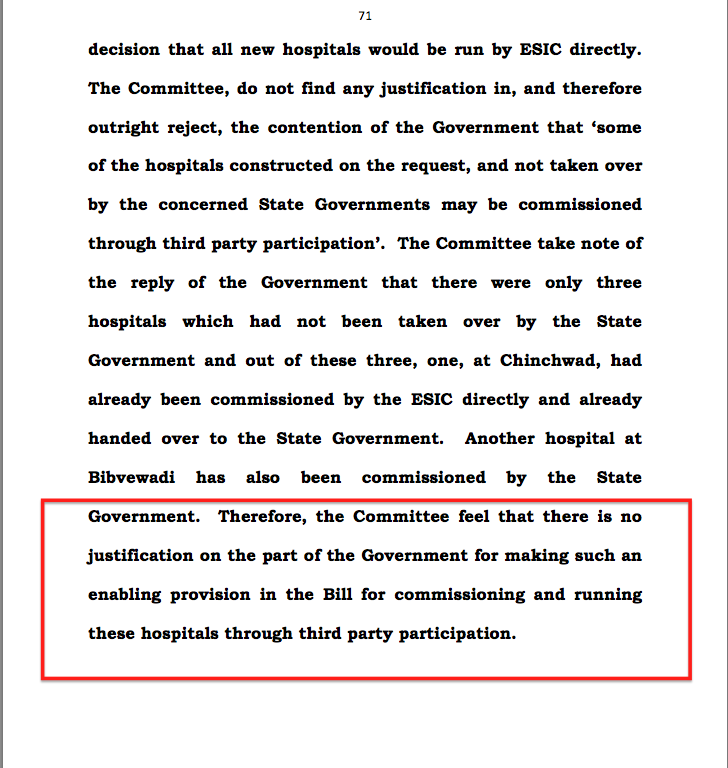
In the present case, the issue is even more serious. The Parliamentary Standing Committee on Labour examined the amendment proposed in the Bill No. 66 of 2009 to insert Sec. 59 (3) in the ESI Act to enable and empower the ESI authorities to run hospitals through third party participation. The Committee had, in Para 113 of its Report dated 09.12.2009, said, “there is no justification on the part of the Government for making such an enabling provision in the Bill for commissioning and running these hospitals through third party participation”.

Yet, the authorities placed the Bill before the Lok Sabha for approval without modifying or changing any sentence in the proposal to insert Sec. 59(3), which had been deprecated by the Standing Committee. The issue had not been taken up for discussion for two sessions. At last, on the last day of the winter session meant for Labour Department, i.e., on 03.05.2010, it was taken up, when there was pandemonium created by the opposition over the Sibu Soren issue. It was all of a sudden announced that the ESI Amendment Bill had been passed. The Minutes of the Lok Sabha proceedings show that the Bill had been read and passed, within nine minutes, amidst repeated interruptions, between 1420 and 1429 hours that day.

There was no information placed before the Hon’ble Members of Parliament, at the time of presenting the Bill, about the observations of the Parliamentary Standing Committee on Labour on that proposal to insert Sec. 59 (3) for third party participation. The Members were not made aware of the reprobation of the proposal by the Standing Committee, during the presentation of the Bill, by the Hon’ble Minister for Labour.

“The need for committees arises out of two factors – the first one being the need for vigilance on the part of the Legislature over the actions of the Executive, while the second one is that the modern Legislature these days is over-burdened with heavy volume of work with limited time at its disposal. It thus becomes impossible that every matter should be thoroughly and systematically scrutinized and considered on the floor of the House. If the work is to be done with reasonable care, some Parliamentary responsibility has to be entrusted to an agency in which the whole House has confidence. Entrusting certain functions of the House to the Committees has, therefore, become a normal practice. This has become all the more necessary, as a Committee provides the expertise on a matter which is referred to it”.

Again, as per Rule 331N of the Rules of Procedure and Conduct of Business in Lok Sabha, “The report of the Standing Committees shall have persuasive value and shall be treated as considered advice given by the Committees”.

Yet, no documents were placed before the Members to persuade them how the persuasion by the Standing Committee was not correct. No note of dissent was given by any Member of the said Standing Committee (nor by the Executive). No attempt had been made to explain the stand of the ESI Corporation that the “considered advice” of the Parliamentary Standing Committee were wrong and could be over-ruled by the Parliament. The pandemonium prevailing at that time was taken advantage and a Bill that contained the proposal to set up medical institutions, appointment of consultants by exercising sky-high powers, and other issues which were to cause far-reaching effect had been seen through.

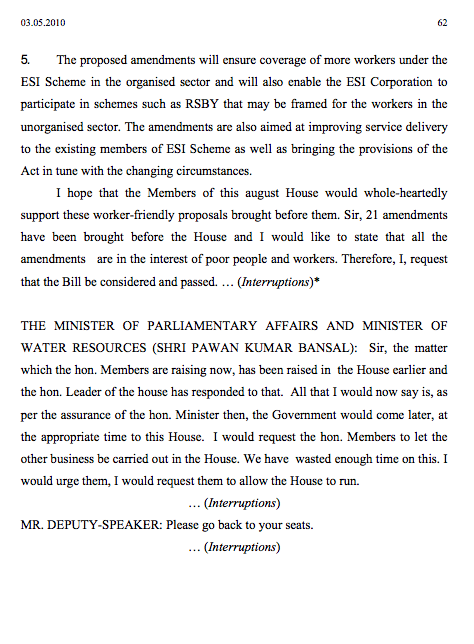
In fact, the observations of the Parliamentary Standing Committee with reference to Sec. 59 (3) had been deliberately suppressed as could be seen from Pages 60, 61 & 62 of the Hansard dated 03.05.2010 of the Lok Sabha.

Now, the authorities who do not know what to do with the many white elephants (massive structures for unwanted medical colleges and hospitals), are

(1) toying with the idea of running the ESI Medical institutions on their own;

(2) making efforts to hand them over to the State Governments of the respective Regions.

(3) thinking of handing over the medical colleges to Third Parties under (Public Private Partnership) “PPP” arrangements.

(4) considering whether they could just “divest” the property.

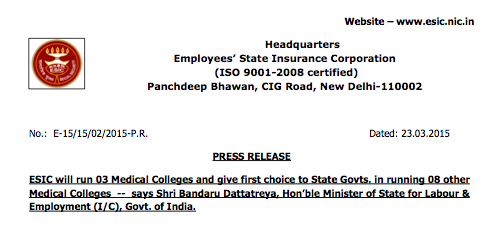
This is evident from the Press Release issued by the Hqrs. Office of the ESI Corporation in E-15/15/ 02/ 2015-P.R. dated 23.03.2015.

Excerpts:

PPP Press release 23 03 2015 Head

Extract from Page 2 of the Press Release:

PPP Press release 23 03 2015


The authorities believe that Sec. 59 (3) which had been inserted in the ESI Act, 1948 through the amendment of 2010 empowers them to think of the PPP options. The amended Sec. 59(3) is reproduced below:

Sec 59 3


But, the moot question is whether the Parliament of India consciously approved the amendment for inserting the aforesaid Sec. 59 (3) when its own Parliamentary Standing Committee on Labour had, in its report dated 09.12.2009, categorically refused to endorse the proposal for third party participation to run the ESI hospitals.

Answer:

1. While the authorities may cite only the Sec. 59 (3) and claim that it is “law” as on date, the insured persons can object to it, citing the observations of the Parliamentary Standing Committee on Labour and prove that the Legislature had been tricked on 03.05.2010 by the Executive, whose intention was only to observe the formality of getting the Bill declared by the Speaker as passed on the floor of the Lok Sabha.

2. The absence of any reason recorded by anyone to counter the argument of the Standing Committee on the proposed Sec. 59 (3) would help the insured persons to establish the fact that the Executive had not been sincere and honest in giving right and complete information to the Legislature on this issue before asking for its approval.

3. The Executive had, with mala fide intention, placed this Sec. 59(3) before the Parliament, in its original draft form, even after the Standing Committee had objected to the draft proposal. It is not the ‘end’ but the ‘means’ adopted by the Executive to make the said Sec. 59 (3) law, which makes that provision questionable and justiciable.

4. Even assuming, without admitting, that the present Sec. 59 (3) is valid, the ESI authorities cannot think of PPP in respect of medical institutions, as Sec. 59 (3) refers only to hospitals and not medical institutions. (Besides, the provision for setting up medical institutions comes later as Sec. 59-B).

5. Besides, the talk of “divesting” the property or handing them over as “gift” to the State Governments are not permissible, as the ESI Act, 1948 permits the ESI Corporation only to “accept grants, donations, gifts from the Central, or any State Government, Local authority, or any individual or body whether incorporated or not for all or any of the purposes of the ESI Act”. There is no provision to gift away the Corporation’s property.


No third party participation is possible in running the ESI Hospitals, in spite of the “managed-to-be-passed” Sec. 59 (3).

No third party participation is possible for running the ESI medical colleges, because even that Sec. 59 (3) talks only about hospitals and not about medical colleges.

It would, therefore, be just and proper, in the given circumstances, to make use of the massive infrastructure created for the medical colleges in such a manner that it brings annual revenue to the Corporation.

=====================================================

NB: The following is only for those who want to go deep into the issue:

=====================================================

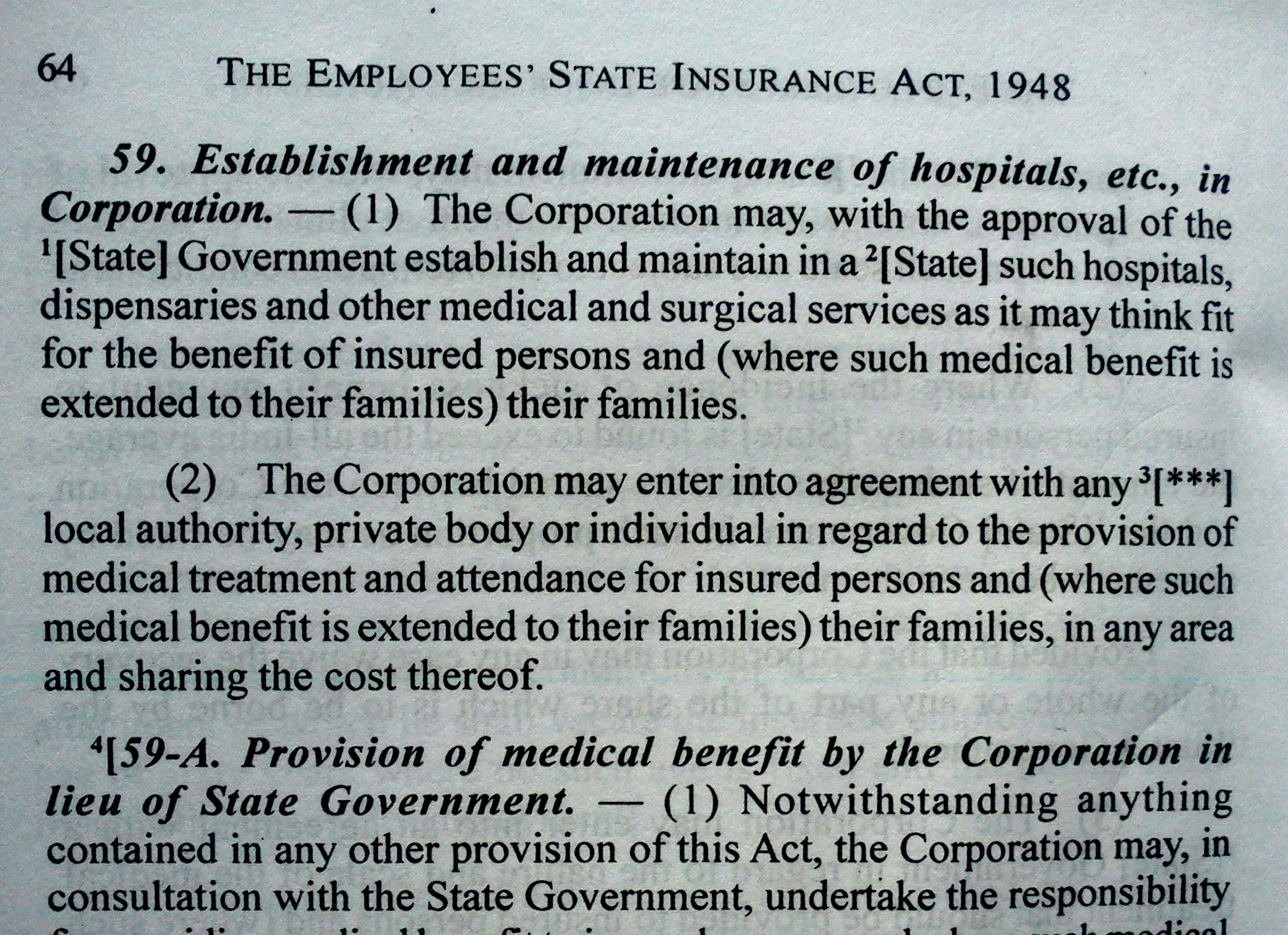
Sec. 59 of the ESI Act, as it was in the year 2008,  when the authorities took steps to amend that Section: 

DSC00204


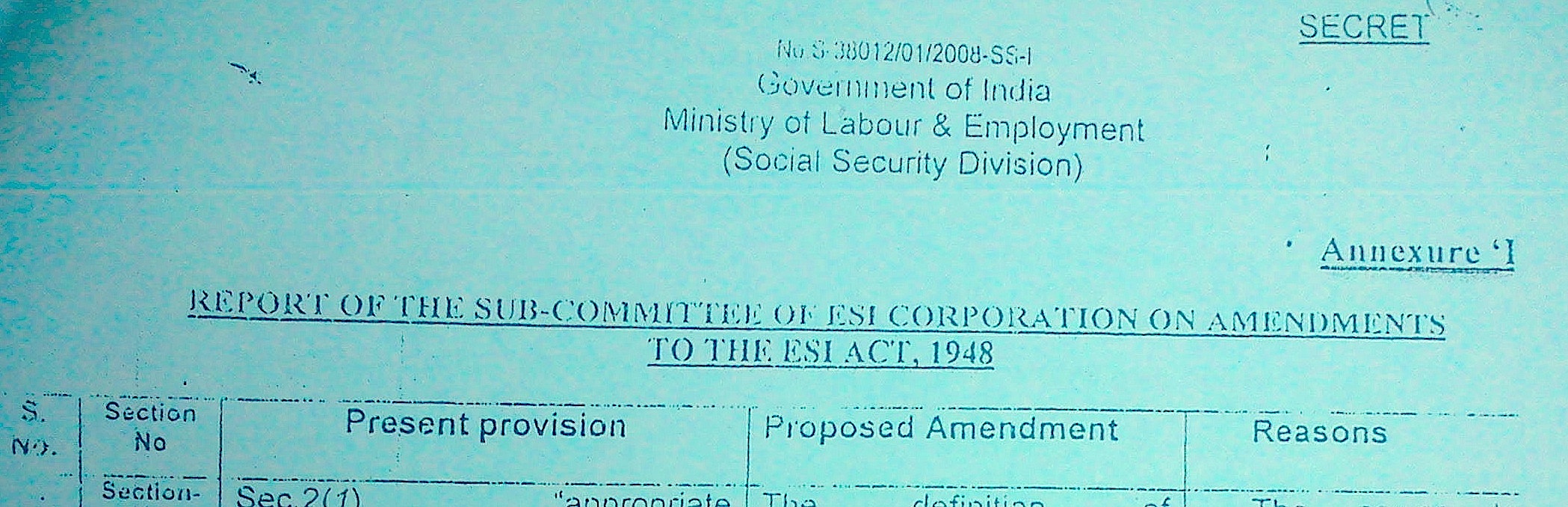
ESIC Sub-Committee’s proposal in the year 2008 to amend (i.e., by making addition to) Sec 59 (1) and Sec. 59 (2) for private participation :

DSC00205

DSC00206

DSC00207

Amendment proposed as per Clause 14 of the Bill No. 66 of 2009 to add Sec. 59 (3) to the ESI Act:

Sec 59 2 Bill Text

Report of the Parliamentary Standing Committee on Labour presented to the Lok Sabha on 09 .12. 2009 and laid in Rajya Sabha also on the same day (From pages 70 & 71):  

Para 113 page 70 PSC report


Page 71 of the PSC report


Sec. 59 (3) of the ESI Act after Amendment of 2010, in force, as on date:

Sec 59 3


Readers may please note that the text of he original Clause 14 in the Bill No. 66 of 2009 has been made to become law, without taking cognizance of the observations of the Parliamentary Standing Committee on Labour.

========================================

Now, what had actually happened in the Parliament in the nine minutes between 14.20 and 14.29 on 03.05.2010?

(One has to go through thePages from 58 to 69 of the Hansard) given in the following link:

Hansard showing how the Parliament passed the bill

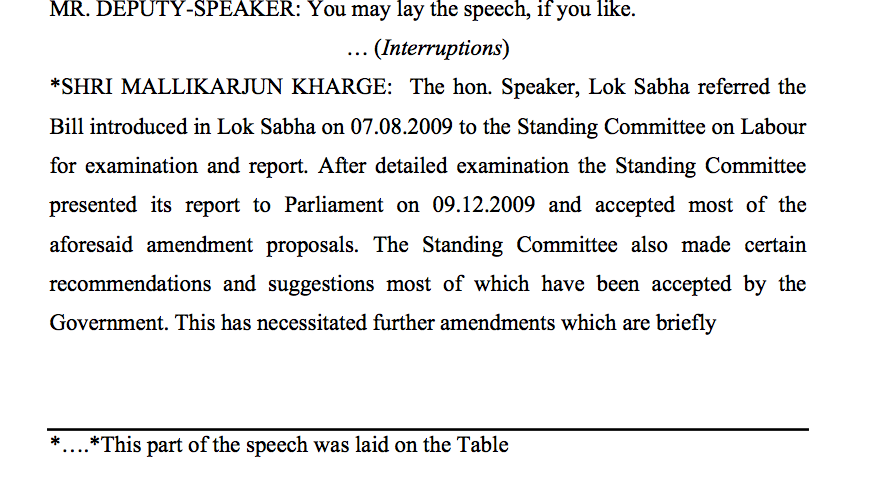
It is significant to note that the Hon’ble Minister just lays on the table, on the advice of the Hon’ble Deputy Speaker, his statement about the observations of the Parliamentary Standing Committee. This portion of his speech was not, actually, spoken in the Lok Sabha.  Even in that ‘speech’ laid by the Hon’ble Minister, which is available in Pages 60, 61 & 62 of the Hansard, there was no reference to the objection of the Parliamentary Standing Committee to Sec. 59 (3) as per Para 113 of the Report.

Labour Minister on PSC report


Parliament passes Bill Page 61


Parliament passes Bill Page 62

Can anyone say that the MPs were aware of the observations of the Parliamentary Standing Committee on the proposed Sec. 59 (3) ?

Can anyone say that they were aware of the fact that the ESI authorities did not modify the Bill, in spite of the advice of  the said Committee in Para 113 of their Report? 


Leave a comment

Filed under Amendment 2015, Amendments 2010

ESIC’s Medical College Muddle – Part 3 : Consolidated Fund Vs. ESI Fund !

Atifete 2


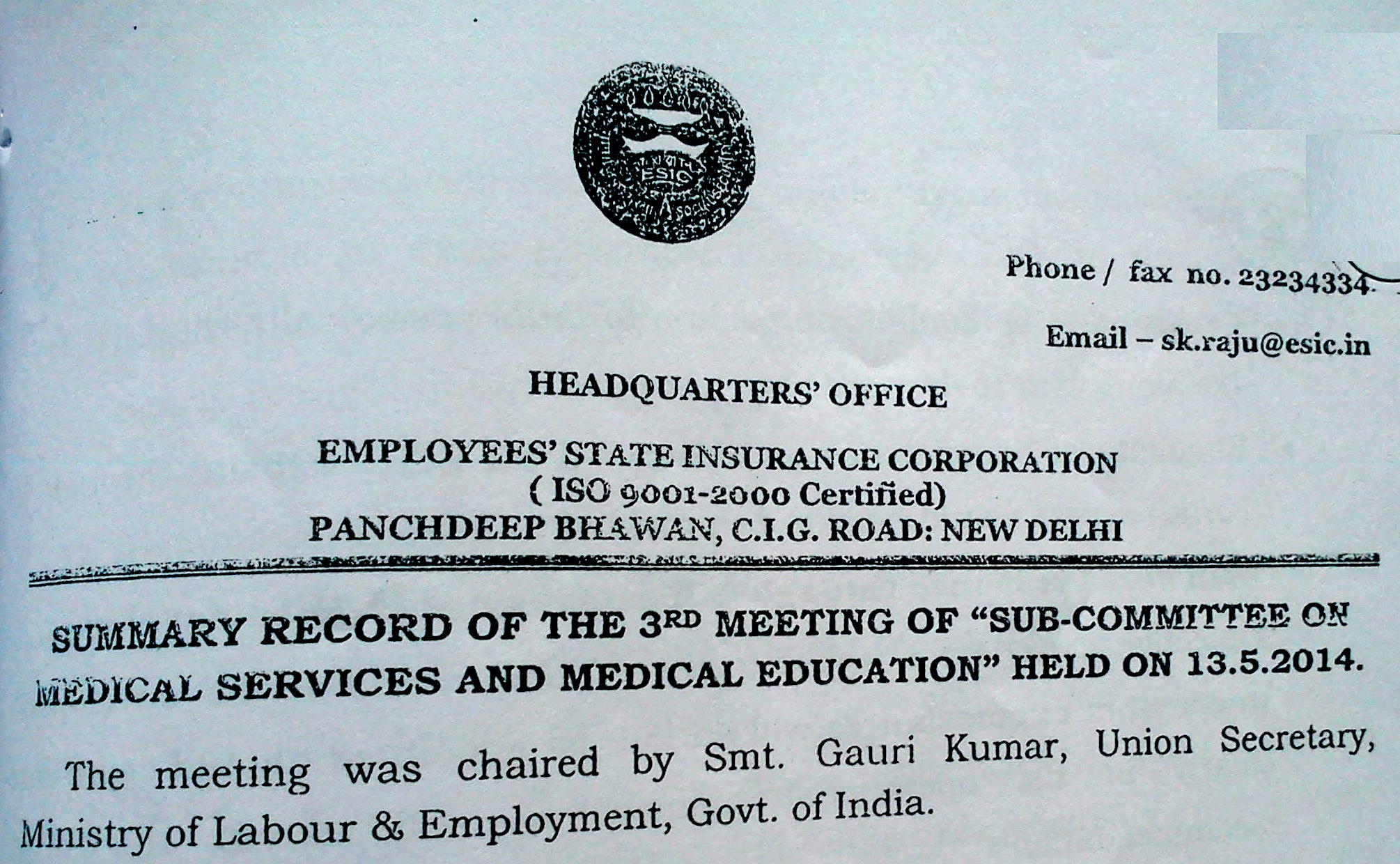
The report of the ESIC Sub-Committee on Medical Services and Medical Education dated 13.05.2014 said as under:

  1. “Setting up and running of Medical Colleges is a cost intensive proposition in respect of capital cost, recurring cost, loss of revenue, etc.,” (Para 6. g)   and
  2. “based on Current projections, the surplus funds of the ESI Corporation are likely to be negative by 2016-17”. (Para 6.h).

But, the Financial Memorandum that was part of the Bill No. 66 of 2009 placed before the Lok Sabha said, in Para 3, that “The Bill does not involve any expenditure whether recurring or non-recurring nature”.

Application under the RTI Act

One citizen, therefore, asked for the supply of the following information under the Right to Information Act, 2005:

“It has been mentioned in the Press Release dated  5.03.2014 that the ESIC was running 7 PG institutes, 4 ESIC Medical Collages, one Dental collage,  one Nursing College, and one Para Medical Institute all over the Nation. It shows that there are 14 ESIC medical institutions in all.

a. Kindly intimate the recurring expenditure incurred for running these fourteen (7+4+1+1+1) institutions  for the two financial years, i.e., for the year 2013-14 and also for the year 2014-15.

b. Kindly  intimate the anticipated recurring  expenditure (Running cost) for  running these  14 medical  Institutions  during  the year 2015-16 and also for the year 2016–17. It becomes clear from the report of the above mentioned Sub-Committee that you had already made the required calculation and assessment, for the year up to 2016-17.

c. Please also furnish following details for the year 2016 -17.

  1. Annual Income of the ESI Corporation  through contribution & other sources, as anticipated, for the year 2016 -17.
  2. Anticipated  total expenditure for the year 2016-17 including the running cost  of  all the  Medical institutions.
  3. Anticipated surplus / shortfall for the year 2016- 17.

This information can be collected easily form the particulars furnished by the Hqrs. Office of the ESI Corporation  to the above mentioned sub-committee that met on   as 13.05.2014.”

But, he has not received any reply, till date, from the CPIO of the ESIC. Why?

  • Is there anything wrong in the request of the citizen to ask for the above-narrated information?
  • Is not the supply of that information in public interest?
  • Shouldn’t the public know the truth?
  • Why are the authorities so indifferent?

Kosova adores informing the Public

World wide, even the newly formed nations like Kosova, adore freedom of the people and their right to information. But, the ESIC authorities choose to scoff at the provisions of the RTI Act, 2005. They do not care that any and every citizen has the right to know what had happened and happens in this public organisation. They do not want to provide any information. Their non-response is unlawful. Moreover, they know that, by such non-response, they are violating the Statutes. Yet, they do so, because they believe that the penal provisions would not be enforced against them.

If there is no penalty or if they can manage to escape penalty, they can violate any law, they have discerned. It was only this belief that encouraged them to consciously violate not only the provisions of the RTI Act but also many provisions of the ESI Act, specially, in the matter of setting up medical colleges in a large scale, even before the amendment came into force.

What Parliament was informed

One of the very important aspects to be kept in view, in the context, is that when the Bill No. 66 of 2009 was presented in the Lok Sabha in August 2009, the ESI authorities had already charged away more than Rs. 6000 crores for construction of medical colleges. They were, therefore, desperate to get the amendment passed by Lok Sabha somehow. The had ventured to mislead the Parliamentary Standing Committee on Labour also only because of such desperation. They did not want the Parliament to know the exact amount to be spent by the ESI Corporation to set up and run the medical institutions.  So, they chose to misinform the Parliament that there would be no recurring or non-recurring expenditure to set up the medical institutions. The Ministry of Finance also colluded with them and added the following sentence to the Financial Memorandum placed before the Lok Sabha along with the Bill: “The Bill does not involve any expenditure whether recurring or non-recurring nature”. 

Consolidated Fund of India Vs. Public Fund of the ESIC

The ESI Fund is, actually, a Public Fund although it is not part of the Consolidated Fund of India.The Annual Report of the ESI Corporation is placed before the Parliament for its scrutiny and approval every year, as per Sec. 36 of the ESI Act.

36. Budget, audited accounts and the annual report to be placed before Parliament. — The annual report, the audited accounts of the Corporation, together with the report of the Comptroller and Auditor-General of India thereon and the comments of the Corporation on such report under section 34 and the budget as finally adopted by the Corporation shall be placed before Parliament.

This Section makes it very clear that the Parliament is very earnestly concerned about the manner in which the officials of this autonomous body generate  the public funds and utilise them.

The Parliament is concerned about the financial position of the ESIC and has (a) the authority, (b) the right and (c ) the duty to feel so concerned.

The authorities of the ESIC or the authorities in the Ministry of Finance cannot, therefore, contend that the information they provided in the Bill was only about the Consolidated Fund of India and not about the Public Fund generated by the ESI Corporation.

Pulling wool over the Parliament’s eyes

Such an attempt would show that they chose to play clever with the Parliament, while attempting to get the Parliament’s nod for setting up medical colleges, to cover up their desperation to get such a nod, as they had already spent thousands of crores of rupees to construct buildings for medical colleges.

These authorities cannot take the stand that they were not required to inform the Parliament about the financial requirement of the ESIC to run such medical colleges and how they were going to meet it.

But, what actually happened was that the authorities of the Ministry of Finance had helped the authorities of the ESIC to effectively mislead and prevent the Parliament from knowing the financial requirement of the ESIC to run the medical colleges.

The result is that the Sub-Committee headed by the Secretary of the Ministry Labour in which the Director General and the Financial Commissioner of the ESIC were members, which analysed the impact of these ESIC run medical institutions found that the surplus would likely be in the negative by 2016-17, based on the current projections.

  • What would have happened had the Parliament been informed of the details of recurring and non-recurring expenditure from the ESI Fund?
  • Was such a calculation ever made, before the Bill was tabled in the Parliament, or, at least, before it became part of the Act?
  • What would have happened had, at least, the Parliamentary Standing Committee on Labour asked or been informed of the details of recurring and non-recurring expenditure from the ESI Fund?
  • What is the reason the ESIC authorities go to the extent of defying law so brazenly to deny information to the public?

Leave a comment

Filed under Amendment 2015

Dog-feed expenses: Wages u/s 2 (22) !


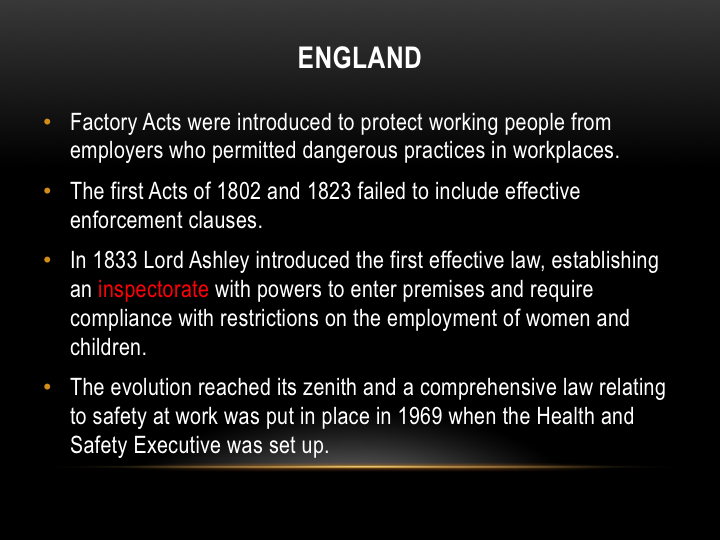
The ESI Act was enacted only with the objective of providing a variety of benefits to the working population. The provisions for inspection mentioned in the statute are, therefore, not contradictory to this objective but only to ensure and further that objective. The perception that the inspection procedure in the ESI Act is intended to harass the employers is not correct and has been orchestrated by vested interests with ulterior motive. One may recall that when the Government of the UK had brought in many labour reforms through the Factories Act 1802 (also called the “Health and Morals of Apprentices Act”, which regulated factory conditions, especially in regard to child workers in cotton and woollen mills), provisions were made to impose fine between £2 to £25 on the factory owners for violation of law. But, the Act did not yield the desired results, as it failed to include any provision for supervision to make sure the law was being followed. It was in the year 1833 that the concept of inspection was born and the sufferings of the workmen at the hands of greedy employers came to be preventable.

Slide1

But, in India, the importance of inspection is diluted again and again for the past seven years in the ESIC. Adding to the misery of the workforce is  the amendments in other labour laws and dilution in their implementation, All these have practically converted the entire labour force of India  into Slave Labour. The latest dilution in inspection of the factories and establishments, in the guise of mechanisation and centralisation, results in the sufferings of the honest and innocent workmen as the employers have come to know that they would not, in practice, face any penal action for non-payment of contribution on all items of ‘wages’ in respect of all ‘employees’. The drastic reduction in revenue that flows in, on its own, through Sec. 39 & 40 of the Act is a clear indicator of this fact. India is virtually sliding backwards to the pre-1833 era of the UK.

It is a fact that large number of employers try to avoid paying contribution in respect of “all” (as mandated by Sec. 38) the persons employed by them for wages. They resort to various methods of manipulations of their records to conceal the “employment of persons’ and “payment of wages”.

Such concealed employment can be detected only through proper inspection including Ledger Verification in a thorough manner. A simple visit by the Inspector or his going around the factory cannot help detecting such cases.

 You get only what you inspect.

Proper and in-depth inspections alone can ensure that all the coverable employees have been covered without being left out, and that contributions are paid on their behalf on all items of wages. Simply expecting that the employers would pay contribution on all items on which it is payable, just because there is a law to that effect would not work.”You don’t get what you expect. You get only what you inspect”. This is what the IAS officers are taught too.

Besides, when contribution is not paid on all items of wages, the benefits payable becomes only be a pittance and would not help sustenance of the family of the insured persons during the periods of sickness, maternity, etc.,

Sec. 45 (1) and (2) are there in the ESI Act is, therefore, intended to safeguard the benefit provisions and they are there in the Statute to protect the interest of the employees. (For more on the need for inspections: https://flourishingesic.info/2012/11/22/esic-inspection-procedure-and-its-impact-on-society/)

Voucher Verification

The most essential component of inspection is “voucher verification”. The inspectors (SSOs) of the ESIC and the officers who conduct test inspections are specially trained on this aspect, so that they can detect concealed employment and omitted wages. “The books of accounts would not be of much use without the vouchers, records, papers, etc., on the basis of which such books have been prepared” (Circular dated 27.06.1961 of the Department of Company Affairs).

Any expenditure without proper voucher is to be frowned upon. Instances are numerous when wages were hidden in a voucher pertaining to different kind of expenditure. Likewise, many employees were paid through a voucher created in the name of a single person. The inspector, therefore, goes through vouchers with adequate care and caution.

But, in the peculiar circumstances of our society, there are many instances where genuine expenditure on certain other items are booked in the ledger, without there being any supporting voucher. Such expenditure does not, actually, represent the wages paid by the employer to his employees. What should the inspecting authorities do, then? Can they treat all such voucher-less expenditure, automatically, as wages and claim contribution from the employer? Do they have discretion to ignore such vouchers in toto? Where, then, is the line that differentiates genuine or arbitrary exercise of such power of discretion?

A case of huge expenditure without vouchers

There was a hotel of repute in a prime locality in a city. A minimum of five thousand customers visit the hotel every day to take food. The inspecting authority of the ESIC was pouring through the ledger and vouchers. He found that a large chunk of money accounted for as expenditure in the ledger under a head of account without any voucher for any day. The amount was too huge to ignore. The head of the account was ‘Purchase of Vegetables’. An inspecting authority is not there just to report the expenditure to the Regional Office and believe that he has done his work. He must, being the man on the spot, make genuine efforts to collect all the relevant documents and evidences and arrive at his findings and report the details to the Regional Office for decision. What did he do, in this case?

The employer explained that as a caterer he had to buy vegetables from various vendors, both retail and wholesale, in the market early in the morning at about 3.00 am, every day, depending upon the price and quality. No vegetable vendor would give receipts for the transactions. Not every vegetable vendor is running his trade in an organised form. So, obtaining vouchers from vegetable vendors is simply impossible, practically, he said. And, what he said was true, the inspecting authority knew.

He, therefore, verified the expenditure incurred by the hotelier for purchase of Rice, Wheat, Rava and Maida. He prepared a chart comparing the total expenditure incurred for purchase of these items with the expenditure incurred for the purchase of vegetables. He went through the ledgers once again to ensure that the expenditure for purchase of vegetables had not been booked under any other head of account. He arrived at the fact the expenditure shown under the head ‘Purchase of Vegetables’ had been incurred only for purchase of vegetables although it was not supported by vouchers. He reported all these facts along with his findings that the expenditure on purchase of vegetables was not wages, although the expenditure every year on that count was very huge. His report was examined in depth at the Regional Office and the Regional Director accepted his findings. (Even if the Regional Director had differed, he cannot blame the inspecting authority for his findings. Because, the inspecting authority had given not only his findings / opinion but also all the relevant facts on which he based his opinion and had left the decision to the Regional Office. If the Inspecting authority had reported only the quantum of expenditure as per the ledger figure, he would have been guilty of non-exercise of the power vested in him and transferring his work to the Regional Office. If he had reported only his opinion that said item of expenditure was not wages, he would have made his position vulnerable, in the event of the higher authority taking a different stand. In this case, the inspecting authority had given a speaking and convincing report, the contents of which proved that the inspection had, really, been purposeful.)

Another case of huge but sporadic expenditure

There was an inspector of the ESIC, who was known among employers of the area for his sincerity, honesty and pleasing manners. (It is appropriate to mention in the context the fact that the employers do always collect information about the nature and disposition of the inspecting authorities of various departments, whenever a new incumbent assumes charge in their area). This inspector of the ESIC was conducting regular inspection of the factory of an employer who was employing around 40 employees in his factory, situated in a semi-urban area with a sufficiently large lawn and backyard with many trees all around.   The inspecting authority, while verifying the ledger, came across a head of account titled ‘Dog-feed Expenses’. He thought that the entries of expenditure under that head of account showed the cost of food and, possibly, other maintenance charges to rear the dogs in the premises of the factory. But, he found some peculiarity in the pattern of expenditure. The expenditure had not been incurred every month in a uniform pattern. There was some expenditure in a month. There was no expenditure at all next month. There was huge expenditure in the subsequent month. The inspector was puzzled.

He, therefore, asked for the vouchers. But, the clerk of the employer did not produce them. The inspector insisted on the production of those vouchers. Yet, no voucher was produced and no explanation offered. The inspector, therefore, completed the inspection otherwise and, then, wanted to meet the employer. It was around 3.00 pm, when he was ushered in to meet the employer. The inspector conveyed his findings to him. The employer was listening and was agreeing with him about the defects pointed out by the inspector.

The inspector, then, asked the employer about the expenditure shown as ‘Dog-feed expenses’. The employer said that it was not wages. But, he expressed his inability to produce vouchers for that expenditure. He was also not able to explain how and why the expenditure was sporadic and not uniform every month, if the amount was spent to feed the dogs.

The employer maintained silence. The inspector said that, because of the non-production of vouchers in spite of specific demand, all the items of expenditure under that head of account, could be presumed to be wages and contribution claimed on those omitted wages. The employer thought over for some time and said that he would pay contribution on those omitted wages. He was, still, not ready to explain what that expenditure was. The inspector said that he might have to pay interest and damages too on that expenditure. The employer said that he knew that.

The inspector recorded these facts and issued Visit Note and wound up the inspection. He did not receive the ‘cover’ repeatedly attempted to be given to him by the clerk of the employer, during the course of the day and at the time of leaving the factory. The employer was impressed as he had already heard of the reputation of that inspector. He, therefore, volunteered to walk along with the inspector to the front gate to see him off. The inspector could not see any dog anywhere in the factory precincts and asked the employer about it. The majestic-looking turbaned employer put his hand on the shoulders of the inspector, hugged him and replied, softly, with a smile, that the expenditure booked under that head of account was not the money spent to feed the real dogs. It represented the amount demanded by and paid to the officers of various departments as bribe and to the political parties as donations. That was the reason for the sporadicity of the expenditure, he said. Both of them burst into laughter.

The employer, then, asked the inspector to keep the information confidential and said that he was revealing it only to him, in appreciation of the commitment of the inspector to remain honest by choice.

If only all the employers follow suit ……

1 Comment

Filed under Benefits, For Trainees, Inspections

ESI coverage: Extension, to On-site Construction Workers !

It is reported that “the labour ministry will soon extend its medical coverage benefits to on-site construction workers, a step in the direction to provide social security to a huge section of the unorganised workers”.

Read more at:
http://economictimes.indiatimes.com/articleshow/48123354.cms?utm_source=contentofinterest&utm_medium=text&utm_campaign=cppst

Extending the ESI security-net wider is appreciable indeed.

But, when the Government itself agrees that the On-site construction workers are unorganised workers, it must move forward cautiously. It must keep in view the points discussed during the numerous tripartite talks in the Seventies, Eighties and Nineties. The records in this regard must be available in the Hqrs. Summary of those facts had been recorded in the Annual Standard Notes also upto the year 2000.

It must ensure proper actuarial calculations, especially when the ESIC does not have its own Actuary with the real knowledge about the working of the organisation. It is very essential.

ESI Act is essentially for organised workforce, in spite of the term “otherwise” in Sec. 1 (4). Payment of contributions, submission of returns, reporting accidents and many other formalities would show that the scheme is employer-centric. Yet, the ESIC could not extend the scheme to construction sector because of many practical considerations. That, precisely, was the reason for so many tripartite talks for decades.

So, if necessary, a separate structure may be evolved the way it was done in the later nineties for cashew workers of Kerala. The scheme was, ultimately, discontinued by the ESIC. The documents that show why that scheme meant for cashew workers had been dispensed with may also be gone through, in the present context.

Thereafter, let the authorities have some pilot projects regarding extension of ESI Coverage to the construction workers, experimented in one or two regions, one in the North (Rajastan)  and another in the East(Bengal)  or South(Andhra Pradesh). Let the experience gained be analysed before embarking on coverage nationwide. That will be a prudent, essential and reasonable precaution.

Formulate a system in such a way that it does not allow malingering and false claims.

The experience of the ESIC in respect of the TDB in Bihar and Gujarat must be taken into account with the seriousness it deserves.That will guide the authorities before venturing into the extension of the scheme to construction workers throughout the nation at the initial stage itself. Already, many construction agencies, undertaking Turn-key projects are abusing even the existing provisions, by covering the on-site construction workers, on the sly. The impact of such wrong coverage and the intention behind such voluntary coverage by the construction agencies must be studied with open mind and the facts that emerge out of such study must be accepted, before moving forward with such coverage.

Prof Adharkar, the visionary, has rightly said that when a scheme is proposed it must be workable in the “peculiar circumstances of Indian labour and industry”. Sage words !

Slide2

Already, inadequate knowledge coupled with over-enthusiasm on the part of the people who count has played havoc with the system in certain areas. The Medical College matter is one such case where the authorities do not know what to do next. Let not this proposal to extend the provisions to the on-site construction workers also result in chaos and meet the same fate.

ESIC is not only meant for providing benefits to the deserving insured population. ESIC is also the custodian of funds contributed by honest workforce who believe that the funds would be used rightly, to provide benefits to the really needy. They believe that because the ESIC is a public organisation, it wold take every care to ensure that the funds are not misused by  dishonest employers and employees in connivance with greedy consultants and covetous  bureaucrats.

Proposed scheme must be on practical lines and there must be proper, effective and unambiguous checks and balances. Nebulous law and procedure for settling the claims of such on-site construction workers would result in honest officers and staff shying away from handling the subject.


Leave a comment

Filed under Benefits, For Trainees, Inspections

ESIC’s Medical College Muddle – Part 2

Synopsis: Is there a grand design behind the desperate action of the ESI authorities to facilitate a political bigwig to take over ESIC properties as running medical colleges? Why are they hell-bent on continuing with the medical colleges when they know that their financial position would nose dive very seriously in the year 2016-17, if they continue to run them? Why are the ESIC authorities moving the Supreme Court and High Court New Delhi so desperately to get the required certificate from the Medical Council of India which did not certify the fitness of these colleges for the year 2015-16?  Are the ESIC authorities going to protect the property of the Indian labour force or are they playing active role in the conspiracy? Do the authorities have any right to keep people in the dark, by not answering legally valid questions? The article is intended to find answers. 

=======================================================

The ESI Corporation started establishing medical colleges and are running them from the year 2010 onwards in (1) K.K. Nagar, Chennai, Tamilnadu, (2) Rajaji Nagar, Bengaluru, Karnataka (3) Joka, Kolkata, West Bengal, (4), Gulbarga, Karnataka and (5) Dental College, Rohini, Delhi. It was later realised by the ESIC, in the year 2014,  that it had ‘no core competency to run medical colleges’. A Sub-Committee was, therefore, constituted to examine the issues involved. The Secretary of the Ministry of Labour & Employment, Government of India had been the Chairman of that Sub-Committee on Medical Services and Medical Education. The Director General of the ESI Corporation had been one of the Members along with the Financial Commissioner of the ESI Corporation.  And, that Committee had given report on 13.05.2014 stating, among many, that based on current projections, the budget of the ESIC would likely be negative in the year 2016-17.

DSC00193


DSC00015


DSC00016

The authorities had, therefore, informed the Hon’ble Prime Minister, in a meeting held on 05.07.2014, that “since the ESI Corporation did not have the core competency to run medical colleges, they may be handed over to relevant agencies with capability and mandate to run medical colleges”.

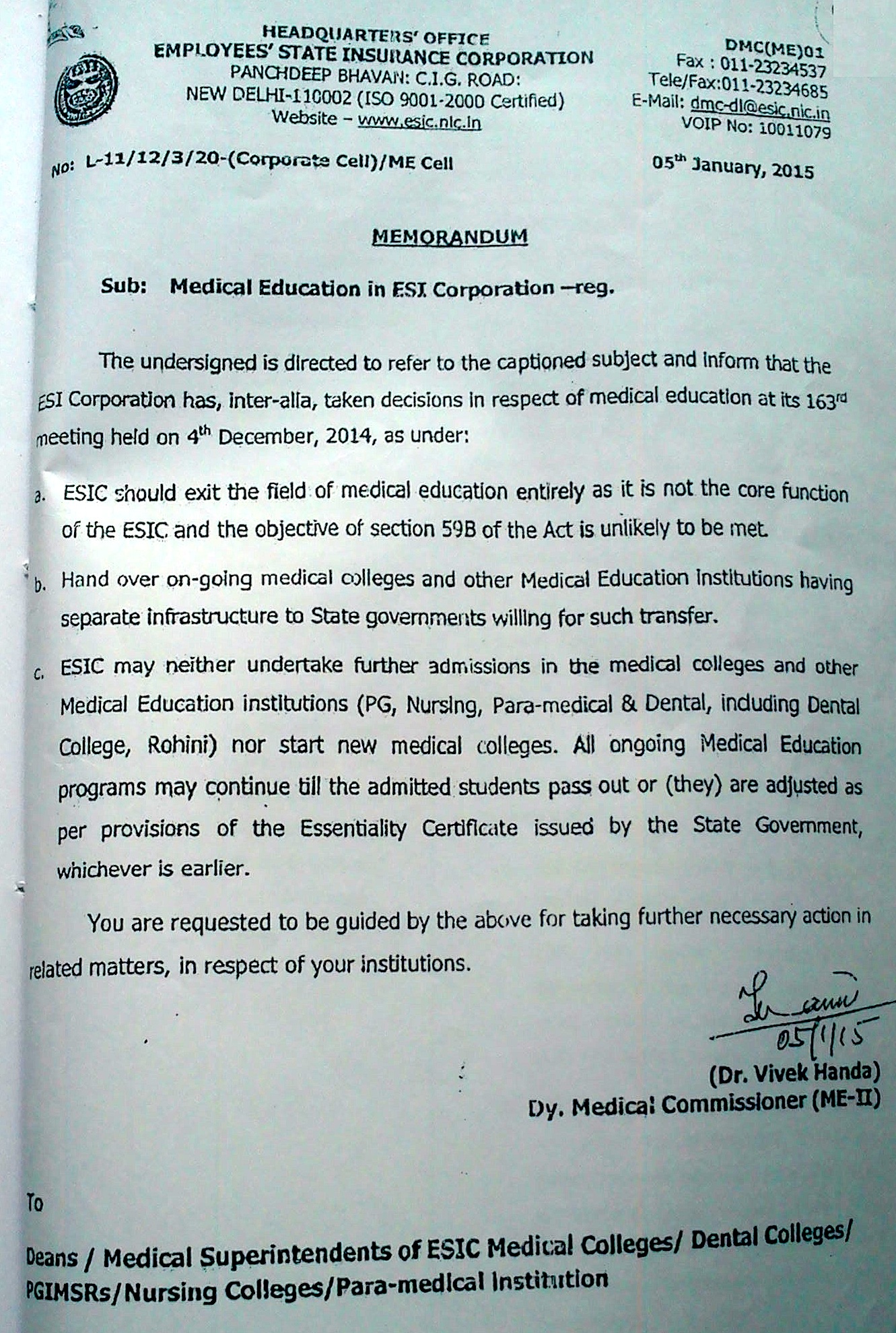
The Apex decision-making body, the ESI Corporation had, thereafter, taken a formal decision, on 04.12.2014, that the “ESIC should exit the field of medical education entirely” as that was “not the core function of the organization”, as could be seen from the Memo dated 05.01.2015 of the ESIC.

The ESIC had also decided to ease itself out of the situation in a phased manner by running the colleges only for the purpose of enabling the already-admitted students to continue and complete their studies or to close all the colleges, at once, by apportioning the admitted students among other medical institutions.

The ESIC had also decided not to undertake further admissions. It has been specified in the aforesaid Memo dated 05.01.2015 that the “ESIC may neither undertake further admissions in the medical colleges and other Medical Education Institutes (PG, Nursing, Para-medical & Dental including Dental College Rohini) nor start new medical colleges”.

Memo dated 05.01.2015

Memo dated 05.01.2015

They decided, rightly, to quit “earlier”

The memo revealed that the ESI Corporation had, as an Apex Body, taken a considered decision to quit medical education and to close down the medical institutions in a phased manner or to close them down immediately by apportioning the existing students among other medical colleges of the respective state governments, “whichever is earlier”.

While this was the decision taken, rightly, by the Apex body on 04.12.2014 and communicated on 05.01.2015, the ESIC authorities had, in their subsequent Memo. dated 18.03.2015, communicated a diametrically opposite administrative decision (and that too, without placing that issue before the aforesaid Apex Body) to admit students for MBBS/BDS/PG courses in all the aforesaid four institutions for the year 2015-16.

Memo dated 18.03.2015

Memo dated 18.03.2015

When the ESIC had confessed earlier, in categorical and clear terms, that it did not have the core competency to run the medical colleges and that running medical colleges was not its core activity, it cannot, later, take an arbitrary and unjustified decision to admit students for one more batch and aggravate, thereby, the problems of both the organization and the prospective students.

Rumours galore

The contents of the Memo dated 18.03.2015 were really puzzling. And, rumours were afloat,  that the reason for the decision communicated by the ESI authorities on 18.03.2015 to reverse the earlier decision dated 05.01.2015 was to facilitate handing over the four medical colleges at the four metros with the entire infrastructure to some, already-identified-political-bigwig, at a later date, as a running institution. The rumour gained credibility as the decision communicated on 18.03.2015 had been taken without recording convincing reasons anywhere to prove how the issues raised by the Sub-Committee were wrong or, at least, surmountable. Was it not the duty of the bureaucrats to record reason rebutting all the points raised by the Sub-Committee that led to the decision to quit medical education?

The relevant questions of a citizen

A citizen had, therefore, decided to ascertain for himself the facts relevant to the issue. He wanted to know whether the ESIC, which had taken decision to admit students for the next year would continue to run the medical colleges “forever” or would hand over those colleges, at a later date, to  someone through some arrangements, as the authorities have already been demonstrating considerable enthusiasm (over-enthusiasm, in fact) in PPP very often.

He, therefore, sent an application under Sec. 6 of the Right to Information Act on 19.05.2015 (which had been delivered to the CPIO on 25.05.2015), seeking the following information:

  1.  Kindly intimate whether it has been recorded anywhere in the records of the Hqrs. Office of the ESI Corporation that these five institutions would continue to be run by the ESI Corporation forever.
  2. Kindly intimate whether any analysis of the financial implications in running these five institutions for another, at least, five or six years (until the students who join complete the courses) had been made on the file before issuing the instruction in the above-mentioned Memo dated 18.03.2015.
  3. Kindly intimate whether the concurrence of the Financial Commissioner of the ESI Corporation had been obtained on file for such calculations regarding the running cost.
  4. Kindly intimate whether the ESIC will, again, express its inability to run the medical institutions and try to hand over these five institutions to anybody, at a later date.

Silence of the CPIO 

But, the CPIO of the Headquarters Office of the ESI Corporation maintains total silence and does not respond to the application. He is violating the provisions of law, in the belief that the penal provisions of the RTI Act would not be enforced.

But, the public has the right to draw adverse inference when a public authority does not discharge his legal duty to respond and maintains total silence.

“Information is Power”, said Robin Morgan. But, the Indian bureaucrats believe that “Suppression of information means more Power”.

But, their unlawful non-response lends credence to the rumours that they are abetting the process of handing over the four important structures in the four metros at Delhi, Bengaluru, Chennai and Kolkata, really, to the private bigwig at a not-so-distant future, as running institutions.

=============================================

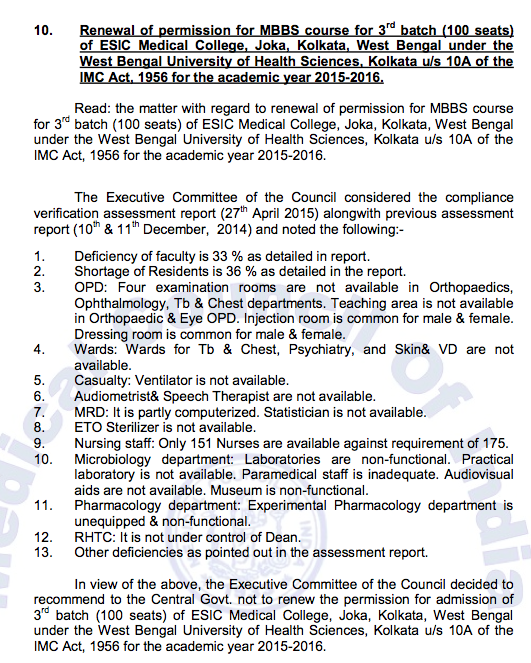
NB: The Medical Council of India denied permission to the ESIC to admit students in the ESIC run medical institutions at Kolkata (Joka), Chennai (K.K. Nagar), Bengaluru (Rajaji Nagar)  and Gulbarga (Kalaburagi).

Karnataka Colleges:

http://www.thehindu.com/news/national/karnataka/no-mci-nod-yet-for-seven-medical-colleges/article7360040.ece

Chennai College:

http://www.thehindu.com/news/cities/chennai/esic-medical-college-denied-permission-to-admit-students/article7380951.ece

Kolkata College: 

MCI report on Joka ESIC Medical College.

MCI report on Joka ESIC Medical College.

The  latest news is that the ESIC authorities have gone to Supreme Court and then to the High Court of New Delhi seeking direction to the Medical Council of India to reconsider its earlier decision not to recommend issuing Letter of Permission to run the ESIC Medical Colleges. Why are the authorities so desperate to run the ESIC medical colleges in spite of clear cut red-signals seen by them ahead? Why are they so desperate to consciously go the wrong way, which, they are aware, is wrong?

Is this desperation of the ESIC authorities in the interest of the insured persons?

1 Comment

Filed under Amendment 2015

ESIC’s Medical College Muddle – Part 1

“Rulers in autocracies create and apply the legal norms governing the social order from above without any participation by the individuals who are subject to them. Whereas democracies, in so far as they allow the greatest possible number of persons to be subject to rules of their own making, approximate a legal order structured around individual autonomy

– Kelsen.

The preamble of the Right to Information Act, 2005 clarifies that the purpose of the Act is to “promote transparency and accountability in the working of every public authority”.

The website of the Government of India, http://www.righttoinformation.gov.in says, “The basic object of the Right to Information Act is to empower the citizens,promote transparency and accountability in the working of the Government,contain corruption, and make our democracy work for the people in real sense.It goes without saying that an informed citizen is better equipped to keep necessary vigil on the instruments of governance and make the government more accountable to the governed”.

But, the CPIO of the Headquarters Office of the ESI Corporation maintains total silence and does not respond to many applications sent for seeking various essential details pertaining to the ESIC’s medical college issue. Law permits drawing adverse inference when the public authority does not discharge his legal duty to respond but maintains total silence.

Excerpts from an unanswered application sent by a citizen of India on 19.05.2015 which had been delivered to the CPIO on 25.05.2015 are given below:

===========

Sir,

1. The Indian public have been informed through the ESIC’s Press Release dated 07.04.2015 that the ESI Corporation had, in its meeting dated 07.04.2015, discussed regarding the provision of “option” to employees/insured persons to choose either ESIC benefits or Health insurances products recognized by IRDA. It has been mentioned in the said press release that “It was felt that if workers have an option it is likely to bring in competition, leading to improvement in service by ESIC ”.

2. I, therefore, request you to kindly supply the following information to me under sec.6 of RTI act 2005.

a. Kindly intimate whether any intensive and extensive study was conducted by any committee of experts who examined the benefits provided under the ESIC act to the employees/insured persons with reference to the benefits alleged to be available to those who are covered under the medical benefit scheme by the IRDA- recognized health insurance providers.

b. If so, please furnish the details of the names of the Chairman and Members of the concerned committee of experts.

c. Please intimate the date on which the said committee had submitted its report to Director General of ESI Corporation.

d. Kindly intimate whether the said committee of experts examined only the medical benefits provided uder the ESI Scheme vis-s-vis the medical benefits provided by the IRDA recognized health insurance providers or whether the cash benefits provided under the ESI Scheme also.

e. It has been mentioned in the said Press Release dated 07.04.2015 that it was “felt” that if the workers had option it will lead to improvement in services. Please intimate, with reference to the record, who “felt” so.

f. Kindly intimate whether the Verbatim Minutes of the ESI Corporation Meeting held on 07.04.2015 is kept, to enable the insured population and the members of the public to ascertain whether any member of the ESI Corporation “felt” so only during the meeting.

===

Leave a comment

Filed under Amendment 2015