Monthly Archives: September 2012

Enigmatic Amendment 2011 that affects the Benefits

There was, all of a sudden, an amendment, which came into force from 01.07.2011, stating that it was intended to simplify the term ‘average daily wages’ mentioned  in Rule 2 (1) (1-A) of the ESI (Central) Rules, 1950.  The definition in this sub-rule is meant for regulating the rates of various Benefits provided under the Act while the definition in in sub-rule 1-B is for deciding coverage.

The need for such simplification, after the vigorous efforts to computerize all works of the Branch Offices is not clear. But, the fact is that that amendment has reduced the rates of benefits which were available to the insured population up to 30.06.2011.

After 01.07.2011,

  1. the employees receiving wages at the lower level like Rs. 5000 or Rs. 8000 etc., p.m. get less amount when they seek two benefits, Sickness and Maternity;
  2. the employees in higher income group get less amount of benefit only for Maternity;
  3. but, all of them get more benefits for Disablement.

Natural justice demands that no amendment should result in reduction of benefits, unless such reduction is actually contemplated and discussed openly before making such amendment.

Can there be reduction of benefits through indirect amendments without making the public aware of it through categorical proclamations, beforehand?

How can the bar under Sec. 61 of the ESI Act be justified, hereafter?

Readers are welcome to share their enlightened opinions!

Please Click on the small Presentation on Amendment that affects Benefits

3 Comments

Filed under Amendments 2010, Benefits, Powerpoints

ESI Act – Statement of Objects and Reasons – 1951

The ESI Act, 1948 was amended first in 1951 even before the scheme was actually implemented first. Chaper V A was, mainly, introduced along with other amendments. The ESI Act (Amendment) Bill No. 24 of 1951 was introduced in Parliament on 19.3.1951. The Amended Act was notified in the Gazette of India Part II Section 2 dated 31.3.1951 in Pages from141 to 144.

1 Comment

Filed under For Trainees

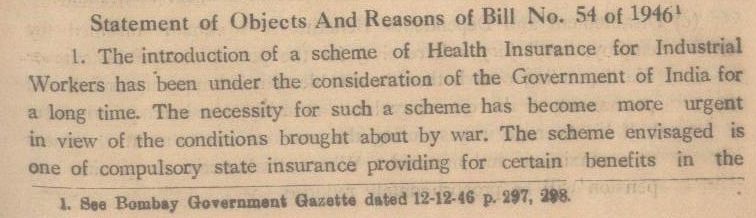
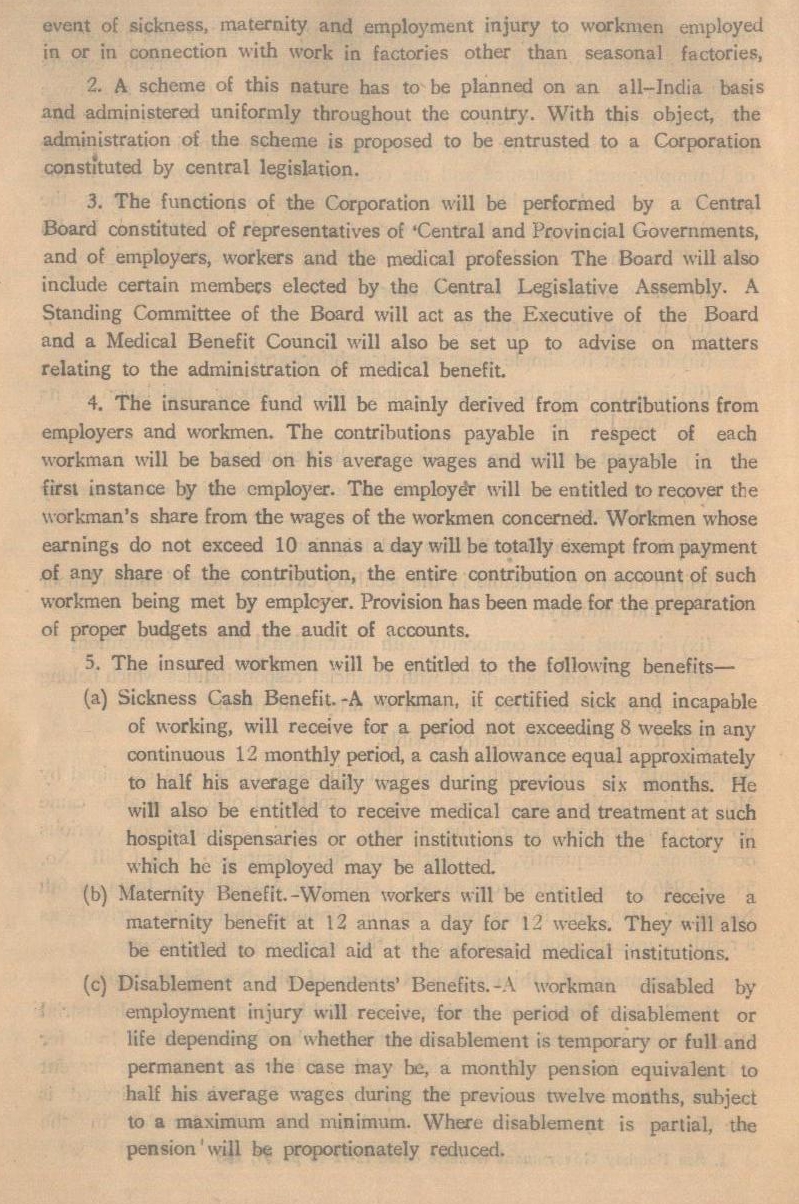
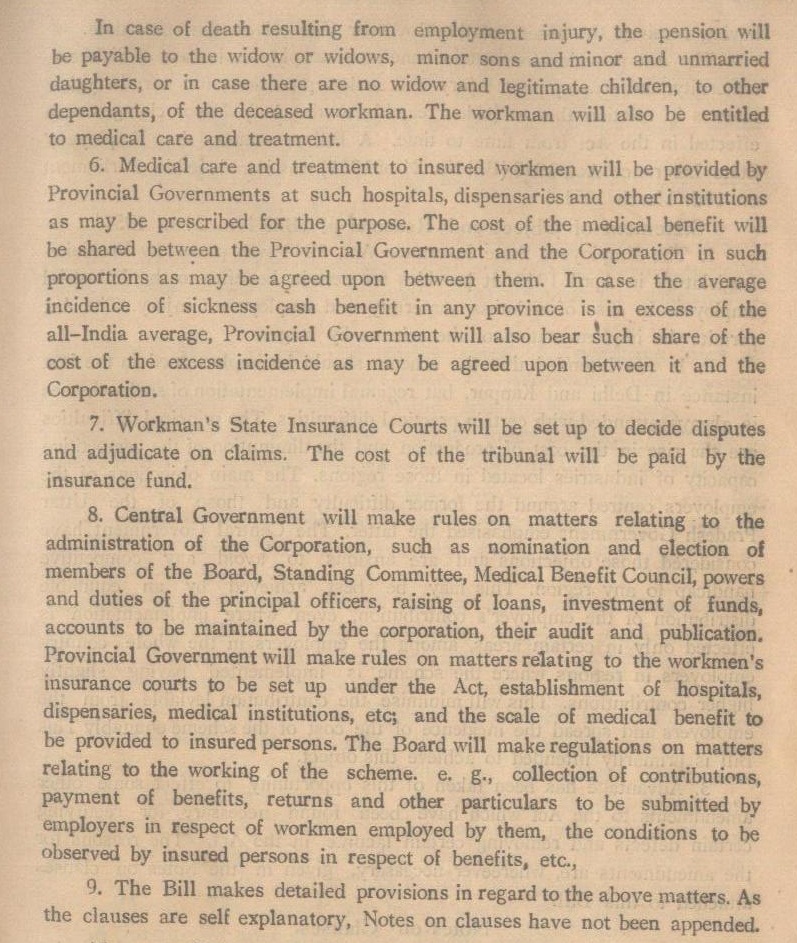
ESI Act – Statement of Objects and Reasons – 1946

The original Statement of Objects and Reasons that everyone is searching for happened to be available in a very old publication. The details of publishers could not be ascertained. The relevant pages containing only the contents of the Gazetted public document are posted here in public interest. The youngsters in the ESIC,  may find it useful.

We thank the publisher. There does not seem to be any subsequent publication by the publisher concerned. If there had been any such publication, the necessity of this Post would not have arisen.

Page 1:

Page 2:

Page 3:

The Bill was placed before the Central Legislative Assembly, as the Dominion Legislature was called at that time, for discussion. It was referred, thereafter, to the Select  Committee. The Select Committee had given its  report vide Gazette of India Part V of 1948 Pages 124 to 159.
The Act was passed by the Legislature on 19.4.1948.
The Governor General had also given his assent on 19.4.1948.

3 Comments

Filed under For Trainees

No time to read! So, ESIC got Medical Colleges.

“Why did the Congress bring the proceedings of the Lok Sabha to a stand-still for seven days over the issue of ….?” asks and justifies Ms. Girija Vyas in her article in http://www.congresssandesh.com/apr_issue/viewpoint1.html

That was when BJP was in power. Now a days, we see how BJP is also doing even more vigorously what the Congress was doing earlier.

Where is, then, the time for the MPs to read, study, understand, analyse and take a considered stand over the Bills placed before the House of the People for approval? Naturally, they do not have time.

The important Bills are just taken as read on the last day of the Session or simply ignored and taken to the next session. If people whose vote alone is essential for the Bills to become Law choose to remain indifferent or ignorant of the intricacies of the Bills and their votes are taken for granted on the last day of every session, with or without their being aware of it, who else can discuss the impact of a Bill?

Will there be any law to make all such Bills public and enable the Public to offer their opinion on the Lok Sabha website so that the points of view expressed therein are analysed on record and a report placed before the Lok Sabha so that the Members will be free from reading the Bills and will be free to stall the House.

Some solution, we have to find.

One such instance that shows what happened in the Lok Sabha  on 03.05.2010, when the Members did not have time to discuss the Bill because of the practice of stalling the proceedings of the House,  is analysed in the Powerpoint Presentation given hereunder. Please click on the links:

Presentation on Medical Colleges

Appendix I – Parliamentary Standing Committee report on Amendment Bill 2009

Appendix II – Parliament passed the bill

Readers are welcome to correct the mistakes, if any,or offer their viewpoints!

4 Comments

Filed under Amendments 2010, Powerpoints