It is always a matter of joy to be powerful. It is more so when one could appropriate the power of some other organisation and use it as per one’s whims and fancies. The Middle Management of the ESIC Hqrs. Office is abusing its position and power to divide the employees and play fvourites by setting one against the other and cultivate the lobbying culture. It is a fun, as long as it does not happen to that Middle Management by the acts of Higher Management.
In government offices, objective and neutral management of service matters is a fundamental ethical principle of public administration. Upholding this standard is essential for maintaining fairness, public trust, and effective governance. But who cares? If an officer feels that he can manipulate things in such a way that he would not be made accountable for his commissions and omissions, he can do anything in violation of law and enjoy his own ability to manipulate.
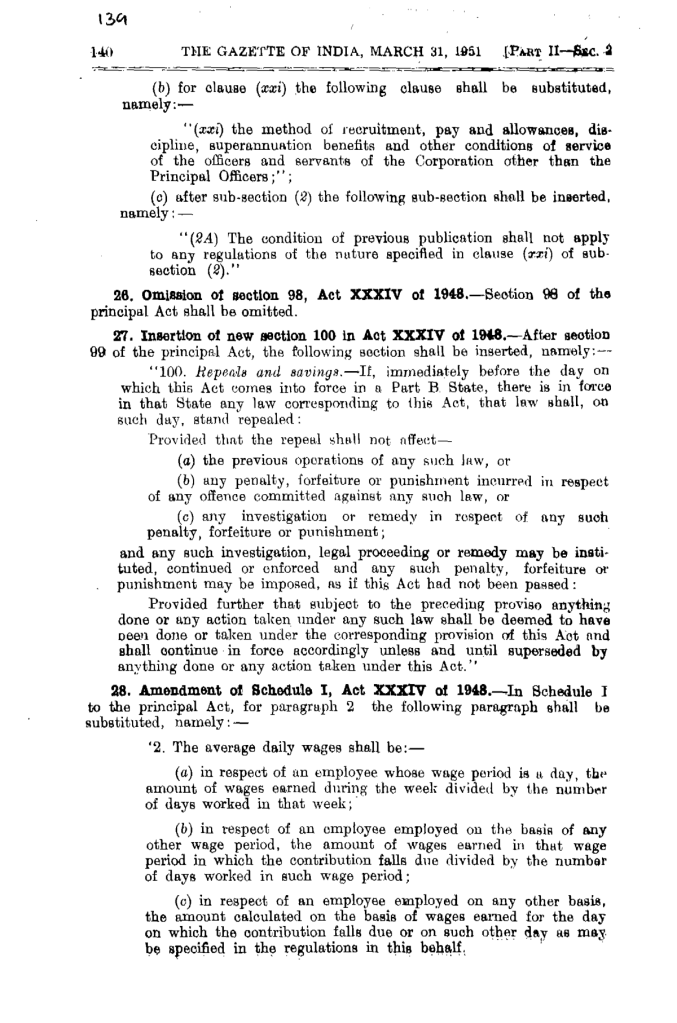
What is Sec. 97 (2A) for? .
What was the need for inserting Sec. 97 (2A) in year 1951 when Sec 97(3) had already been there in the Act, like Sec. 95(3) and Sec.,96 (2) ?
What was the need for the exemption from notification in the gazette?
How can the power of the UPSC be exercised by the ESIC, after the UPSC has communicated its concurrence to take over the power of recruitment?
Without going deep into those details by putting forth our narratives, we place before the readers the copies of the relevant documents to enable the reader to arrive at his own conclusions. Any query from the readers would be answered in the same thread. The following portions of the documents may be gone into, to ascertain the facts for oneself:
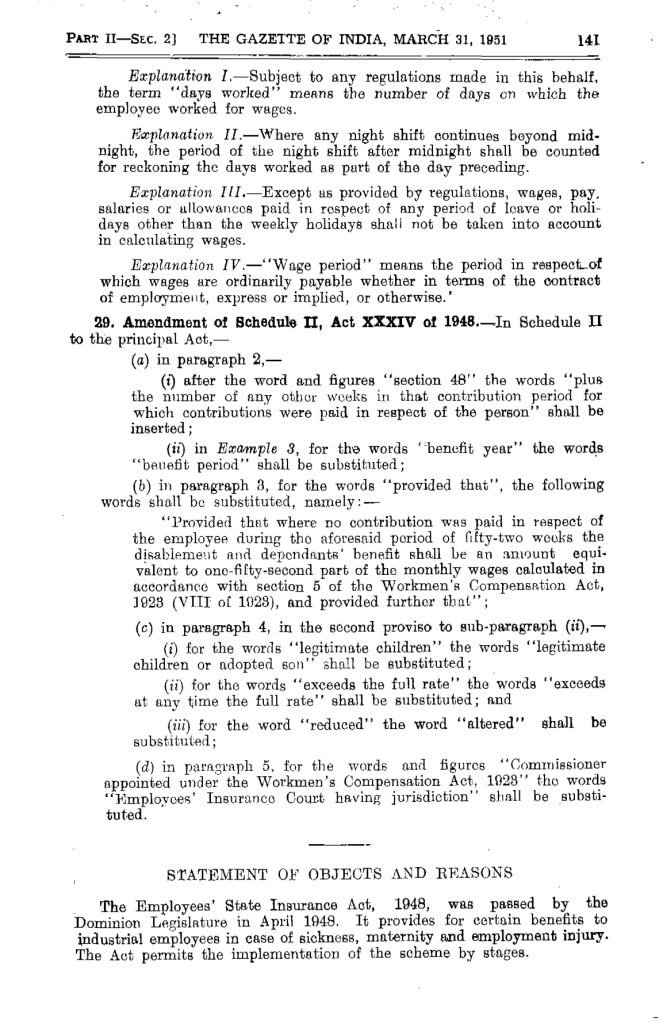
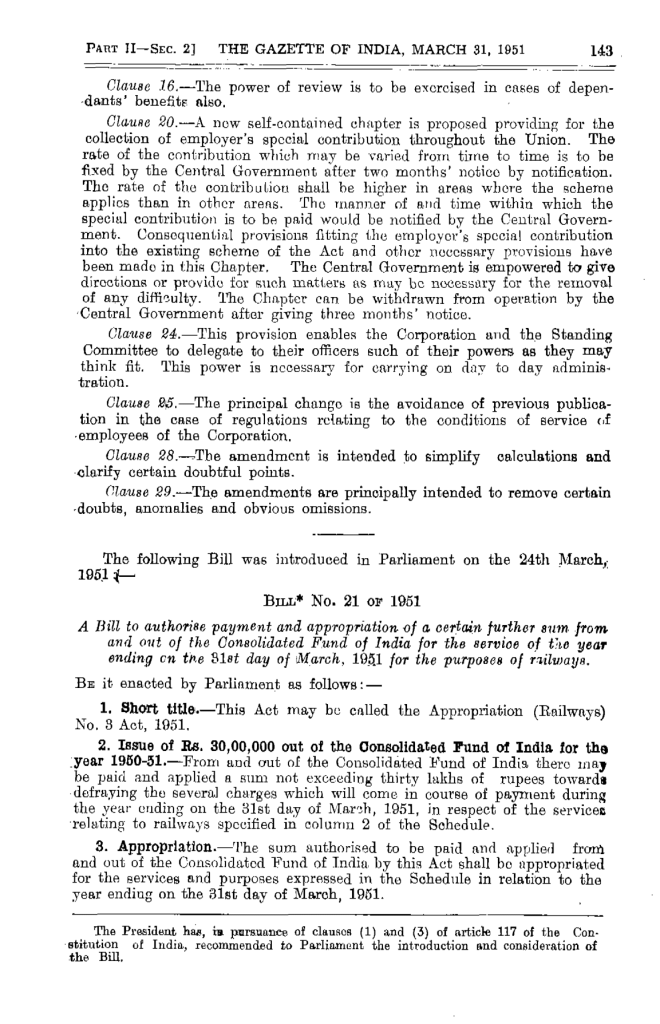
a. Clause 25 of the ESI Act (Amendment) Bill No. 24 of 1951 (published in Pages 139 & 140 of the Gazette on 31.03.1951)
b. Statement of Objects and Reasons.
c. “Notes on Clauses” published thereunder in Page 143 in respect of the same Clause 25,
Suffice it to quote here, what Mr Jagjivan Ram, the then Labour Minister of India in 1951 had, on 19.03.1951, said before he Parliament of India while explaining the need for inserting Sec. 97 (2A) along with other amendments, at the time of tabling the ESI (Amendment) Act, 1951, in Para 3 of his Statement of Objects and Reasons:
“Advantage has been taken of this opportunity to effect some other amendments to the Act which have been found necessary for rectifying certain defects and removing certain lacuna, in the Act. The reasons for the amendments are, wherever necessary, given in the Notes on Clauses attached to this Bill.”
The Bill passed by the Parliament of India got the assent of the President of India on 06.10.2021.
Hope, at least, the public opinion may prevent the middle management of the Hqrs. Office of the ESIC from indulging in further violation of law on the matters in which Sec. 97 (2A) play a vital role.
Sec. 97 (2A) comes into force the day on which the Chairman gives his assent to the resolution passed by the Corporation.
And, where, the UPSC has a role to play, Sec. 97 (2A) comes into force on the day on which the concurrence of the UPSC (to the resolution already assented to by the Chairman, ESIC) is received by the Hqrs. Office. That is the earliest available date to the ESIC to enforce the same. And that cannot be postponed by the officials of the ESIC, who want to wield the powers vested in the UPSC, at the behest of the ESIC which sent the proposal to the UPSC after examining all the issues involved.
Hope law will be allowed to prevail on this matter, at least, hereafter!
Robert Reich, former Secretary of Labour during the period from 1993 to 1997 in the cabinet of President Bill Clinton, writes:
“A recent report found that the for-profit US healthcare system ranks last among peer nations. We spend twice as much per capita on healthcare and have the worst health outcomes. Since 2010, profits of top health insurers have hit a collective $371 billion. At least $120 billion was funneled shareholders.Meanwhile, half of US adults say they can’t afford an unexpected $500 medical expense. We do not have to keep living like this.”
It is necessary that the officials who deal with the provisions of Sec. 17 of the ESI Act, 1948 (as amended), keep in view the sea change that was effected in the year 1989 in the administrative matters of the ESI Corporation after the crucial amendment made in the year 1989 to Sec. 17 (2) of the ESI Act, 1948, through Act 29 of 1989.
2. Sec. 17 (2) as was obtaining up to October 1989 is given below:
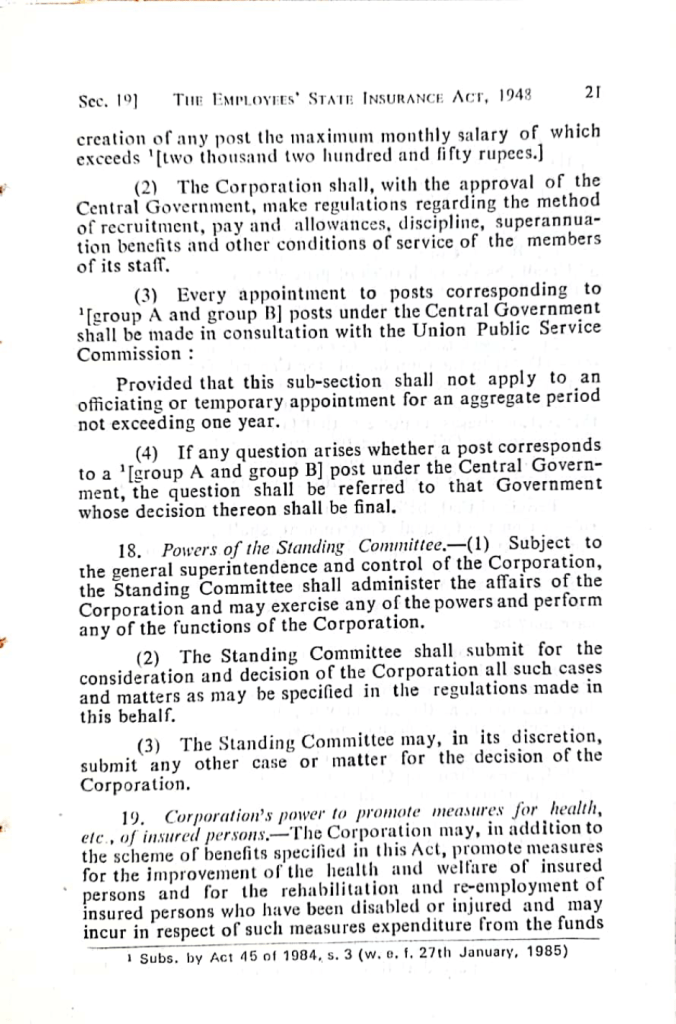
“(2) The Corporation shall, with the approval of the Central Government, make regulations regarding the method of recruitment, pay and allowances, discipline, superannuation benefits and other conditions of service of the members of its staff.”
This Sec. 17 (2) of the ESI Act, as was in force up to October 1989, enabled and empowered the Corporation to frame independent Recruitment Regulations regarding (a) the method of recruitment, (b) pay and allowances, (c) disciplinary rules, (d) superannuation benefits and (e) other conditions of service, of the members of its staff, as the Corporation deemed fit, subject only to the condition that it had to obtain the prior approval of the Central Government for enforcing those regulations.
3. The ‘method of recruitment’ included ‘Promotion’ too, as could be seen from the Recruitment Rules/Regulations of various posts in every Central Government organisation.
4. As the Corporation could decide on its own formula for recruitment and pay and allowances, as empowered by the wordings in the then existing Sec. 17 (2), quoted supra, there emerged the lobbying culture of the employees of the ESIC through their Union. And the management yielded too.
5. The employees of the ESI Corporation were, consequently, getting many facilities, including enhanced HRA, which was 5% more than what was being given to the Central Government employees. They were getting impressive leave encashment facility of 30 days every year, without actually going on leave, which was not given to the Central Government employees then. It was called as a “facility”.
6. And they kept on demanding more. There was a constant and consistent pressure for an independent pay structure to the employees of the ESIC, like those obtaining then in the LIC and the banking sector. All such demands could be raised by them, then, only because of the then existing Sec. 17 (2) which did not, literally, put any cap on the benefits payable. What was required as per the then prevailing Sec. 17 (2), was that “the approval of the Central Government”, was required to be obtained, only whin Regulations are made, like the Recruitment Regulations, ESIC (Staff & Conditions of Service)Regulations, etc., No such approval was insisted for extending every single service benefit that is extended to the Central Government servants, when they fall within the major head called Regulations.
7. As a result, the management of the ESIC had to go through a separate motion of considering and formally adopting the instructions of the DoPT and the DoP&PW, whenever new orders on service matters were issued by those departments and some service benefits extended to the Central Government employees. That procedure was followed even when Pay Commission’s recommendations were implemented, although the ESIC employees were not permitted to represent before the Pay Commissions.
8. It is worth noting to quote at this juncture that there was a high-power committee set up in the early 1960s under the Chairmanship of the then Central Labour Commissioner and its report was made available in the form of a book. That Committee had considered the nature of qualification required for various posts in the ESIC, duties, responsibilities of various posts and compared them with various posts in the Central Government Departments to decide the corresponding category of posts in the ESIC. That Committee had, significantly arrived at the decision that the post of Insurance Inspector in the ESIC was carrying more responsibilities than the post of Income Tax Inspectors, CBI Inspectors and Excise Inspectors. That was true. And the report of that Committee had been cited in the case filed by the then ESIC Officers Association in the later 1990s before the Hon’ble Central Administrative Tribunal at Jabalpur, when the then Director (Administration) caused an amendment to the Recruitment Regulations of the Insurance Inspectors and reduced the stature of that post.(These details must be available in the relevant case file of the Hqrs. Office or can be ascertained from the Hon’ble CAT, Jabalpur, if the copies of the pleadings are obtained.) Until then, the ESI Insurance Inspectors were drawing pay on a scale higher than those of the CBI Inspectors, Income Tax Inspectors and Excise Inspectors. It happened that a CBI Inspector applied to ESIC, passed the examination and become Insurance Inspector in the ESIC.
9. That comparison apart, when the earlier Sec. 17 (2) mentioned supra was prevailing up to 1989, as a matter of practice, whenever some benefits were extended by the Central Government to its employees, the ESIC management would take a decision, on record, whether it would or would not extend those benefits to its employees, or whether it would extend the same benefits or increase or decrease those benefits. And that process was called, in the official parlance within the organisation, as the process of ‘adoption’ of central government’s orders.
10. The management soon found that that leeway given in the Act to modify the benefits posed a lot of administrative problems to the Secretary of the MoLE, as he had to balance the interests of the employees of the ESI Corporation and his own employees in the Ministry, who were grudgingly watching the ongoings in the ESIC. The officers and the employee of the MoLE were, on many occasions, trying to undermine the autonomous nature of the ESIC, a Central Autonomous Body and a Statutory Body. (Note: There are many Central Autonomous Bodies which are not Statutory Bodies).
11. When the ESIC employees’ union got recognition as Trade Union, things became worse for the Management. The demands from the employees union in the Corporation became never-ending. The Director Generals of the ESI Corporation thought it necessary to put a stop to such unending demands from the unions. They worked on it and brought in an amendment through Act 29 of 1989. The amended provisions of Sec. 17 (2), which were brought into force in October 1989 read as under:
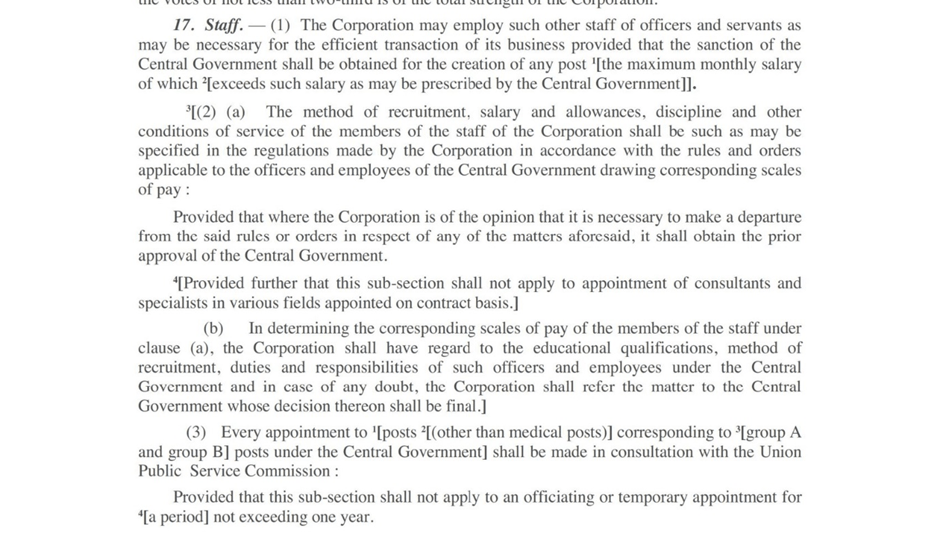
“(2) (a) The method of recruitment, salary and allowances, discipline and other conditions of service of the members of the staff of the Corporation shall be such as may be specified in the regulations made by the Corporation in accordance with the rules and orders applicable to the officers and employees of the Central Government drawing corresponding scales of pay:
Provided that where the Corporation is of the opinion that it is necessary to make a departure from the said rules or orders in respect of any of the matters aforesaid, it shall obtain the prior approval of the Central Government.
(b) In determining the corresponding scales of pay of the members of the staff under clause (a), the Corporation shall have regard to the educational qualifications, method of recruitment, duties and responsibilities of such officers and employees under the Central Government and in case of any doubt, the Corporation shall refer the matter to the Central Government whose decision thereon shall be final.”
This amended provision ensured that the employees of the ESI Corporation would get only what their counterparts in the corresponding category in the Central Government would get and nothing more and nothing less. That was a cap invented by them, introduced through the Amendment and enforced from October 1989 onwards. With that the process of Adoption became unnecessary and was stopped, because Sec. 17 (2) of the ESI Act mandated that the employees of the ESIC, a Statutory Body, would be entitled to get all that is granted to the central government servants of the corresponding category.
12. These amended provisions provided a categorical and clear parameter for comparison and contrast, whenever the ESIC Management wanted to take decision on the method of recruitment (including promotion) of his employees and their pay and allowances and conditions of service. Many a benefit given earlier were put an end to, as they were not given to the employees of the corresponding category in the Central Government. Whenever new orders were issued by the DoPT or the DoP&PW, the decision-making-process became easier for the Administration Branch which had just to compare the issues pertaining to the employees of the ESI Corporation with the employees of the “corresponding” category under the Central Government and decide to go by what the Central Government was providing to the corresponding category. How to decide that “corresponding” category had also been provided in the amended and newly inserted Sec. 17 (2) (b), given supra.
13. The MoLE need not, therefore, entertain any doubt about the applicability of the DoP&PW, O.M. dated 17.02.2020 and 03.03.2023 to the employees of the ESI Corporation.The aforesaid amendment to Sec. 17(2) gave the positive assurance to the employees of the ESI Corporation that they would get whatever the employees of the corresponding category in the Central Government would get. It did not, however, restrain the Management of the ESIC from paying more or less but imposed a pre-condition that if it wanted to make a departure and pay more or pay less or to deviate from a certain mode of recruitment followed in the Central Government for the employees with ‘corresponding scales of pay’, it should obtain prior approval of the Central Government for it, as mandated in the proviso to Sec. 17 (2) (a). This is the law in force as on date. And that cannot be an arbitrary decision.
14. In regard to the medical personnel in the ESI Corporation, the Ministry of Health had made the medical posts in the ESI Corporation also as part of the CHS, as per the CHS Rules, 1963. There had later been the famous Tikku Committee report and documents enabling the medical officers in the ESIC also to get the same benefits as given to the medical officers of the Central Government.
15. Hon’ble Supreme Court had, while examining a different issue, recorded in its order dated 21.11.2013, in ESIC Medical Officers’ Association Vs. ESI Corporation (SLP (C) No. 35821 of 2013), the fact that “The Corporation in the year 1974 set up its own ESIC Medical Centre and under its regulations, the medical doctors recruited in the said medical centre were entitled to the same pay and allowances as admissible to medical doctors in the Central Government Health Services.” (Para 6).
16. The service benefits of the engineers in the ESIC are with reference to the corresponding category of engineers in the CPWD, although the ESIC does not have all the grades of engineers as the CPWD does. This is in accordance with Sec. 17 (2) (a) and Sec. Sec. 17 (2) (b) of the ESI Act amended in 1989.
17. The service benefits of the Hindi Officers in the ESIC are regulated in accordance with those available in the Department of Official Language under the Central Government. This is in accordance with Sec. 17 (2) (a) and Sec. Sec. 17 (2) (b) of the ESI Act amended in 1989.
18. The service benefits of the stenographer hierarchy are regulated in accordance with those available in the CSSS, the Central Secretariat Stenographers Service, although there is no Principal Staff Officer or the Senior Principal Private Secretary in the ESI Corporation, while there are officers of that grade under CSSS. This is in accordance with Sec. 17 (2) (a) and Sec. Sec. 17 (2) (b) of the ESI Act amended in 1989.
19. The service benefits of the Public Relations Officer in the ESI Corporation are being given on par with the officials of the corresponding category in the Indian Information Service in the PIB, although there is only one officer in the cadre of PRO in the ESI Corporation. This is in accordance with Sec. 17 (2) (a) and Sec. Sec. 17 (2) (b) of the ESI Act amended in 1989.
20. The argument of the MoLE regarding ‘adoption’ of government orders, selectively, became irrelevant, after October 1989.
21. The ESIC Management which extended to the medical officers of the ESI Corporation, the allowances like Annual Allowance and Post Graduate Allowance, as could be seen from his letter No. A-28/12/1/2009-Med.IV (Pay & All.) dated 25.05.2018 on par with the provisions of the CHS can convince the MoLE that the employees of the ESIC are entitled to the benefits of the DoP&PW, O.M. dated 17.02.2020 and 03.03.2023, automatically.
22. The essential fact was that that Bill for that amendment of the Parent Act in 1989 had been introduced by the Ministry of Labour in the Parliament, then, only after obtaining the required financial concurrence from the Ministry of Finance, as could be seen from the Financial Memorandum placed along with the Bill concerned.
The issue in this sad case is not about the permission not granted to that girl to Work From Home, but the failure of the State to ensure the availability of Social Security Benefit for adequate length during the period of confinement.
Every Indian is guilty in having allowed this kind of degeneration set in our public life.
The least theUnion of India, Ministry of Labour, can do, as a first step, to avoid recurrence of such incidents is to throw the cruel Code of Social Security, 2020 into dustbin, which is the only place it deserves.
The next thing is to enhance the limit for coverage under the ESI Act, 1948, keeping in view the historical facts recorded in the thread, given below:
Sir Hamilton Freer-Smith’s Committee set up by the Government of the UK had given its report on labour reforms and factory law. Subsequently, Indian Factory Labour Commission was set up under the Presidentship of W.T. Morrison of which T. M. Nair was also a member. That committee had to examine the suggestions of the Freer-Smith’s Committee too.
Courtesy: M. Anees Chrishti
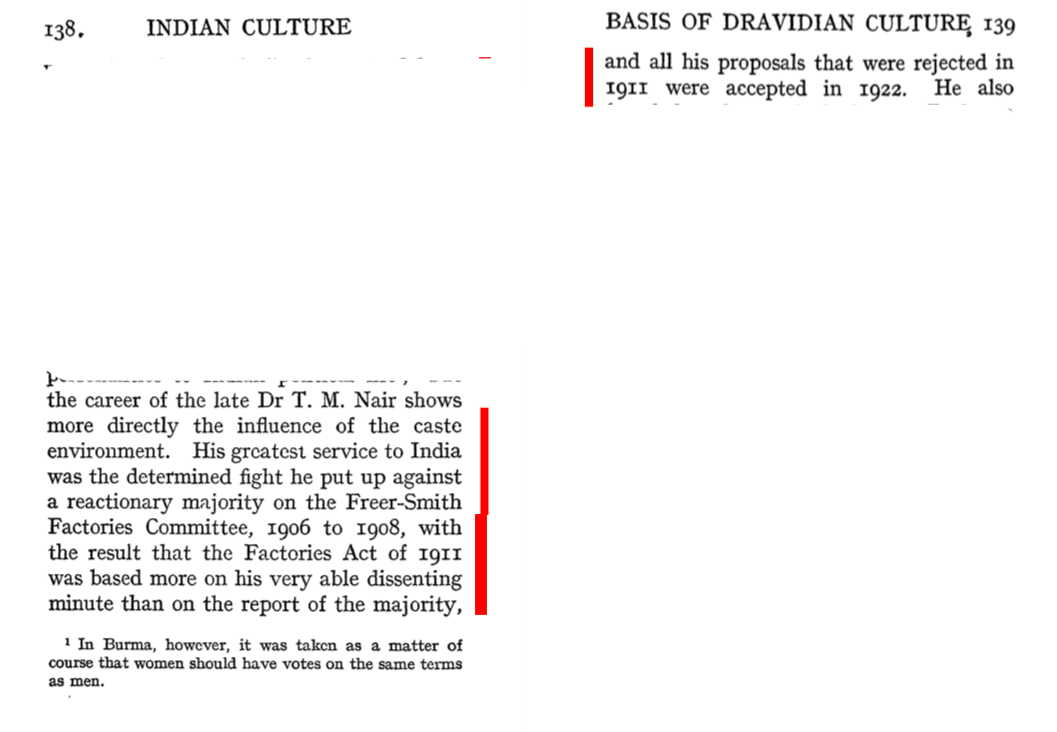
T. M. Nair had given his Dissent Note when the Report had been given by the Committee to the Government of India, set up on 17.12.1906. His Dissent Note condemned the plight of workers in factories and recommended the reduction of hours of work and introduction of other welfare measures.
And, lo and behold, the British Government appreciated his sincere report and it was the contents of his Dissent Note which became the basis of the Factories Act, 1911. Some of his suggestions which had not been accepted in 1911 had been accepted later in 1922 and made law.
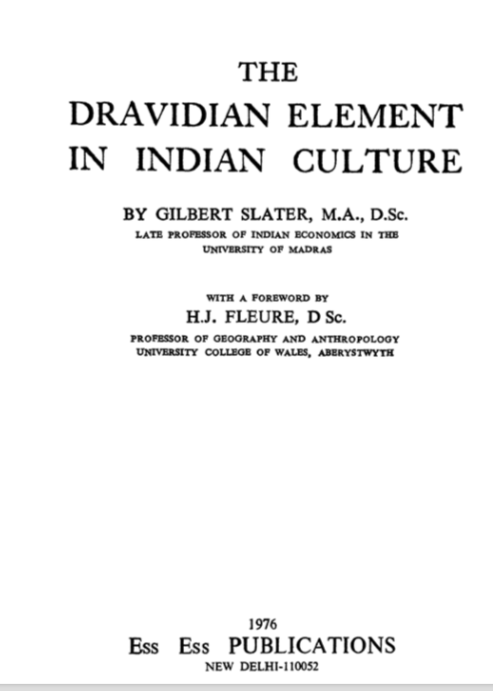
Gilbert Slater in his book, “The Dravidian Element in Indian Culture”, published in 1924, says thus, in Pages 138 and 139 of his book:
2017:
The present day politicians in power proclaim that they are bringing out this Labour Code on Social Security as per the recommendations of the Second Labour Commission. But, the fact is that the motive of that Commission was sinister and that Commission did not consist of the representatives of many trade unions of all India level. The broad spectrum of views of all the trade unions could not therefore be represented in the Commission.
That Dissent Note submitted very honestly by the Member Mr. C.K. Saji Narayanan on 21.05.2002, testify to the fact that it was only he who acted in the interest of working population.
But, the politicians in power do not care to consider the issues raised by them.
The traditionally selfish Indian society does not want to spare time to insist on the powers-that-be to explain its stand on the said Dissent Note and enlighten itself about the impending dangers it would face if and when the proposed Labour Code on Social Security comes into force.
Let the rulers be made accountable for the misadventure they rush into that would destabilise the health-care structure of the entire nation.
The best method advocated by governments all over the world to control corruption among public servants is that the person who is harassed must report the matter beforehand to the authorities of the vigilance wing of the government which would help trap the corrupt.
But, the method used by clever employers of factories and establishments is something different. They pay the corrupt officers whatever they demand. Get it video recorded without the knowledge of the concerned officers and keep it documented. Thereafter, they get whatever report they want from those officers. Once the inspection is over, they invite the inspecting officer back to a room and replay the recorded video, which shows (1) the demand and (2) the receipt of illegal gratification. They recover the entire amount of bribe or the excess amount of bribe, as per their assessment, from the corrupt officer who pays back the money and runs away. The inspecting officers remain, thereafter, at the control of those corrupt employers.
Now, the entire nation knows that an agriculturist Mr. Balan, was severely beaten by the police at Thanjavur district of Tamilnadu for not having repaid two instalments of loan that he had bought for buying a tractor. The Hindu 11.03.2016 reports: “Balan had borrowed Rs.3,80,430 in 2011 from the Thanjavur Branch of the Kotak Mahindra Bank. He has so far repaid in six half yearly instalments of Rs. 68,543 each, a sum of Rs. 4,11,200 and needed to pay only two instalments when crop failure in successive seasons hit him like other delta farmers, forcing him to default on repayment …. Meanwhile, taking a stern look at the incident, the NHRC has issued notices to the State Chief Secretary and the DGP. Stating that such form of forcible recovery by itself amounted to human rights violation and compounded the nature of the offence committed by those who assaulted the defaulting farmer. The officials have been asked to file their report in two weeks time.” (For more: http://www.thehindu.com/news/national/tamil-nadu/assault-of-farmer-nhrc-notice-to-chief-secretary-dgp/article8338865.ece)
The same nation saw the rulers allowing Mr. Vijay Mallya, who had to pay about Rs. 9000 crores, to flee and escape, because, Mr. Mallya knew how to deal with the corrupt. But, the talent of this businessman does not end with the corrupt officers and political leaders. He had also been bribing the media men all along and recording the events.
Now, he is threatening them openly, which is another crime. This criminal must be booked for this crime of blackmail also and the documents seized and made public to enlighten the public about the ‘great’ media souls who corrupt the public opinion day in and day out.
When Ms. Bedford, the sex-worker, threatened that she would reveal the names of her customers, it worked.
As Mr. Mallya has threatened the media thus, his blackmail must already be working. The media would hereafter ‘behave’. And, Mr. Mallya who was fond of wine and women could continue to invent ways, with the help of the political leaders in his pockets, to borrow the remaining money from the banks and loot the nation.
The corrupt officers, political leaders and media men, who sold their souls and fell victims to the methods of seduction of Mr.Mallya would veer around now to protect him.
Truth must come out, in spite of these pests.
This incident must also warn, at least, the other officials of what is going on in the corporate world.
Silappadhihaaram, an illustrious Tamil literature of the days of yore, explains the real-life incident of a 22 year old woman fighting for justice and exposing, with evidence, the corrupt bureaucracy and the defective decision-making-process of the competent authority (the King). Her fight was a lone battle. She asks, after having established the facts, why others did not come forward to question the wrong committed by the Palace Goldsmith and the King. She asks, to the eternal shame of the so called intellectuals, whether there were learned men at all in the country (Saandrorum Unduhol?).
This literary work addresses the imperative for the consciousness among the people not just to be narrow-minded to look after their individual needs but to actively involve themselves in public issues and work for ensuring justice to the affected and thereby keep the society free from corruption and injustice. Kannahi the Great, is admired and adored by the posterity for her courage, talent and valour that she demonstrated at that tender age.
The statue of Kannahi on the Marina Beach
“The world is a dangerous place to live. Not because of the people who are evil: but because of the people who don’t do anything about it”- said Albert Einstein.
Now, here is an excellent editorial from the newspaper, the “Imphal Free Press”. It is consoling to find a newspaper that sets the standard for journalism in an era in which many other major newspapers have gone for paid news and sectarian views. The editorial titled, “Future Imperfect” published by the newspaper on 23.10.2015 is reproduced below for the benefit of the readers:
==============================
Future Imperfect
The need to be remembered as men of integrity, and as someone who has contributed his little to society and humanity must have to be behind so much human valour, inventions, ingenuity, courage, philanthropy, generosity…. the list of virtues can go on. This need must be a basic instinct, although it has the tendency of showing up in varying degrees in different peoples and communities. Some are sensitive to it, others not so much. And this must also be what in the long run distinguished societies that have emerged at the top and those condemned to backwardness and subordinate position in the hierarchy of nations. In a way, the instinct must be also linked to man’s craving for immortality in an irredeemably transient world that has led many a philosopher to discover only absurdity in life. With death as the grim leveller of all life, men like French existential philosopher and literature Nobel Prize winner, Albert Camus, were led to believe that all philosophies are a matter of a desperate grapple with the absurdities of life to give meaning to what are essentially meaningless.
This absurdity is profoundly evident in existential questions that ask for an explanation how even the most powerful men and women, such as Ronald Regan, President of the US for two terms and Margaret Thatcher, the Prime Minister of Britain who ruled with an iron hand once, and many others like them can also be reduced by Alzheimer disease to a vegetable like any other geriatric anywhere in the world before he met his end. What profound meaning can there be too in the fact that the greatest conqueror of the earth, Alexander of the Great should have died of the bite of a tiny and insignificant insect like mosquito in the prime of his life.
There is no escape from this overwhelming meaninglessness and hence the appeal and indeed relevance of the “existential despair” in everybody’s life. In the beginning and in the end, is the unavoidable void. A realization so well encapsulated in the Meitei cosmology symbolized by the various postures of the serpentine god, Pakhangba, with his tail in the mouth – in the beginning is the end and in the end the beginning.
Still the quest for permanence in the transience that is life must continue. This thirst is in fact as inevitable and compulsive as the existential despair itself.
This must be also what led many to resist a resignation, and not end up only as someone who live only for the present. Captivating as the picture of life portrayed by existentialism, even existentialist themselves have shown their longing for meaning. In Albert Camus’ much quoted essay “Myth of Sisyphus” for instance, the meaning and salvation of Sisyphus’ struggle, becomes the struggle itself. In Greek mythology, Sisyphus was punished by the gods to roll a massive rock up a summit-less hill. His whole purpose and mission in life thus became the prospect of toiling to push the rock up or be crushed under its weight. His endless and futile toil has today become an image of life, at once captivating, heroic and tragic, from the existentialist’s viewpoint. The toil itself becomes the meaning, for beyond it, there is nothing else. What exactly is there beyond our own individual struggles in life, and when can this struggle ever come to a conclusion, except in death.
The only way to ensure one’s legacy lives on is to leave footprints in time. And this is where the need to leave behind a memory of integrity and courage becomes an essential quality of winners, not just as individuals but also as a society. The two are closely interrelated, for indeed the achievement of the society is but the accumulative result of the achievements of individuals. The essential attribute of a society with a survival instinct in terms of this quest for permanence is a capability to leave enough space and concern for the future.
The urgent question that we are all called upon to ask at this tumultuous junction of the history of our society is, do we bother to contribute our share to the future or do we live just for the present. In the face of all the corruption, bribery, sycophancy, siphoning money from development projects, dishonest contract works, unfair trade practices, which have all become rampant today, we cannot at all be optimistic that there is such a concern for the future beyond myopic individual concerns and insecurities. Embedded in this unconcern for the common future, disturbing as the thought may be, there may be a societal death wish. Should we not make the move now to exorcise ourselves of this demon.
I have a much worst example from my days in Calcutta, now Kolkotta. As the central director, I suddenly got a summon from labour secretary requiring me to meet labour minister same day. The Labour minister was an old communist veteran while State ESIC had an exclusive minister, a very friendly woman (Bengal was the only state I saw this arrangement of an exclusive minister for ESIC). I was asked to come up with a cheque of few crore of Rupees same day to pay some enhanced compensation for some land. As I had no idea of any such case and had, in any case, no power to give such cheque, I told the minister in front of Labour Secretary and the ESI minister that I would need a day to examine and come up with a response. The old communist was furious and asked whether I knew to whom I was speaking. The Labour secretary (a thorough gentleman from TN) restrained me from reacting knowing my “wayward” ways earlier.
On examination, I found that the ESIC was not required to pay a single penny. Few decades back( that must have been 1960s), the state ESI(Medical) Dy Director had sent a requisition for land for hospital in a suburb of Calcutta( place called Gauria or something like that) and the land was acquired and some compensation ( not clear from which fund) paid. As usual the owner went for enhancement of compensation through several layers and ultimately the High court had enhanced the compensation. The SLP to SC wad promptly rejected. All these events were some years before my aforesaid meeting with the minister.
ESIC was not a party to that case and another land across this land was acquired later without any knowledge of this issue. The layout and plan for hospital in this new land was approved with the knowledge of the state and during these developments, the State Government never informed us of the litigation. What is more, there was a statutory notification of state annulling all the acquisition notifications before a specified cut-off period where the final notification had not yet been issued or possession taken. The statutory notification aforesaid had automatically annulled all steps taken till then for acquisition and directed restoring land to original owners. This particular case under that category and all that was required was to file this notification while the case was pending.
I was able to get all these materials by late night and next day early morning I visited the land and found several encroachments there, houses, tea shops, grocery shops, kali temple and so on, many with communist flag and some with congress flag. I got them photographed. My note with these photos was ready by 5pm, as promised, may be, in 25 hours instead if 24. I went to meet the Minister with secretary by 5.30 but before that I had these faxed to DG ESIC with a detailed covering letter.
The Minister was furious and promptly asked Secretary to have me removed as I was working against the State. The Secretary quietly said there are already letters from communist leaders and MP to transfer me. In the corridor, the Secretary was gracious enough to tell me that I was absolutely right and, if he had been in my position, he would have done same but in a round about manner buying time. Only then I was informed that there was a contempt of court matter against the State and the High court had ordered attachment of Medical director’s office building.
Next day I spoke with our DG and other officers and I was given in writing upholding my view fully and asking me not to pay any amount and not to take the land.
After a fortnight, I got an order to give a cheque of few crores and take it to minister. I asked my Finance Officer to take the cheque. Mr Sharma DG was decent enough to ring me up and inform me that there was very high level pressure that he could not withstand and that I should not write anything further on this.
I had faced a few more such incidents. Everyone misused the ESIC and its funds, though the worst case was the manner the medical colleges were sanctioned and crores of public funds casually sanctioned and released violating every known rule of proprietary. Unfortunately these are not known to public or press as hardly anyone know what ESIC is all about.
The small time politicians who rule various countries of the world are leading the world to insecurity and chaos. The situation cannot be remedied unless these politician are stopped from running after the businessmen for their money to fight elections in their own countries and for their own survival. It is time the UNO took effective steps to see that real democracy is practised in all its member nations so that sanity prevails in the world.
It was Mr. Manmohan Singh who brought in the so called globalisation in 1991. Twenty years later during the independence day speech in 2011 he was talking about the poverty of the nation and malnutrition of the children. Now, the BJP government ups the ante and increases the social insecurity of the common people. The bill called Small Factories (R & CS) of 2014 is a classic example proving that the rulers do not bother about commons.
Readers may please go through the following article in The Economist which is an eye-opener.











 Flourishing ESIC