Making ESI Medical facilities optional: Abdication of responsibility!


It is said that the Government of India is going to make the ESI Medical facilities optional. It is also said that the employees would be given option to choose medical insurance of private operators.

First of all, ESIC does not provide medical facilities only. Medical Benefit is just one of the five major benefits provided by the Government of India to the working population through the ESIC. The other four are cash benefits provided in the contingencies of sickness, maternity, disablement and in the event of fatal accidents. No private player can ever match the benefits provided by the Government through the ESIC. It is not necessary for one to cudgel one’s brains to go through the monumental document of Sir William Beveridge, and the passionate report of the compassionate Prof. Adharkar to understand how and why it must be the duty of the Government of India to provide these benefits to the working population.

Even The Hindu conceded editorially on 01.01.2005 that “The package (of benefits provided by the ESIC) can rarely be matched by private employers on their own because of the heavy costs involved – not to mention the disinclination among employers, with honorable exceptions, to operate health care systems for their workforce”

It is the Government, which runs the ESIC. As far as the medical benefit is concerned, the Government can run the hospitals and dispensaries very well. It can control corruption, if it wants to. But, the political parties that came to power successively were not interested in proper running of the administration. They wanted to have the power of transfer of the officers of the ESIC, for mala fide reasons. The financial strength of the organisation, appreciated by the Economic Times in 2003 was weakened deliberately and more than Rs. 15000 crores of ESIC funds frittered away for questionable purposes.

ESI Scheme is the backbone of the nation’s economy. Just like the backbone, it remains invisible. So, the sensation seeking media – even major media – did not care what was going on in the ESIC when so many things went awry.

BJP is definitely leading the country in the wrong direction. We have to learn from USA and Cuba about the provision of medical benefits to the people of the nation. US is a warning and Cuba is  an example. Poor in USA go to Cuba for treatment. (Of course, not only those employed in factories but others as well).

Whatever be the ‘ism’s they are calling, nothing could succeed in India or any nation, for that purpose, unless corruption is controlled. And, corruption can, really, be controlled.

Making the source of finance for every political party transparent is the first step to eradicate corruption. Unless BJP comes forward to enact appropriate law for this purpose, they cannot make the people believe they are the saviours of the people. Because, as things stand, the political parties collect money from corporates and the people in that party share that money among themselves. Funny, these people quote scriptures in public, to the public.


When Tony Blair laid down office as the Prime Minister of the UK, his personal worry was how to settle his personal loans. In India, no councillor of Municipality would remain a debtor after a single tenure in office as councillor. What to talk of Ministers who are fond of aristocratic life style!

ESI medical benefits are supposed to be really qualitative. The pharmacopeia is of WHO standards. Still, it is the unwillingness and greed of the politicians in power and the corrupt motive of the officials, which prevent the ESI medical institutions from reaching greater heights.

Mediclaim policies of private institutions are not the panacea for it. There are many other practical problems posed by the latest decision of the Government, which wants to abdicate its responsibility on this score. They will be dealt with later, in public interest.

An article underscoring the importance of this social security scheme is uploaded in the following link, for those who would like to know the history behind the scheme.

Click  for Articles here.

Sickness Benefit?

Now, more than anything else:

Who will provide Sickness Benefit? And, on whose certificate? Has the BJP chosen to away with the Sickness Benefit altogether? Has it examined the issues involved in it? Pity indeed!

1 Comment

Filed under Amendments 2010, Benefits

Mr. O. Abdul Hameed, Former A. C, writes on the misuse of ESIC funds!

I have a much worst example from my days in Calcutta, now Kolkotta. As the central director, I suddenly got a summon from labour secretary requiring me to meet labour minister same day. The Labour minister was an old communist veteran while State ESIC had an exclusive minister, a very friendly woman (Bengal was the only state I saw this arrangement of an exclusive minister for ESIC). I was asked to come up with a cheque of few crore of Rupees same day to pay some enhanced compensation for some land. As I had no idea of any such case and had, in any case, no power to give such cheque, I told the minister in front of Labour Secretary and the ESI minister that I would need a day to examine and come up with a response. The old communist was furious and asked whether I knew to whom I was speaking. The Labour secretary (a thorough gentleman from TN) restrained me from reacting knowing my “wayward” ways earlier.

On examination, I found that the ESIC was not required to pay a single penny. Few decades back( that must have been 1960s), the state ESI(Medical) Dy Director had sent a requisition for land for hospital in a suburb of Calcutta( place called Gauria or something like that) and the land was acquired and some compensation ( not clear from which fund) paid. As usual the owner went for enhancement of compensation through several layers and ultimately the High court had enhanced the compensation. The SLP to SC wad promptly rejected. All these events were some years before my aforesaid meeting with the minister.

ESIC was not a party to that case and another land across this land was acquired later without any knowledge of this issue. The layout and plan for hospital in this new land was approved with the knowledge of the state and during these developments, the State Government never informed us of the litigation. What is more, there was a statutory notification of state annulling all the acquisition notifications before a specified cut-off period where the final notification had not yet been issued or possession taken. The statutory notification aforesaid had automatically annulled all steps taken till then for acquisition and directed restoring land to original owners. This particular case under that category and all that was required was to file this notification while the case was pending.

I was able to get all these materials by late night and next day early morning I visited the land and found several encroachments there, houses, tea shops, grocery shops, kali temple and so on, many with communist flag and some with congress flag. I got them photographed. My note with these photos was ready by 5pm, as promised, may be, in 25 hours instead if 24. I went to meet the Minister with secretary by 5.30 but before that I had these faxed to DG ESIC with a detailed covering letter.

The Minister was furious and promptly asked Secretary to have me removed as I was working against the State. The Secretary quietly said there are already letters from communist leaders and MP to transfer me. In the corridor, the Secretary was gracious enough to tell me that I was absolutely right and, if he had been in my position, he would have done same but in a round about manner buying time. Only then I was informed that there was a contempt of court matter against the State and the High court had ordered attachment of Medical director’s office building.

Next day I spoke with our DG and other officers and I was given in writing upholding my view fully and asking me not to pay any amount and not to take the land.

After a fortnight, I got an order to give a cheque of few crores and take it to minister. I asked my Finance Officer to take the cheque. Mr Sharma DG was decent enough to ring me up and inform me that there was very high level pressure that he could not withstand and that I should not write anything further on this.

I had faced a few more such incidents. Everyone misused the ESIC and its funds, though the worst case was the manner the medical colleges were sanctioned and crores of public funds casually sanctioned and released violating every known rule of proprietary. Unfortunately these are not known to public or press as hardly anyone know what ESIC is all about.

Leave a comment

Filed under Uncategorized

BJP surpasses Congress in increasing social insecurity!

The small time politicians who rule various countries of the world are leading the world to insecurity and chaos. The situation cannot be remedied unless these politician are stopped from running after the businessmen for their money to fight elections in their own countries and for their own survival. It is time the UNO took effective steps to see that real democracy is practised in all its member nations so that sanity prevails in the world.

It was Mr. Manmohan Singh who brought in the so called globalisation in 1991. Twenty years later during the independence day speech in 2011 he was talking about the poverty of the nation and malnutrition of the children. Now, the BJP government ups the ante and increases the social insecurity of the common people. The bill called Small Factories (R & CS) of 2014 is a classic example proving that the rulers do not bother about commons.

Readers may please go through the following article in The Economist which is an eye-opener.

http://www.economist.com/news/leaders/21637393-rise-demand-economy-poses-difficult-questions-workers-companies-and

Economist

(Courtesy: The Economist.

Leave a comment

Filed under Uncategorized

Black Money, Black Politics and Black laws against labour !

There is a strong connection between the funding-‘system’ of political parties in India and the manner in which the labour welfare measures  are diluted by the political parties that capture and run the government. The money siphoned off by the corporate houses is very very huge that the politicians in various political parties sell their souls easily to the corporate crocodiles.

The result is that these politicians yield willingly to the pressure brought on them by the corporates and betray the ordinary people. It is a shame on the educational system that it does not inculcate honesty in the people that many choose politics as a source of livelihood, attracted by the easy money that they are able to make. Common people of India are going to lose a lot at the hands of these wily politicians, who are there to make money through unfair means, while at the same time, projecting themselves as the saviours of the commoners.

In its editorial dated 24.12.2014, Kashmir Times writes:

“Majority of the political parties have been getting most of their funds from corporate houses, who donate money as per the size and numbers of a political party and patronize all of them as per their preferances. As of now, BJP is one of the parties, which has not filed its return for the previous year for the donations received by it in excess of Rs 20,000 or more. … Other parties are no different so far disclosures on donations are concerned. The Income Tax exemption to the extent of 4 percent on the profits of a corporate house is too much keeping in view the volumes of money siphoned off to the political parties on annual basis. Unless some arrangement is made to ensure transparency in donations to political parties is made, the black money will continue to breed black politics in India where poor masses will continue to suffer”. (http://www.kashmirtimes.com/newsdet.aspx?q=39725)

The Small Factories (Regulation of Employment & Conditions of Service) Bill, 2014 is one such irresponsible bill intended to convert the masses into slave labour in a massive scale. Employers, except a few who are really benevolent, do not want proper labour laws. When there was a survey in Mumbai in the late 1990s, 85% of the employers did not want ESI Scheme while  85% of the employees wanted the scheme for them. Labour welfare can be protected only when government is ready to monitor and enforce it, in the Indian circumstances. But the politicians in power do not worry about the labour but only about the corporate money for their political parties. And, the pity is that there are so many bureaucrats who aid this betrayal of common people.

Unless we address the root cause of the problem and compel all the political parties to make every single donation public, through their website, irrespective of the quantum of such donation, the poor will suffer for long and the politicians will ally themselves with the rich for the money they throw at them.

Leave a comment

Filed under Labour Bill of 2014

Railways dumps the proposal for Medical Colleges!

From the Times of India:

NEW DELHI: The railways have shelved former minister Mamata Banerjee’s ambitious plan of setting up medical colleges across the country. Officials said the hospitals run by the transporter are ‘white elephant’ eating up funds while quality of treatment is poor due to non-availability of good doctors.

The cash-strapped transporter cited Medical Council of India (MCI) rules to junk the proposal.

Most of the railway-run hospitals are equipped with massive infrastructure, located at prime real estate, but they don’t have specialist doctors and act as mere referral centres. Even the Central Hospital in Delhi refers most of the patients to private hospitals which was on the railways’ panel.

“The cost of running a hospital is six times more than the bearing the complete cost of treatment of an employee in a private hospital,” said an official, adding nowhere in world railways own and manage hospitals.

The employees can get free treatment if the hospitals are handed over to private players, considering the prime location and huge huge infrastructure, he said.

Another official said cases of alleged malpractices have been reported in supply of equipment and medicines. He also pointed to a big ‘sick and fit’ racket in which doctors allegedly charge money to declare an employee either sick or fit to be on duty.

In 2009-10 rail budget, Banerjee had announced setting up of medical colleges attached to existing railway hospitals through PPP mode to give higher education facilities to children of railway personnel.

“As per MCI rules, medical colleges on PPP mode with government (railway) hospitals are not permitted. The ministry has therefore dropped the proposal of setting up medical colleges,” junior railway minister Manoj Sinha told Parliament.

After Mamata’s proposal, RITES, a railways subsidiary, was awarded the work at an estimated cost of Rs 187 lakh besides service tax for consultancy and preparing bid documents for selection of private partners. RITES had submitted preliminary reports on feasibility studies in Chennai, Secunderabad and Kharagpur for which Rs 29.41 lakh was spent.

Other proposed locations were Barasat, Garden Reach, Kolkata, Hyderabad, Bilaspur, Lucknow, Bhubaneswar, Mysore, Guwahati, Ahmedabad, Nagpur, Jodhpur, Dibrugarh, Bhopal, Jammu and Thiruvananthapuram.

(Courtesy: Times of India. http://timesofindia.indiatimes.com/india/Railways-dumps-Mamatas-proposal-on-medical-colleges/articleshow/45341235.cms

One of the points to Note:

Expenditure for consultation: Sanctioned Rs. 187 lakhs only. Spent Rs. 29.41 lakhs only.

What was the amount paid by the ESIC to the consultant?

2 Comments

Filed under Medical College Bond

Ms. Mamatha Banerjee happy with the ESI Hospitals in Kolkata!

“The excellent performance of the ESI Hospitals in West Bengal run by our labour department has been recognized by the Centre. An incentive grant of Rs 22.33 crore has been provided, which is first time ever to be received by any ESI Hospital in the country,” the CM posted on her Facebook page on Saturday.For more:

http://timesofindia.indiatimes.com/india/Mamata-Banerjee-praises-Centre-on-Facebook/articleshow/45084287.cms

Leave a comment

Filed under Benefits, Medical College Bond

Representation to the Ministry of Labour about the Draft Bill.

To

Mr. S. C. Sharma, Deputy Director [IR (PL)],

Ministry of Labour and Employment,

New Delhi 110001 sc.sharma56@nic.in

Sub: The Small Factories (Regulation of Employment and Conditions of Services) Bill, 2014
Ref: Note No. Z-13025/31/2014-IR (PL) dated 10.10.2014 of the Ministry of Labour and Employment.

Sir,

This refers to “The Small Factories (Regulation of Employment and Conditions of Services) Bill, 2014”, intended to be made law.

Kindly drop your proposal to make that draft Bill as Law. That will convert our nation to be an uncivilized one once again. In the year 1922, when India was reluctant to enforce any of the labour welfare measures suggested by the International Labour Organisation, one member went on record saying that among the civilised countries, India was the only country where no social security measures was in existence. Immediately, the embarrassed Indian representatives gave an assurance that steps would be taken to enact legislation for insurance in respect of accidents. It was because of that commitment that the Workman’s Compensation Act came into existence in the year 1923.

Now your intention to exempt the factories from the applicability of even “The Employees’ Compensation Act, 1923” , as could be seen from Cl. 54 of the Bill, shows that your aim is to set the clock back to pre-1923 era. Can we, then, call ourselves a civilized nation?

The Law Commission of India in its report on Workman’s Compensation Act, 1923, had said, “It is an oft repeated slogan: ‘The cost of the product should bear the blood of the workman’. The objective may not have been realized fully. But, it gives us, in striking language, a clue to the governing principle of the Act, and its socio-economic importance”.

Now, by exempting the factories from the purview of even this Act, even the elementary protection that was given to the working population is going to be taken away.

The Employees’ State Insurance Act, 1948 was brought into force immediately after independence in 1947, as part of a bouquet of labour welfare measures along with the Factories Act, 1948. It was the brainchild of Prof. Adharkar who modeled it on the report of Sir William Beveridge, whose report is still considered as the monumental document on social security. It provided a host of benefits both to the employer and the employees. It is a protective umbrella to the employer safeguarding him from huge unforeseen liabilities. It provides a security net to the employees so that their living conditions would not fall below certain standards.

The Hindu had also, in its editorial dated 01.01.2005, said, “The package (of benefits provided by the ESIC) can rarely be matched by private employers on their own because of the heavy costs involved – not to mention the disinclination among employers, with honorable exceptions, to operate health care systems for their workforce”.

None of the civilized nations who top the list in the Human Development Index follow the method proposed to be adopted by you, now, by making the important labour welfare enactments ineffective. We do not find Germany or Japan saying that they could improve their economy only by inviting foreign capital, selling the land to the foreigners by displacing the natives by alluring them of menial jobs, and then by closing down the factories within a short while and, thereby, making the natives refugees.

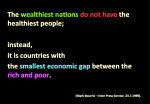
The draft Bill will make the working population of our nation to be virtual slaves. They will be squeezed by the ‘rich’ (the businessmen) and the ‘powerful’ (the politicians of the ruling party) and there will only be misery everywhere. The fact is that “The wealthiest nations do not have the healthiest people. Instead, it is countries with the smallest economic gap between the rich and poor”. (Mark Bourrie- Interpress Service – 23.07.1999).

There will be large scale migration of the working population resulting in loss of proper education to their wards and that lack of education will continue the vicious cycle of continued supply of slave labour. Our nation will not flourish as a mature democracy but will decay to become a society of medieval era. The charter of the International Labour Organisation of 1919 says that the peace and harmony of the world was imperiled, because the welfare of the working population was not taken care of.

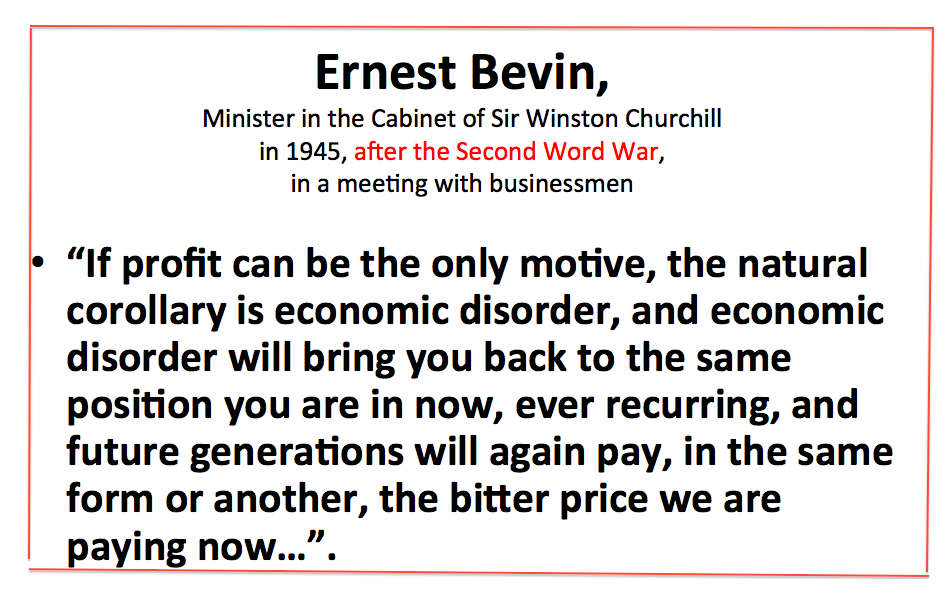
While addressing businessmen, in the year 1945, after the Second World War, UK Minister Ernest Bevin stressed on the need for providing basic economic security to create fairer conditions of living for the working population also. “If profit can be the only motive, the natural corollary is economic disorder, and economic disorder will bring you back to the same position you are in now, ever recurring, and future generations will again pay, in the same form or another, the bitter price we are paying now…” he said.

The Declaration of Philadelphia of 1949 says that “Labour is not a Commodity” and it warns that “Poverty anywhere constitutes danger to prosperity anywhere”.

I, therefore, request you to kindly drop the ill-considered proposal to exempt the factories from the purview of the well-intentioned labour laws. The decision to re-classify the term ‘small factories’ as those employing 39 workmen and below (excluding the persons in the wings of administration, distribution, etc) shows the sadistic cleverness of the people who drafted the Bill. Dr. F. J. Foakes Jakson has said,

“It is no use trying to be clever – we are all clever here.

Just try to be kind – a little kind”

Please find attached two articles on the same issue published in the website ‘Flourishing ESIC’.

  1. Builders : Germans : : Sellers : Indians.

(https://flourishingesic.info/2014/10/14/builders-germans-sellers-indians-part-i/   )

  1. Opaque Party funds and Repressive Labour Laws.

(https://flourishingesic.info/2014/10/16/opaque-party-funds-repressive-new-labour-laws/ )

Yours faithfully,

Copy to Mr. Piyush Sharma, Consultant, MOL&E.

2 Comments

Filed under Labour Bill of 2014

Opaque Party Funds & Repressive new Labour laws

Running a political party in India is not for rendering service to the people. It is more of a business. If one needs to be rich, one can start a political party, collect donations through various means and then claim the privilege of immunity from disclosing the source and then, claim again, that the party needs a lot of money to perform its ‘democratic’ duty.

The Association for Democratic Reforms (ADR) has shown that about 75% of the funding of the major political parties, including Congress and BJP, comes from unknown sources.According to the ADR analysis of income tax returns and statements with the Election Commission, the total income of the six national parties from 2004-05 to 2011-12 was Rs 4,896 crores. Yet, for as much as Rs 3,675 crores, those parties gave no details of their sources.

Running a political party requires, thus, money and more money. So, the politicians of all the parties tend to collect money from businessmen. All that is collected is not brought to party’s accounts, and most of it is apportioned among the party-men at lower and higher levels, who are there, precisely, for that purpose. All this results in unholy ‘Politicians and Businessmen’ nexus.

The unscrupulous among the top-level bureaucrats, mainly from the IAS, seize this opportunity to act as facilitators between the two. This leads to a lot of corruption within various departments under the control of these officers. Ultimately, nation ends up seeing the purpose for which a department was set up is not achieved, only  or mainly because of this “Politician + Bureaucrat + Businessmen” nexus.

All businessmen are not Robert Owen or George Cadbury. They do not worry about the welfare and security of that section of humanity which is called as labour force. They want only their pound of flesh, the profit for themselves. Naturally, the first victim in the process, because of such malicious nexus among the aforesaid trio, is Labour. The proposed Bill in respect of Small Factories is one of that kind, which paves way for abundant supply of slave labour and sweatshops.

Unless all the political parties are compelled to make public by displaying all their sources of funds irrespective of the quantum of donation, through website, the irrepressible willingness of the Indian politicians to kowtow before the money-bags cannot be checked. The victims, in the process, will only be the poor who will always remain poor.

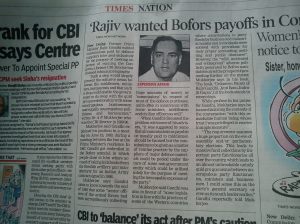
The manner in which Rajiv Gandhi wanted to avoid going to various businessmen for party fund was made public by Dr. A.P. Mukherjee, former CBI Director in 1989-90.  A news item, with reference to his book “Unknown Facets of Rajiv Gandhi, Jyoti Basu and Indrajit Gupta” is given below for the information of the readers

.   Party funds

Leave a comment

Filed under Labour Bill of 2014

Builders : Germans : : Sellers : Indians – Part I

Presentation 1

(Dear Readers, The nation is now in the throes of crisis. Present rulers intend to deny the benefits of 14 labour welfare enactments to the workforce in the factories that employ up to and including 39 ‘workers’ for wages, excluding the ‘persons’ who are performing in administrative, supervisory or managerial functions. This will result in abundant supply of Slave Labour to facilitate Money Sharks to exploit and squeeze labour and share the spoils between them and the politicians who are powerful. The text of the Bill is available in the following link:

http://labour.gov.in/upload/uploadfiles/files/latest_update/what_new/5437e6a63557bSME23.sept.pdf

The issues involved are going to be analysed in this web-site, in detail. Readers may convey their views to the Ministry of Labour in sc.sharma56@nic.in and piyushsharma_del@yahoo.com before 10.11.2014. Part I of the series is here for the readers to have a birds-eye view of the subject)

==============================

It was 11.10.2014. When we sneaked into Heaven, we happened see three persons sitting under a tree in the morning sun. On closer view we found that they were the souls who worked for the welfare of humanity, when on earth. They were Otto Von Bismarck, the Iron Man of Germany, Sir William Beveridge, Father of the Welfare State, and Ernest Bevin, the Minister of Labour in the Cabinet of Winston Churchill. All of them looked sad and it seemed that they were concerned about certain issues. We made an attempt to overhear their conversation. Ernest Bevin said, “Mr. Beveridge! I share your concern. I did not know how the Indian bureaucrats put forward such cases before lawmakers. Although it is said, on theory, that the Executive must do what the Legislature says, the reverse is always the case in India, in practice. I find that the Indian politicians do not know the subjects much and are falling victims to the manipulations of the bureaucrats and become willing tools in their hands. I am afraid what the future holds for the common men in India”. “Yes, many Indian politicians want only the post and glory. They do not want to work to understand the issues and explain their enlightened stand in the forum to which they have been elected. This was the attitude of the politicians of India even when they were members of the Constituent Assembly. Wwhen crucial subjects were discussed in the Constituent Assembly, the members were not ready to extend their stay in Delhi but wanted to catch their trains to go back. They subordinated the national interests to their own personal interests, although they visited Delhi at government’s expense, at that time. The trend continues even now.”

Bureaucrats manage the Politicians

“Yes. I find that it is because of the incompetence of the legislators who know only how to manipulate people to win elections. They do not have the capacity or inclination  to understand and analyse the macro-issues affecting the nation. As a result, many bureaucrats have been, directly, made ministers in the central cabinet, to man important portfolio. The elected MPs are just looking at them helplessly. Consequently, the other bureaucrats also find it convenient to keep the legislators as ignorant as possible,  forever, so that their bureaucracy can have upperhand in the governance of the nation.” “I agree. In India, except in exceptional cases, it is the bureaucracy that runs India. The business-magnates, therefore, find it easy to get things done their way, by patronising the bureaucrats who take care to manipulate the opinions of the Legislature. During the discussion in the House of the People on 23.3.1992, Mr. A.B. Vajpayee blamed that the bureaucrats were more responsible for creating the economic crisis than the political leadership. His statement is one of the many evidences available to prove that the politicians are led by and not obeyed to by the bureaucrats. What has been depicted in the famous serial ‘Yes, Minister’ is  applicable more to India than any other country.” Slide2 At that moment, Prof. Adharkar came to the meeting spot. The others welcome him and asked him if he had seen the draft of the “The Small Factories (Regulation of Employment and Conditions of Services) Bill, 2014”, proposed to be made law. Prof. Adharkar, who looked downcast, did not give any reply but sat down on the floor, near Bismarck. Ernest Bevin prodded Adharkar to speak. Adharkar just threw his hands in despair and did not say anything. Bismarck patronisingly patted Adharkar on his back and said, “What can he do, friends? He had done whatever he could and his role was over on 15.08.1944 when he handed over his report to the Government. But, does anyone care to read it, now? He had enumerated some Fundamental Principles also for the success of social security in India. That too is not read by anyone. At least, the present day politicians can read the 1929-31 report of the Royal Commission of Labour. Many findings reported therein are relevant in the present context too. But, nobody cares, now. That was not the case then. Those were the days when politicians were really concerned about the real welfare of the people. It is natural that Mr.Adharkar is upset.” Beveridge said, “Yes. But, now a days the politicians in India run after moneybags and believe that the poor can be quietened by propaganda and repression. In short, the politicians believe that they can flourish by making the rich really happy and by making the poor believe they are happy.”. Adharkar looked at the other three. He said, “What the Bill is going to do is to take India back to the pre-1923 situation. It was only in 1923 that the Workman’s Compensation Act was enacted. Before that, there was no labour welfare measure at all. Even this was enacted in 1923 only because of some provocative remarks by others in the ILO meeting in 1922. All other labour welfare legislations like the Factories Act, Employees’ State Insurance Act, Minimum Wages Act, etc., came after Independence as a bouquet. But, this Bill intends to undo all this.”

 Bismarck pleased the workers and not the employers

Bismarck agreed. “When I wanted to build a mightier Gemany, I laid stress on labour welfare. I set up separate hospitals for factory workers. I brought into force the Accident Insurance Act in 1883, Maternity benefit provisions in 1884, Sickness and Old-age Pension in 1889 and so forth. The nation flourished because the government took care of the people in the lower strata who work on the field by providing them security for livelihood and incentive to work. Even after Germany was devasted after Second World War, it re-emerged to become a mighty economic power and its monetary unit attained full value within 26 years in 1971. But, India which got peaceful transition of power in 1947 has not seen its rupee attain full value till date. The Indian politicians, in my assessment, do not care for the real development of the nation.” Adharkar said, “Yes. In India, politics is the means for making money. Those who have talent enter politics, become leaders and amass wealth. Those who are not fit for anything also enter politics, work as party-workers with the aim of sharing the party-money. They are in politics not for service to the society but to earn their livelihood. The former and the latter make a perfect combination to cheat the public. You see, Tony Blair. He was worried how he could settle his debts, after he ceased to be the Prime Minister of England. But, in India you cannot find a single Municipal Councillor with debts after his tenure even for a single term. The system is corroded so much. There is, therefore, nobody to care for the commoners. The Bill is just symptomatic of this rot that has set in.” “Is the system so rotten?”, asked Beveridge. Adharkar nodded. “Yes. That is why none of the major political parties is ready to disclose the source of their income to the public, through website, in spite of the direction of the Central Information Commission to that effect. A political party supposed to work for the public and collects money as donations from public for the proclaimed public cause, is duty bound to disclose its complete source of income. But, the politicians are mortally afraid to make the source public, only because they remain there as politicians, just in order to apportion that party money among themselves for their personal consumption. As long as the Indian politicians, including the so-called Communists, fight shy of disclosing their complete source of income, they will run after the moneybags only. They will use their legislating power to further the interests of only the rich, who pay them donations heftily as a quid pro quo. This is the root cause of this kind of Bills. This does not take into account the welfare of the workers. Their tall talks about welfare of the people, patriotism, etc., are nothing but farce.”

Indian politicians pave way for  Forced Labour 

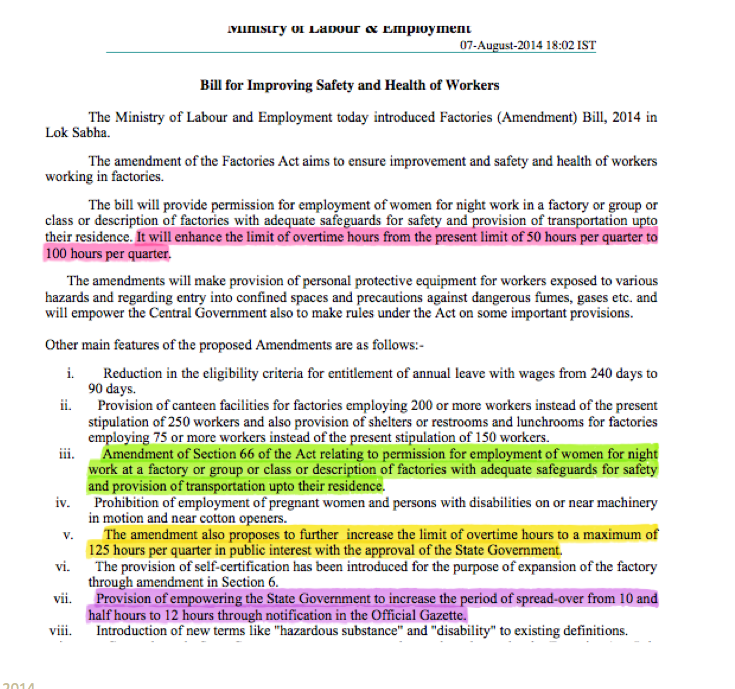
Adharkar continued, “These bureaucrats do, however, have a sense of sadistic humour. They call this Bill a part of ‘reforms’. “Yes, I noticed too” said Beveridge. He continued, “Earlier, these bureaucrats called a bill that permits exploitation of work force as the ‘Bill for improving Safety and Health of Workers’. The Indian politicians and bureaucrats believe in forced labour. But, that will not help evolve a civilised nation, as explained in the  Charter of the International Labour Organisation. All along, I had been saying that the making of a nation is possible only with “willing participation of labour”. But, the Indians do not care”. Slide 3 Ernest Bevin interjected. “I find Indian politicians and bureaucrats pursuing a path which is not followed by the UK, Germany, Japan, Switzerland or the Scandinavian countries. These leaders in India mislead the masses. A simple analysis of the employment position in the beverage industry after the entry of two MNCs would show that the opportunity of employment has become less than what it was in 1990. Profit is the only motive for the businessmen now a days, especially those of MNCs. I had said, in the year 1945 itself, after the Second World War was over, that such profit-motive of the businessmen had resulted in world war. I stressed on the need for providing basis economic security to create fairer conditions of living for the working population also. But, Indian politicians do not realise the need for taking real care of their working population. The business organisations like Times of India editorially welcomes such anti-poor, anti-labour and pro-rich policies as ‘labour reforms’ (14.10.2014). India, with this kind of politicians around, is in the throes of crisis.”

ESI Act aims at extending coverage

“I agree”, said Adharkar, “Our ESI Act was intended to provide social security to the employees in the organised sector and its aim was to cover the factories with ten or more employees and also to extend the scheme to establishments in industrial, commercial and agricultural sectors and thereafter to other areas too. But, the proposed Bill, says that the ESI Act and many other Acts are not applicable to ‘Small factories’ which term has been defined as “any premises wherein a manufacturing process is carried on and which employs less than forty workers”. The exploitation of common man by the economically mightier rich will be more acute, if and when this Bill becomes an Act. The protagonists of this Bill have not explained how the ESI Act and other Acts had worked against the interests of the nation. But, they won’t as their aim is to placate the moneybags and, specially, the MNCs, only and not the commoners”.

 Institutional Economists work for better world

Beveridge said, “ See,  what Communism could not achieve has been achieved by Social Security. The rulers must aim for less gap between the rich and poor. That alone will make the nation civilised and the people happy. But, the basic flaw is that  the Indian politicians do not care for Institutional Economics which focuses on understanding the role of the evolutionary process and the role of institutions in shaping economic behaviour. Indians can do wonders if they fine tune the organisations discharging the work mandated by the Acts to work effectively. But, they propose to drive those organisations out from the factories employing less than 40 workers”. All others were listening to Beveridge with rapt attention. Beveridge continued, “One must read, at least, Edwin E. Witte. He  said that “All or most of the institutional economists have been pragmatists, studying facts, not for their own sake, but to solve problems and to make this a better world to live in”. But, Indian politicians are in a hurry to please the rich and ditch the poor. As you said, unless the source of income of the political parties in India is made transparent, India will continue to be run only by the educated dupes.  It will not become a civilised nation. A nations social security measures and their effective implementations are the symbol of civilisation. One can refer to the Human Development Index in this regard.  Seen in this background, “The Small Factories (Regulation of Employment and Conditions of Services) Bill, 2014” is a move in the wrong direction, where there will be total slavery in the nation. I feel sorry for the common people of India”. Bismarck said, “ I feel very sorry for the poor in India. We, the Germans, built our nation. But, the Indians sell their nation”. Bevin

Leave a comment

Filed under For Trainees, Inspections, International

Keep alive the Employers’ Liability Act, 1938!

Employers Liability Act, 1938 has been legislated with the objective of ruling out certain defences in suits for damages arising out of injuries sustained by workmen. Under the Common law, in case of civil suits for damages resulting from injuries sustained by workmen the employer can plead the Doctrine of Common Employment, by which the employer is not normally liable to pay damages to a workman for an injury resulting from the default of another workman and the Doctrine of Assumed Risk, by which an employee is presumed to have accepted a risk if it is such that he ought to have known it to be part of the risks of his occupation.

The Royal Commission on Labour viewed both these doctrines as inequitable and recommended with a majority that a law should be enacted to abolish these defences in case of all workmen.

Employers’ Liability Act, 1938 says clearly who the employer is in respect of the workers deputed by the contractors and man-power supply agencies to work in the factories and establishments of other employers. The definition in this Act helps understanding the definition of the term ‘Workman’ in the Workman’s Compensation Act, 1923 (now Employee’s Compensation Act, 1923), the definition of the terms like ‘employee’, ‘principal employer’ and ‘immediate employer’ in the ESI Act, 1998, the definition of the terms ‘workman’, ‘contract labour’ and ‘contractor’ in the Contract Labour (Regulation & Abolition) Act, 1970. This Employers’ Liability Act, 1938 would help bridge many gaps that may arise between various other labour welfare enactments. This Act is resorted to for clarification and protection, when there is flaw or doubt in other enactments. This is a protective umbrella for workmen and had been enacted after due deliberations. This has withstood the test of time.

The utitlity of the Employer’s Liability Act, 1938 and the way it helps understanding the subject matter pertaining to the employees employed through contractors including the outsourcing agencies can be seen from the exhaustive Powerpoint Presentation (containing 206 slides) available in the article given in the following link: https://flourishingesic.info/2014/09/27/coverage-of-man-power-supply-agencies/

The Powerpoint presentation explains how this Act supplements and aids interpretation when doubts are raised by the employers in regard to their liability towards the workmen engaged through contractors or in respect of employees whose services are utilised through outsourcing methods.   The history behind this Act and its contents are very useful to explain the concept of contract labour in various seminars of employers, with the help of this Act.

Employers’ Liability Act defines and restricts the occasions and the extent to which public and private employers shall be liable in compensation in case of injuries to their employees occurring in the course of their employment and particularly abolishing the common law rule that the employer is not liable if the injury is caused by the fault or negligence of a fellow servant and also the defences of contributory negligence and assumption of risk.

There is no harm in retaining the Statute as a live enactment, especially when the legislators of these days had shown no interest in proper discussion and understanding the intricacies of amendments proposed by bureaucrats. (Ex. the amendments proposed in 2009 to the ESI Act, 1948 contained so many serious flaws that affect the functioning of the organization till date). It is therefore proper to retain the Employer’s Liability Act, 1938 in the Statutes without repealing it.

  1. Definitions:-

 In this Act, unless there is anything repugnant in the subject or context,–      (a) “workman” means any person who has entered into, or works under a contract of, service or apprenticeship with an employer whether by way of manual labour, clerical work or otherwise, and whether the contract is expressed or implied, oral or in writing; and       (b) “employer” includes any  body of persons whether incorporated or not, any managing agent of an employer, and the legal representatives of a deceased employer, and, where the services of a workman are temporarily rent or let on hire to another person by the person with whom the workman has entered into a contract of service or apprenticeship, means such other person while the workman is working for him.

The definition in this Act helps fix tortious liability on the employers not covered by any other enactment,too. Retaining it on the statute books will not be harmful to anyone.

Repealing it can be harmful to the working population in various contingencies. The text of the Employers’ Liability Act, 1938 is available at:

http://indiankanoon.org/doc/47831/

and also at http://labour.nic.in/upload/uploadfiles/files/ActsandRuleshindi/employeesliabilityact1938.pdf

(although it is written as Employees Liability Act, 1938 there).

Those who agree with this proposition may convey their views to kumar.subhash@nic.in

1 Comment

Filed under Amendments 2010, For Trainees