
Trampling of Beneficial Legislation
by Employees State Insurance Corporation
==========================================================================
(Mr. Hiren Chheda has sent this for publication as comment. But, considering the importance of the issue it is published as a Post. Readers may read the comment below too to have a complete picture of the case)
==========================================================================
The Employees’ State Insurance Act, 1948 is a beneficial legislation. The contributions payable to the fund is in the nature of a tax and hence no “quid pro quo” is attached.
In this regard Sec. 38 of the Act mandates that all employees should be insured and Sec. 44 imposes obligations to furnish returns, maintain registers as specified therein. Regulation 11 &12 prescribe procedure for obtaining Declaration forms from employees. Sec. 14 specifies furnishing of Declaration forms with a return within 10 days of obtaining the particulars. The definition of employee in the Act is also very wide. Sec. 2(14) defines “insured person”. It covers both present and past employees against whom contributions are or were payable. Sec. 2A puts an obligation on the employer to register his factory and establishment as soon as the Act applies. There is no provision in the Act which enjoin a duty on the part of the corporation to keep on informing the employer that they are covered under the Act. Sec. 45 A to Sec. 45 I prescribe the procedure for determination and recovery of contributions. Thus it is clear that once the factory or establishment is covered u/s. 2A, all the coverable employees are automatically become insured persons
Since it is a tax, the Act does not prescribe any limitation for determination and recovery proceedings against the defaulting employer. The legislature was aware that the employer’s default may render the dependants of the deceased employees without any relief. Hence while putting an absolute bar u/s. 53 of the Act for the employees to seek relief under EC Act, 1923 or any other law, Sec. 68 mandates that ESIC must pay to the dependants of the deceased employee the dependants benefit despite violations of the provisions of the Act and recover the same from the employer as if it were an arrears of land revenue at the rate twice the amount of the contribution. Sec. 68 is in addition to other penal provisions like Sec. 39 (5), 45 (C), 85, 85 A, 85 B, 86 and 86 A of the Act and Regulation 31-B and 31-C.
However it is noticed that the beneficial provisions are misconstrued by some of the High Courts, thereby forcing the coverable employees to seek the remedy under Employees Compensation Act merely because the employer had failed and neglected to cover them and send the form no. 1 before their death under Regulation 11 &12 with returns within 10 days to the ESIC under Regulation 14 or for covering them posthumously. The High Courts, it appears, were more concerned to punish the employer who had tried to wriggle out of the financial liability cast on them in a last ditch effort unmindful of the fact that even otherwise for ESIC there is ample scope within the frame work of the Act itself to proceed against the employer.
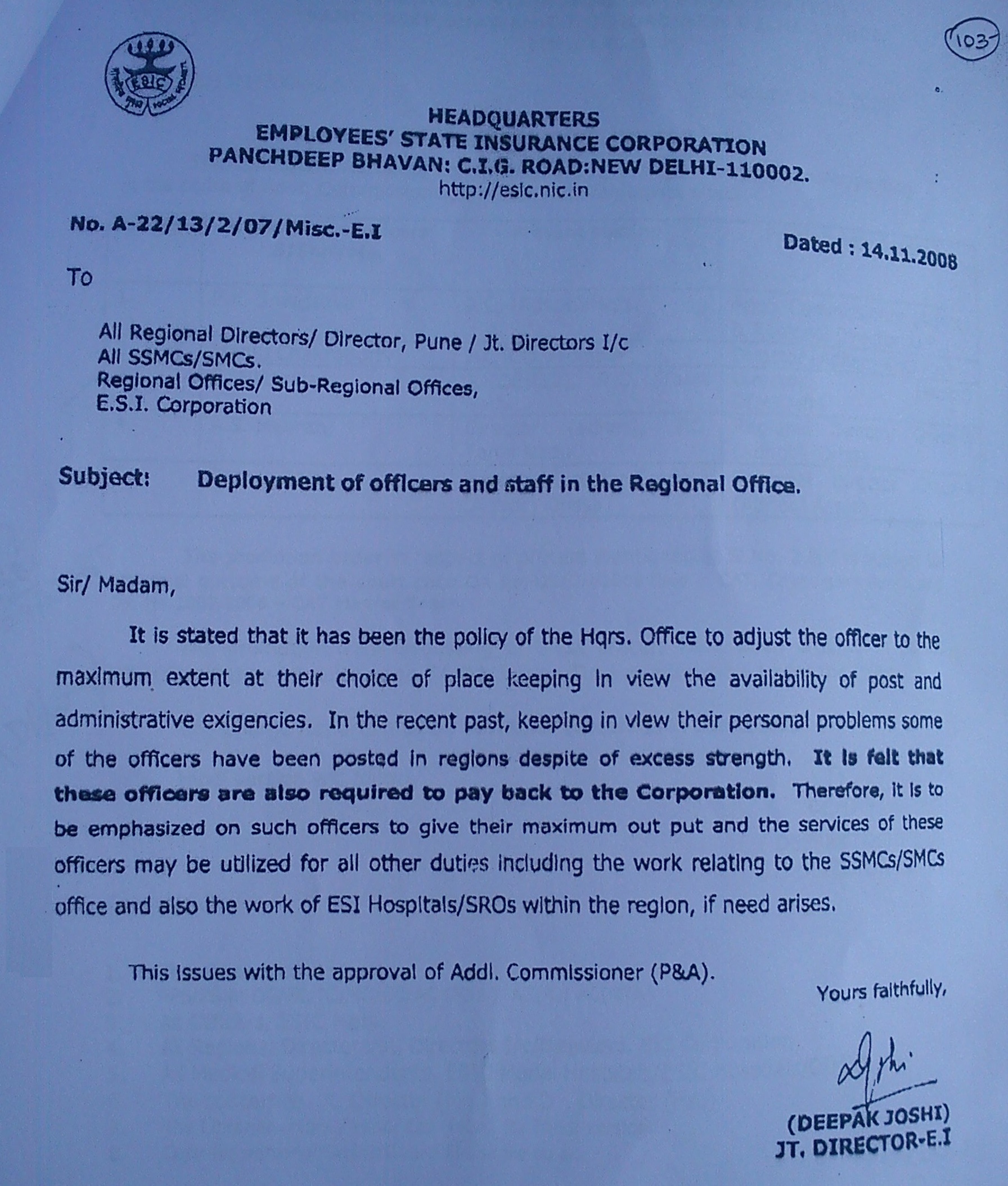
The ESIC itself, also, it appears, is unable to comprehend these beneficial provisions in proper perspective. It is more attuned to interpret these provisions in a pedantic manner so as to deny them the dependants benefit. In the recent past after the judgement of Gujarat High Court in the case of Ranisati Processor Pvt Ltd., v. Deputy Director, ESIC, the ESIC Headquarters New Delhi has framed contradictory and conflicting policies aimed at misinterpreting the provisions of the Act and Law. For example, by their circular dated 29.09.2009 it was directed that the dependants benefits be denied if application for registration of workers with ESIC was submitted after the death of employee due to some accident at work place because according to the judgement of Hon. High Court of Gujarat, they are not liable to pay benefits to the employees/dependants if application for registration was submitted posthumously. On 06.04.2010 these instructions were modified so as to accept the declaration forms where the signature of deceased insured person is available on declaration form though submitted posthumously. On 21.10.2010 these instructions were again modified in which it was directed that declaration forms of coverable employees are to be accepted even posthumously irrespective of whether signatures/thumb impressions are there or not with further directions that the negligent employer is to be proceeded with u/s. 68 including prosecution for violations of the provisions if any. But the circular is totally silent as to how the past denied cases are to be dealt with due to change in their illegal policies undertaken at frequent intervals.
These circulars by themselves are fine examples as to how the Corporation which is responsible for implementing the beneficial provisions of the Act has misinterpreted them time to time at their sweet will even when there is no change in the law passed by legislature. One is clueless to fathom the undercurrent and the mindset of the corporation which changes its policy, depending on the judgement selectively to suit its convenience with single minded objective as to how best to deprive the benefits even when the law remaining unchanged.
There is no doubt that these misinterpretations have a colossal impact on the beneficiaries. It has victimised them and their dependants who have to run pillar to post in search of relief thereby forcing them to enter into costly litigations and yet compelling them to live in lurch and in a state of despair. It is noticed that there are plethora of cases rejected illegally on these grounds in West, Central and Southern regions of the country.
It is hoped that the ESIC may reconsider all these cases and that the policy of the ESIC should be based on a firm footing in accordance with law without any scope for variation in terms of conflicting judgements delivered from time to time by the Courts. If this is done it will go a long way in correctly implementing the beneficial legislation entrusted to ESIC. The thrust must therefore be how to give relief to the beneficiaries and not how to deny it.
Advocate S. D. Puri
 Flourishing ESIC