Time spent traveling to and from work is “work”- European Court of Justice !

” European Court of Justice said its ruling was made to uphold the health and safety of workers, which is protected by the EU’s working time directive. This legislation mandates that no employee should be forced to work more than 48 hours per week.”

For more:

http://qz.com/500186/a-court-has-ruled-that-time-spent-traveling-to-and-from-work-is-work/?utm_source=atlfb

Opposite is in India, run by businessmen-controlled-politicians, notwithstanding Sec. 51-E, which was a definite progress, in spite of procedural difficulties.

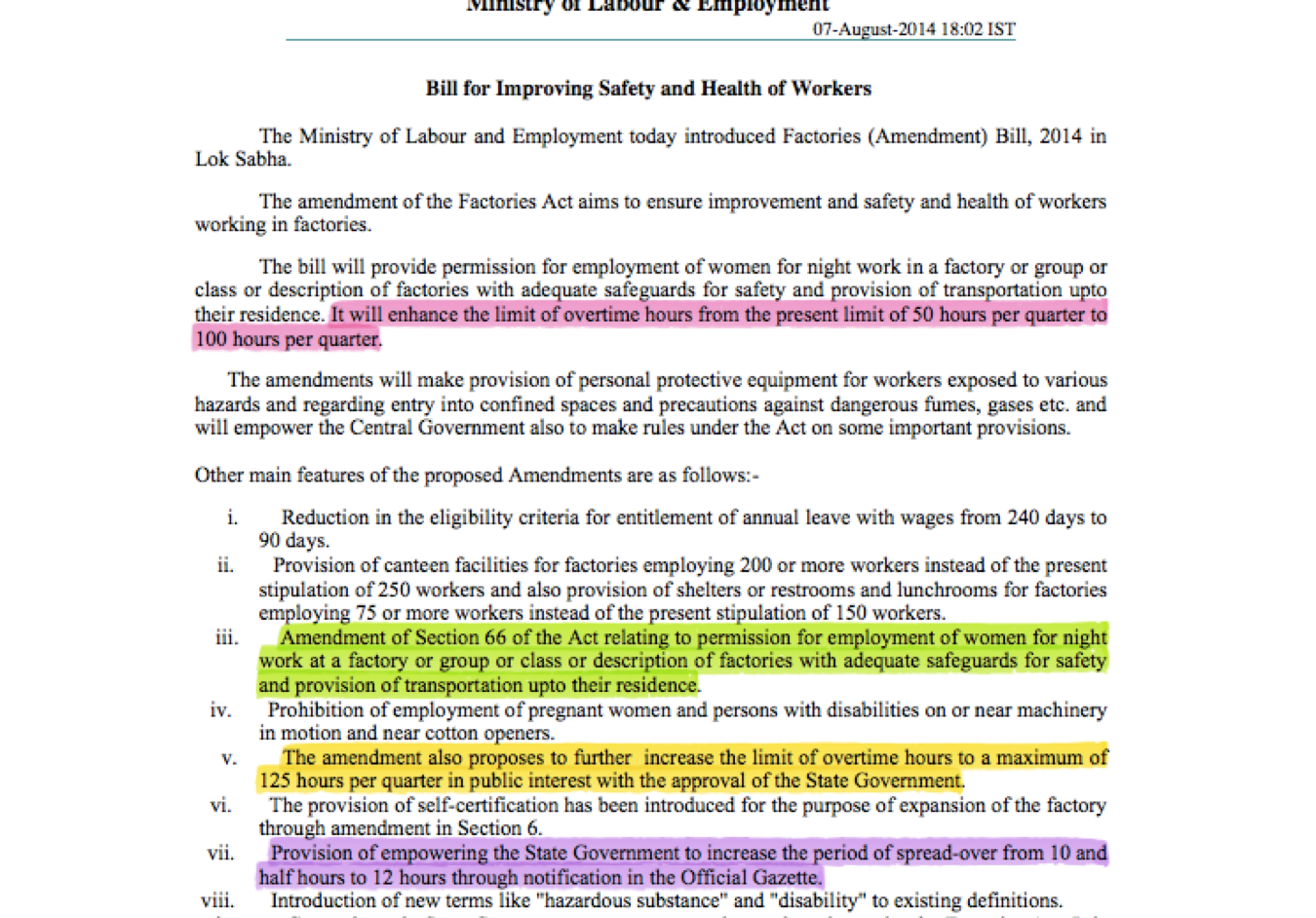
Here, increase in the Over time limit, meant actually to facilitate exploitation by the employers, is projected as a labour welfare measure:

picture1

Safety and Health – Polls apart 

“Requiring them to bear the burden of their employer’s choice would be contrary to the objective of protecting the safety and health of workers pursued by the directive, which includes the necessity of guaranteeing workers a minimum rest period.” – says the European Court of Justice.

Increasing the spread-over period to 12 hours is shown as the a safety and health measure in India. 

There is no necessity to guarantee the workers any “minimum rest period”.

Mayday revolution resulted in 8+8+8 hours, i.e., 8 hours for work, 8 hours for forest, recreation with family and 8 hours to sleep. But, already the official 8 hours work has become 12 hours including the time taken for commuting to and fro workspot, in India. When the spread-over period is 12 hours, and the journey between the residence and workspot takes another 4 hours, where is the time for rest, family and sleep?

We are creating a society that would be poor in health and would need more medical attendance resulting in more expenditure on medical side by the ESIC and the State.

We do not care for any respectable slot in the Human Development Index or Global Prosperity Index.

Those who can change things, do not do their bit. But, they work for extricating themselves from that situation personally.

When are we going to usher in a civilised society free from exploitation?

=======================Added later:=================

The action taken by the Indian government through the Bill for “improving safety and health of workers”  is contrary to the guidelines given by the UNO on “improving the safety and health of young workers” (For more: https://www.ilo.org/wcmsp5/groups/public/—ed_protect/—protrav/—safework/documents/publication/wcms_625223.pdf ) 

1 Comment

Filed under Benefits, Inspections

Outsourcing ESIC’s recruitment process to private agencies: Is it valid in law?

The ESI Corporation is a public organization, a statutory body set up under a Central Act.

The recruitment to this organization at top levels is done by the UPSC. At the lower levels the organization itself had been conducting examinations through its own Examination Wing successfully for decades. But, all of a sudden some decision was taken by someone to outsource the recruitment work to private agencies, charting out, thus, on a wrong, dangerous and legally invalid course.

The decision had been taken without proper analysis of the pros and cons of the issue, without getting legal opinion on the proposal. The irregularity had been continuning for long because

  1. the people who were affected did not know why they were affected.
  2. the people who got through did not care about the process, as they became the beneficiaries of the system and
  3. the people who were in position and power did not care, because they were not affected.

Things went astray, thus, continuously. Now, it is learnt that the ESIC is going to recruit personnel for the posts of MTS and UDCs next week. The examination will be online. But, the candidates have to visit centres far away from their stations.

Physically Handicapped candidates from Tamilnadu are compelled to appear for examination in Thane in Maharashtra. What a wonderful decision? Will the authorities of the ESIC or the agency that got the assignment explain the logic?

Will the Administration make public the parameters on which they chose that private organization to conduct the examinations? What was the contract amount? What would be the cost if the ESIC itself conducted the examination? How does the sanctity of examination for recruitment to a public body assured in the process?

Information is reaching from various sources which raises serious doubts of various kinds about the bona fides of the process.

Every citizen of the nation is affected by the wrong administrative procedure adopted by the ESIC Administration in having outsourced the test to private agencies unnecessarily and, of course, unlawfully. It is time the issue is resolved in a fair and just manner.

Those who feel concerned are requested to convey their stand with adequate evidence so that the issue may be taken to the notice of the Court of Law for proper legal remedy, with reference to the Art. 320 (3) (a) & (b) and Art. 321 of the Constitution of India read with Sec. 17 of the ESI Act, 1948.


2 Comments

Filed under Recruitment

Ms. Bedford and Mr. Mallya ! Methods of Corruption Control in Public Offices !

The best method advocated by governments all over the world to control corruption among public servants is that the person who is harassed must report the matter beforehand to the authorities of the vigilance wing of the government which would help trap the corrupt.

But, the method used by clever employers of factories and establishments is something different. They pay the corrupt officers whatever they demand. Get it video recorded without the knowledge of the concerned officers and keep it documented. Thereafter, they get whatever report they want from those officers. Once the inspection is over, they invite the inspecting officer back to a room and replay the recorded video, which shows (1) the demand and (2) the receipt of illegal gratification. They recover the entire amount of bribe or the excess amount of bribe, as per their assessment, from the corrupt officer who pays back the money and runs away. The inspecting officers remain, thereafter, at the control of those corrupt employers.

Now, the entire nation knows that an agriculturist Mr. Balan, was severely beaten by the police at Thanjavur district of Tamilnadu for not having repaid two instalments of loan that he had bought for buying a tractor. The Hindu 11.03.2016 reports: “Balan had borrowed Rs.3,80,430 in 2011 from the Thanjavur Branch of the Kotak Mahindra Bank. He has so far repaid in six half yearly instalments of Rs. 68,543 each, a sum of Rs. 4,11,200 and needed to pay only two instalments when crop failure in successive seasons hit him like other delta farmers, forcing him to default on repayment …. Meanwhile, taking a stern look at the incident, the NHRC has issued notices to the State Chief Secretary and the DGP. Stating that such form of forcible recovery by itself amounted to human rights violation and compounded the nature of the offence committed by those who assaulted the defaulting farmer. The officials have been asked to file their report in two weeks time.” (For more: http://www.thehindu.com/news/national/tamil-nadu/assault-of-farmer-nhrc-notice-to-chief-secretary-dgp/article8338865.ece )

The same nation saw the rulers allowing Mr. Vijay Mallya, who had to pay about Rs. 9000 crores, to flee and escape, because, Mr. Mallya knew how to deal with the corrupt. But, the talent of this businessman does not end with the corrupt officers and political leaders. He had also been bribing the media men all along and recording the events.

Now, he is threatening them openly, which is another crime. This criminal must be booked for this crime of blackmail also and the documents seized and made public to enlighten the public about the ‘great’ media souls who corrupt the public opinion day in and day out.

When Ms. Bedford, the sex-worker, threatened that she would reveal the names of her customers, it worked.

Bedford and Mallya

As Mr. Mallya has threatened the media thus, his blackmail must already be working. The media would hereafter ‘behave’. And, Mr. Mallya who was fond of wine and women could continue to invent ways, with the help of the political leaders in his pockets, to borrow the remaining money from the banks and loot the nation.

The corrupt officers, political leaders and media men, who sold their souls and fell victims to the methods of seduction of Mr.Mallya would veer around now to protect him.

Truth must come out, in spite of these pests.

This incident must also warn, at least, the other officials of what is going on in the corporate world.

Leave a comment

Filed under Uncategorized

Validation Clause: An IP’s letter to the ESIC Members !

Excerpts from the letter sent by an Insured Person to the Members, who are Employers’ and Employees’ representatives in the ESI Corporation: 

16.12.2015

To

1. Mr. Sudershan Sareen,

2. Mr. G.P. Srivastava,

3. Mr. B.C. Prabhakar,

4. Mr. Michael Dias,

5. Dr. U.D. Choubey

6. Mr. Rajinder Singh Maker

7. Mr. Vijay Kalantri

8. Mr. Rama Kant Bharadwaj

9. Mr. Badish Jindal

10. Mr. Bharat Mehta

11. Mr. Ram Kishore Tripathi

12 Mr. Prashanta Nandi Chowdhury

13. Mr. Gokulananda Jena,

14. Mr. V. Radhakrishnan,

15. Mr. Ajit Sripad Kulkarni,

16. Mr. Dilip Bhattacharya

17. Dr. G. Sanjeeva Reddy

18. Mr. Chandra Prakash Singh

19. Mr. K. Suresh Babu

20. Mrs. Amarjeet Kaur

Sub: Construction of buildings for Medical Institutions in the ESIC – Expenditure during the pre-amendment period – remaining as an unauthorized expenditure till date – false statement by the authorities of ESIC before Court.

Ref: 1. Para 8 of the Affidavit of the Petitioners in the W.P. 12953 of 2015 before the Hon’ble High Court.
2. Para 11 of the Counter-Affidavit filed by the ESI Corporation, the Respondents 2 & 3, therein, in the same W.P. 12953 of 2015.
3. Para 76 & 77 of the Report dated 04.12.2009 of the Parliamentary Standing Committee on Labour & Employment.

======

Sir/ Madam,

I invite your kind attention to the references cited and request you, one of the trustees of the ESI Corporation and the custodian of the ESI Fund, to kindly bestow your personal attention to the issues raised in this letter. This letter arises out of the pleadings of the parties in the W.P. 12953 of 2015 in the Hon’ble High Court of Chennai and explains the manner in which the officials of the Hqrs. Office had deliberately misled the Hon’ble High Court by submitting false statements, even when they were on oath, in the matter of construction of buildings for medical institutions and setting up medical colleges, nursing colleges and training institutes for para medical staff that involves massive expenditure of thousands of crores of rupees.

2. I request you to kindly recall the fact that the ESI Act was amended by the Parliament only on 03.05.2010 to insert Sec. 59-B therein, to empower the ESI authorities to set up medical institutions. The Bill for such amendment, tabled in the Parliament of India on 30.07.2009, contained the following as Clause 15:


Clause 15

The said clause was approved and passed by the Parliament of India as Sec. 59-B on 03.05.2010, the assent of the President obtained on 24.05.2010 and the amended provision became effective from 01.06.2010. as per the decision of the Ministry of Labour and Employment. Sec. 59-B which is in force as on date reads as under, in Clause 17 of the ESI (Amendment) Act, 2010:

Clause 17

It would thus become clear that the authorities of the ESIC did not have the authority to incur any expenditure to construct buildings for medical colleges or to incur expenditure to appoint Deans and Professors, or to spend money to engage even Consultants for setting up of medical colleges, at any time, before 01.06.2010, the pre-amendment period.

3. But what had actually happened was that the authorities of the ESIC had, during the pre-amendment period from 2008 to May, 2010, incurred thousands of crores of rupees and that exprenditure remains an irregular and unauthorized expenditure till date. They had spent such a huge sum of public money even before the Bill was tabled in the Parliament in July 2009.

4. This, in spite of the fact that Sec. 28 of the ESI Act, does not permit expenditure of ESI Fund for purposes which are not within the purview of the Act. The opening sentence of the said Sec. 28 makes it very clear that the ESI Fund can be expended “subject to the provisions of this Act”. The rules can be made by the Central Government to spend ESI Fund, only with reference to the purposes mentioned in the Act. Significantly, no provisions in the Act permitted setting up of medical institutions before 01.06.2010. Besides, no “Rules” have so far been framed by the Central Government to spend ESI Fund for the purpose of construction of buildings for medical colleges. Thus, even Sec. 28 (xii) of the Act cannot be used to justify the expenditure incurred during the aforesaid pre-amendment period. There was no authority for anyone in the ESIC to permit expenditure from the ESI Fund for any purposes relating to the setting up of medical institutions, before 01.06.2010. The expenditure incurred actually by the authorities of the ESIC, thus, during the abovementioned pre-amendment period, was, therefore, an unauthorized one.

5. This fact had been referred to in the pleadings before the Hon’ble High Court of Madras at Chennai in W.P. 12953 of 2015 which had been filed with reference to the issue of new-admission of students into the ESIC-run medical colleges for year 2015-16. Paragraphs 8  of the affidavit of the Insured Persons who filed in the said case read as under:

“8. But, overlooking the importance of the Scheme in the making of the nation, all of a sudden an administrative decision was taken in the year 2008 to set up more than 28 medical colleges throughout the nation. A Chief Engineer was also appointed in violation of the recruitment rules on the subject, in a hurry and hundreds of crores of rupees were sanctioned under his signature for constructing buildings for medical colleges. But, there was no provision at all, at that time, in the ESI Act authorizing the ESI Corporation to establish and run medical colleges. A Bill for amending the ESI Act to empower the ESI Corporation was introduced only later, in the year 2009, in Lok Sabha, as Bill No. 66-C of 2009. That Bill was got passed by the Lok Sabha only on 03.05.2010. The provisions of the Amended Act came into force only on 01.06.2010. These events would prove that the expenditure incurred for constructing buildings for so many medical colleges by the Respondent-2 before 01.06.2010 was, clearly, an unlawful and unauthorized expenditure. It is learnt that such expenditure sanctioned and incurred upto 31.05.2010 itself was around Rs. 10000 crores. The expenditure incurred from and after 01.06.2010 till date is not taken into account here and is said to be more than Rs. 15000 crores.

6. But, the ESIC had filed counter-affidavit stating that the expenditure thus during the pre-amendment period was regularized through the Validation Clause in the Amendment Act, 2010. Their reply in Para 11 of the Counter-Affidavit said, “The Validation Clause in the ESI (Amendment) Act of 2010 (18 of 2010) provides for all expenses incurred.” This statement regarding the Validation Clause, is a deliberate and conscious lie on the part of the officials of the Hqrs. Office of the ESI Corporation besides being blatant perjury in the sworn statement. The authorities had fearlessly made such stunningly false statements before the Hon’ble High Court itself. The said Para 11 is reproduced below:

“11. I submit that the contention of the Petitioners made in Para No. 8 of the Affidavit is misleading in that the decision to set up medical colleges across the country was taken with a view to improve medical care facility to IPs (Insured Persons) and their dependants. The Validation Clause in th ESI (Amendment) Act of 2010 (18 f 2010) provides for all expenses incurred. The expenditure incurred on 12 ongoing medical college projects including the medical education complex at Gulbarga till 30.09.2014 is around 5350 crores only.”

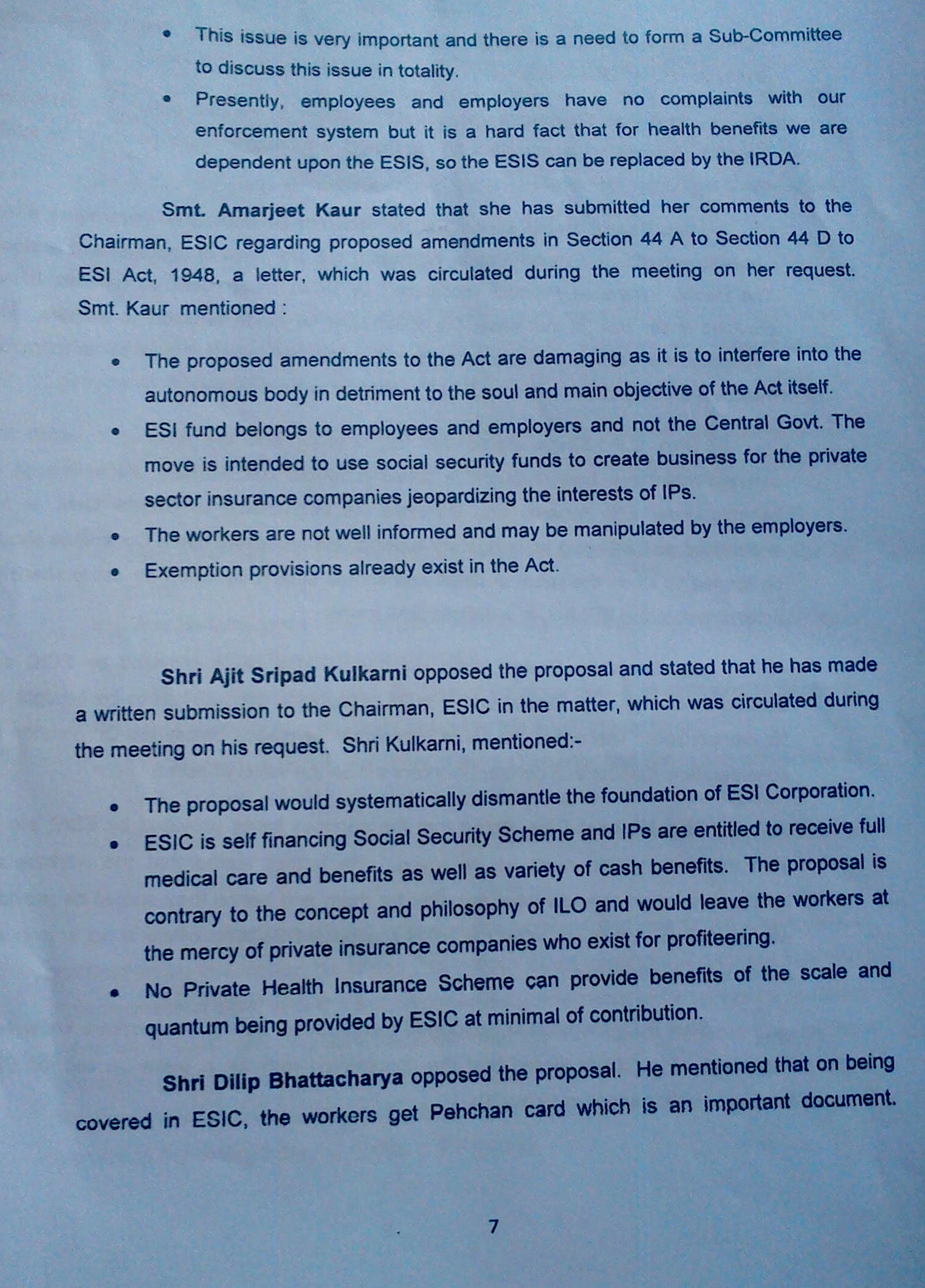
7. The fact is that the Validation Clause had not, at all, been inserted in the Bill 66 of 2009 to ratify the actions and inactions of the Respondents with reference to the expenditure incurred for setting up medical educations or for constructing buildings for medical colleges. In fact, the Parliament was not even made aware of the fact that the Respondents had already taken action (a) for construction of medical colleges, (b) for the payment of salary of Deans and Professors (without students) and (c) for payment of fee to the consultants. To be more precise, the Parliament was not aware that the ESIC authorities had spent thousands of crores of rupees even before the Bill for amendment was placed on the table of Lok Sabha on 30.07.2009.
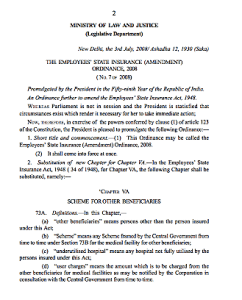
Ordnance First Page

Ordnance First Page

8. The Validation Clause had, actually, been inserted only to ratify the action or inaction on the part of the Respondents with reference to the ESI (Amendment) Ordinance, 2008 which was promulgated on 3.7.2008 (Ord. 7 of 2008) for opening of facilities in ESI Hospitals to other beneficiaries on payment of user charges. The ESI (Amendment) Bill, 2008 (Bill No. 56 of 2008) which had been tabled in the Parliament on 29.09.2008 could not become Act and the Ordinance got lapsed in due course. It was in that context, the Validation Clause was inserted in the ESI (Amendment) Act, 2010 to regularize the action or inaction with reference to the aforesaid Ordinance, when it was in force. Para 76 & 77 of the Report of the Parliamentary Standing Committee on Labour, which examined the Bill No. 66 of 2009 as per the directions of the Hon’ble Speaker of Lok Sabha, would testify to this fact.

9. The observations of the Parliamentary Standing Committee on Labour regarding the need for Validation Clause are reproduced below:
“76. It is proposed to validate actions or measures taken during the period beginning on or after 3rd July, 2008 till the commencement of ESI (Amendment) Act, 2009.
77. The Ministry in their explanatory note stated as under:- “The ESI (Amendment) Ordinance, 2008 was promulgated on 3.7.2008 for opening of facilities in ESI Hospitals to other beneficiaries on payment of user charges. However, as the Bill to amend the Act to replace the Ordinance could not be taken up in the Parliament due to dissolution of 14th Lok Sabha, the Ordinance lapsed. Hence, it is proposed to validate any action taken based on the Ordinance. Grant of exemptions by the State Governments result in denial of social security benefits to workers as well as under-utilisation of infrastructure created for the insured persons of that area. It is therefore proposed that such exemptions may be granted judiciously only where benefits substantially similar or superior to the benefits provided under this Act are provided by the employers.”
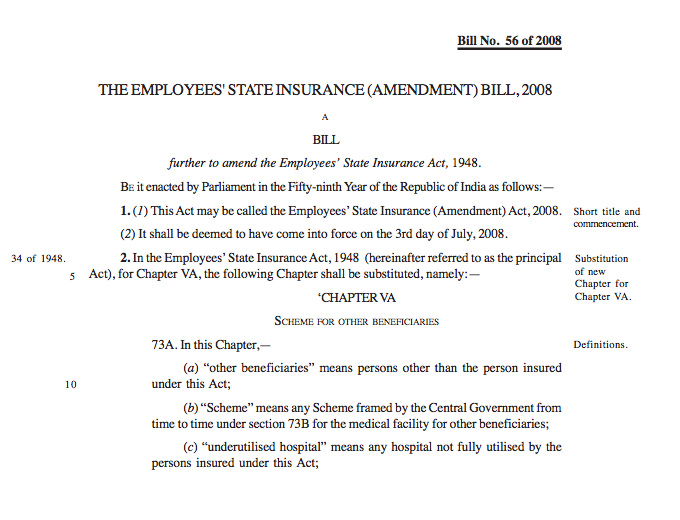
Amendment Bill of 2008 that could not be passed because of the dissolution of the Lok Sabha.

Amendment Bill of 2008 that could not be passed because of the dissolution of the Lok Sabha. If this Bill had been passed in 2008, there would have been no Validation Clause in the ESIC (Amendment) Act of 2010. 

10. These observations of the Parliamentary Standing Committee would very clearly prove that the Validation Clause had no connection at all and had nothing to do with the colossal expenditure incurred by the ESIC authorities during the pre-amendment period upto and including May, 2010 for construction of buildings for medical institutions of the ESIC and other expenditure for this purpose.

11. The ESIC authorities are, therefore, …………………. in their pleadings, that irrelevant Validation Clause to justify the unlawful expenditure incurred by them to set up medical institutions, during the said pre-amendment period. Moreover, it is a fact that the ESI Funds had been siphoned away in the name of construction of medical institutions, from December 2007 onwards, immediately after a Chief Engineer was appointed unlawfully on 28.11.2007, while the Validation Clause talks of the events that had taken place, seven months later, only from 03.07.2008 (with reference to the lapsed ESI (Amendment) Ordinance, 2008).

12. The very fact that the ESIC authorities could not produce any evidence in …………..which was about Rs. 10000 crores, remains an unauthorized one till date.

13. I, therefore, request you to kindly ascertain all the facts pertaining to the incorporation of such a deliberate …………….

14. In the context, it would be helpful to you to understand the attitude of the authorities, if you know the fact that they are maintaining total and unlawful silence to the application of Mr. K. K….. under the RTI Act on 10.07.2015 (Copy enclosed). He had asked for the simple information regarding details of the so-claimed actions and inactions in the field of construction of buildings for and setting up of medical colleges which were proposed to be regularised by inserting that Validation Clause. But, no reply has been given under the RTI Act by the officials of the till date.

15. It would be appropriate, if you could use your good offices to place the issues raised in this representation as an Agenda point before the next meeting of the Standing Committee / ESI Corporation and request the authorities to explain their case to all the Members present in the meeting and get the details recorded in the Minutes thereof. It would be better if you could use your influence as a Member of the ESI Corporation and try to obtain the information even earlier to avoid wastage of time, in seeking legal remedy through Court of Law. It is proposed to seek the kind intersession of the Hon’ble High Court on this issue by filing a Writ in February, 2016.

16. A line in reply about the initiative taken by you, with reference to this representation would, therefore, help me to place the facts before the Judiciary besides convincing my co-beneficiaries of the ESI Scheme to repose faith in you and trust that you are acting in the interests of the ESI Corporation, safeguarding the ESI Fund and, thereby, protecting the interests of the insured persons, when the authorities of the ESI Corporation are indulging in the organised crime of mismanagement of public funds that runs into crores and crores of rupees.

Thanking you on behalf of millions of insured persons like me,
I remain,
Yours faithfully,
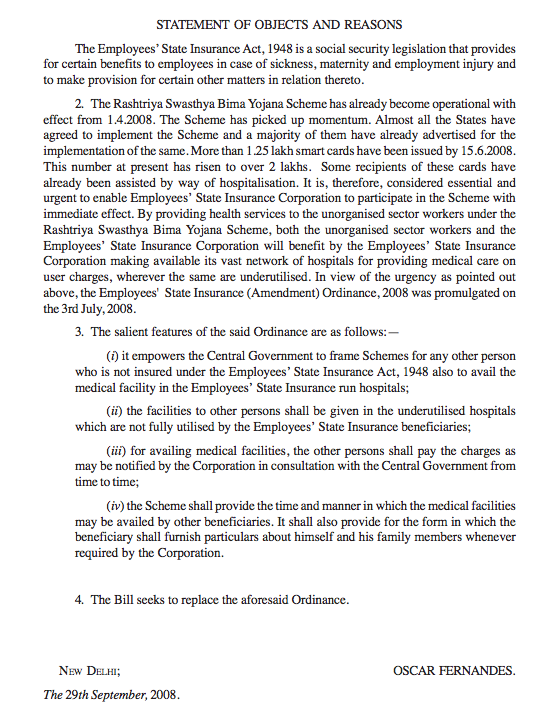
Statement of Objects and Reasons that accompanied the Amendment Bill of 2008

Statement of Objects and Reasons that accompanied the Amendment Bill of 2008

1 Comment

Filed under Amendments 2010

CAG in December 2015 on ESIC Medical institutions !

I. 
Submission in the W.P. 12953 of 2015 filed in April 2015 and in the W.P. 18773 of 2015 filed in June 2015 before the Hon’ble High Court of Madras at Chennai:
“In the circumstances, the decision taken by the Respondent-2 (Director General) on 05.01.2015 to quit medical education and not to admit new batch of students is a correct one and it was intended to salvage whatever is left of the ESI Scheme and to prevent it from getting drowned”.
Findings of the CAG as per the Press Release in December 2015:
“Corporation decided to exit from the field of medical education in its 163rd meeting held on 4th December 2014 as it was not one of its core functions. The decision to exit from this endeavour was only an exercise to limit the liability” (Para 2.12).
II. 
Submission in the W.P. 12953 of 2015 filed in April 2015 and in the W.P. 18773 of 2015 filed in June 2015 before the Hon’ble High Court of Madras at Chennai:
“But, the decision taken all of a sudden on 14.07.2007 during the meeting of the ESI Corporation to establish 43 medical educational institutions in 17 states of India commenced the era of impedance in the functioning of the ESI Scheme. All of a sudden the ESIC started to enter into the field of medical education. And that too on a large scale at the initial stage itself without even testing waters through Pilot Project.”
Findings of the CAG as per the Press Release in December 2015:
“Due diligence, if any, carried out to ascertain the number of colleges required to be opened, to fulfill the future requirement of doctors and other paramedical staff was not available”. (Para 2.6).
“The organisation also did not have any concept paper or project report to assess the viability of opening medical colleges or alternatives to cope up with the shortage of medical personnel in the ESIC hospitals, the CAG said.” – Business Standard 18.12.2015.
For more:
and

1 Comment

Filed under Medical College Bond

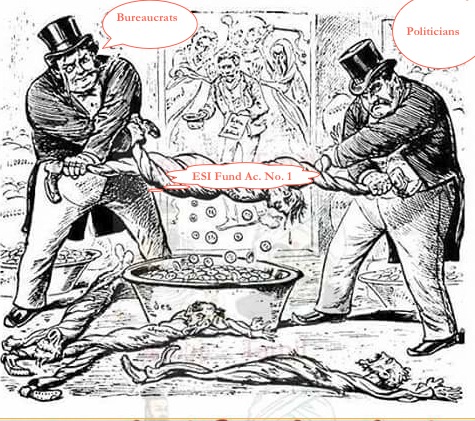
The fine art of squeezing out the ESI Fund Account No. 1.


The ESI Corporation Minutes dated 17.07.2007 shows that the decision to open medical colleges had been taken in that meeting, in spite of the fact that there was no formal agenda on that subject and no discussion on that subject. The Sub-Committee that was constituted, later, in 2008 to formulate proposal for amendments on various issues, recommended setting up medical colleges on the condition that the “doctors and paramedical staff would be required to render such minimum service in ESI hospitals / dispensaries / institutions as may be decided by the Corporation”.

ESI Medical Bond


The Insured Persons whose money was to be spent for this purpose and the Parliamentarians who approved the amendment to insert Sec. 59-B had been given the impression that there was something for the Insured Persons in return for the money collected from them (whether it was proportionate or not is beside the matter).

As the intention was only to fritter away and misappropriate the surplus funds, the authorities did not wait for the essential procedure of formal amendment to the ESI Act, which actually came in the form of Sec. 59 B of the Act only in May 2010 effective from June 2010. They initiated the construction work for so many medical institutions throughout the nation, in a tearing hurry, in the year 2008 itself, and spent about Rs. 10000 crores even before the Act was amended. They did not exhibit ordinary prudence and caution by having a proper and objective in-depth study of the pros and cons of starting medical institutions by the ESI Corporation. They did not even try with a few pilot projects. They started constructing buildings, at one go, for large number of medical colleges including nursing colleges and colleges for para medical staff.

There was never any felt need for the ESIC to start medical colleges to recruit the MBBS-qualified doctors let alone nurses and para-medical staff to run their dispensaries and hospitals. The ESI Corporation had always been getting overwhelming response to its advertisements to recruit MBBS-qualified doctors, BDS qualified doctors, nurses and other para-medical staff. For instance, there had been 3000 applicants when the recruitment process was for 300 vacancies of MBBS-qualifed doctors. Yet, the authorities started constructing about 23 buildings throughout the nation and all of them have now become white elephants. Now, in the year 2014, their own Sub-Committee on Medical Services & Medical Education said that running the medical colleges would result in the budget becoming negative in the year 2016-17.

Hon’ble Minister for Labour Mr. Narendra Singh Tomar has said that “the decision to open medical colleges by the ESIC was a big mistake”.  

Calling the ESIC board’s decision to open medical colleges in 2008-09 a “big mistake”, labour and employment minister Narendra Singh Tomar said he will review the scheme.“The decision to open medical colleges by ESIC was a huge mistake and we will rectify it,” Tomar told reporters after a meeting of the ESIC board comprising representatives of workers, industry and government.

The Financial Commissioner said that the ESIC did not have the core competency:

“Medical education is not our core competency, and we would prefer to focus on our primary job—providing medical care services to industrial workers,” said S.K. Rahate, finance commissioner, ESIC. “We have learnt from experience over the last five years.”

Live Mint reported:

“These are high cost projects causing a significant outflow of funds on both capital as well as revenue accounts. This will in near future cause the ESIC expenditure to be more than its revenue income,” said an internal note based on an ESIC sub-committee report. Mint has seen a copy of the note.”

That Note, the Report of the Sub-Committee  on Medical Services & Medical Eduction submitted in May 2014 discussed at length about the system of Bond that had to be obtained from the students who were given subsidised education from the ESI Funds. In Para XIII (6) in Page 51 of the Report, the Sub-Committee had observed that the ESIC could not subsidise the medical education, when the Bond was not for recovering the full recurring cost. The said para read as under:

“If full recurring cost is to be recovered from UG/PG students, it would require charging very high fees; or, the corresponding Bond amount would need to be very high. If the fees/Bond amount is to be reduced, it would require subsidy for medical education from the ESIC. This may be violative of the spirit of the ESI Act.”

Page 31 of subcommittee report on ME

In Para XIII (5) (e) of the Report, the Sub-Committee had said, “That there was no system of bond enforcement and without an effective enforcement of bonds, the availability of doctors to the Corporation would not be assured.”


Now, all of a sudden, the insured persons are informed that the so-called precautions taken by them, as narrated above, can be and have been thrown to wind. 

This announcement is made even before the first batch of undergraduate students is out and on the verge of their being out, by the summer of 2016. The ESIC does not say that there is no vacancy to accommodate the newcomers. The ESIC says that obtaining such bonds would be considered as anti-people move.

“Since ESIC has spent thousands of crores on medical colleges, it is unfair for students who get subsidized education and then join the private sector, a labour ministry official said. “So, the Rs.25 lakh bond plan was mooted, but in the current political environment, such a move has been put on the back-burner,” the official said, requesting anonymity.”  (http://www.livemint.com/Politics/yJigrCBGE3RY3oBhGp7A2H/Govt-scraps-planned-Rs25-lakh-bond-for-ESIC-medical-students.html)

This is not a correct decision. The reason publicly proclaimed does not appear to be the right one. The money of the Insured Persons cannot be frittered away by the politicians and bureaucrats thus.

Politicians and Officials


Such an awakening that the enforcement of Bond would be seen as an anti-people move did not come in 2007 or 2008, before venturing into the area of medical education. Besides, such Bond system is in vogue as per the CCS (Leave) Rules, 1972,  governing the sanction of even the Study Leave. Nobody has termed it as an anti-people move, during the past 43 years.

In the circumstances, some Insured Persons are already taking action to move the Hon’ble Court to seek its intersession, against this kind of arbitrary decision in the name of Policy Decision.

The copies of the Agenda and the Minutes of the meeting of the ESI Corporation in which such a decision has been taken have, therefore,  been sought for under the RTI Act. But, if any of the readers happen to have those documents, through the ESIC Members, they may kindly transmit the same to this website to facilitate early legal action, in the interest of the working population.

Readers may also evaluate for themselves the manner in which benefits made available to the Insured Persons have been reduced post 2010.

1). http://www.outlookindia.com/article/the-gurney-grinds-to-a-sad-halt/295143

2) https://flourishingesic.info/2012/09/27/enigmatic-amendment-2011-that-affect-the-benefits/

3). and the response of Ms. Nisha Parveen below the thread referred to supra.

1 Comment

Filed under Medical College Bond

Imphal Free Press Editorial on societal death wish !

Silappadhihaaram, an illustrious Tamil literature of the days of yore, explains the real-life incident of a 22 year old woman fighting for justice and exposing, with evidence,  the corrupt bureaucracy and the defective decision-making-process of the competent authority (the King). Her fight was a lone battle. She asks, after having established the facts, why others did not come forward to question the wrong committed by the Palace Goldsmith and the King. She asks, to the eternal shame of the so called intellectuals,  whether there were learned men at all in the country (Saandrorum Unduhol?).

This literary work addresses the imperative for the consciousness among the people not just to be narrow-minded to look after their individual needs but to actively involve themselves in public issues and work for ensuring justice to the affected and thereby keep the society free from corruption and injustice. Kannahi the Great, is admired and adored by the posterity for her courage, talent and valour that she demonstrated at that tender age.

The statue of Kannahi on the Marina Beach

The statue of Kannahi on the Marina Beach

“The world is a dangerous place to live. Not because of the people who are evil: but because of the people who don’t do anything about it”- said Albert Einstein.

Now, here is an excellent editorial from the newspaper, the “Imphal Free Press”. It is consoling to find a newspaper that sets the standard for journalism in an era in which many other major newspapers have gone for paid news and sectarian views. The editorial titled, “Future Imperfect” published by the newspaper on 23.10.2015 is reproduced below for the benefit of the readers:

==============================

Future Imperfect

 The need to be remembered as men of integrity, and as someone who has contributed his little to society and humanity must have to be behind so much human valour, inventions, ingenuity, courage, philanthropy, generosity…. the list of virtues can go on. This need must be a basic instinct, although it has the tendency of showing up in varying degrees in different peoples and communities. Some are sensitive to it, others not so much. And this must also be what in the long run distinguished societies that have emerged at the top and those condemned to backwardness and subordinate position in the hierarchy of nations. In a way, the instinct must be also linked to man’s craving for immortality in an irredeemably transient world that has led many a philosopher to discover only absurdity in life. With death as the grim leveller of all life, men like French existential philosopher and literature Nobel Prize winner, Albert Camus, were led to believe that all philosophies are a matter of a desperate grapple with the absurdities of life to give meaning to what are essentially meaningless.

This absurdity is profoundly evident in existential questions that ask for an explanation how even the most powerful men and women, such as Ronald Regan, President of the US for two terms and Margaret Thatcher, the Prime Minister of Britain who ruled with an iron hand once, and many others like them can also be reduced by Alzheimer disease to a vegetable like any other geriatric anywhere in the world before he met his end. What profound meaning can there be too in the fact that the greatest conqueror of the earth, Alexander of the Great should have died of the bite of a tiny and insignificant insect like mosquito in the prime of his life.

There is no escape from this overwhelming meaninglessness and hence the appeal and indeed relevance of the “existential despair” in everybody’s life. In the beginning and in the end, is the unavoidable void. A realization so well encapsulated in the Meitei cosmology symbolized by the various postures of the serpentine god, Pakhangba, with his tail in the mouth – in the beginning is the end and in the end the beginning.

Still the quest for permanence in the transience that is life must continue. This thirst is in fact as inevitable and compulsive as the existential despair itself.

This must be also what led many to resist a resignation, and not end up only as someone who live only for the present. Captivating as the picture of life portrayed by existentialism, even existentialist themselves have shown their longing for meaning. In Albert Camus’ much quoted essay “Myth of Sisyphus” for instance, the meaning and salvation of Sisyphus’ struggle, becomes the struggle itself. In Greek mythology, Sisyphus was punished by the gods to roll a massive rock up a summit-less hill. His whole purpose and mission in life thus became the prospect of toiling to push the rock up or be crushed under its weight. His endless and futile toil has today become an image of life, at once captivating, heroic and tragic, from the existentialist’s viewpoint. The toil itself becomes the meaning, for beyond it, there is nothing else. What exactly is there beyond our own individual struggles in life, and when can this struggle ever come to a conclusion, except in death.

The only way to ensure one’s legacy lives on is to leave footprints in time. And this is where the need to leave behind a memory of integrity and courage becomes an essential quality of winners, not just as individuals but also as a society. The two are closely interrelated, for indeed the achievement of the society is but the accumulative result of the achievements of individuals. The essential attribute of a society with a survival instinct in terms of this quest for permanence is a capability to leave enough space and concern for the future.

The urgent question that we are all called upon to ask at this tumultuous junction of the history of our society is, do we bother to contribute our share to the future or do we live just for the present. In the face of all the corruption, bribery, sycophancy, siphoning money from development projects, dishonest contract works, unfair trade practices, which have all become rampant today, we cannot at all be optimistic that there is such a concern for the future beyond myopic individual concerns and insecurities. Embedded in this unconcern for the common future, disturbing as the thought may be, there may be a societal death wish. Should we not make the move now to exorcise ourselves of this demon.

===============

The link; http://ifp.co.in/page/items/28904/future-imperfect

Leave a comment

Filed under Uncategorized

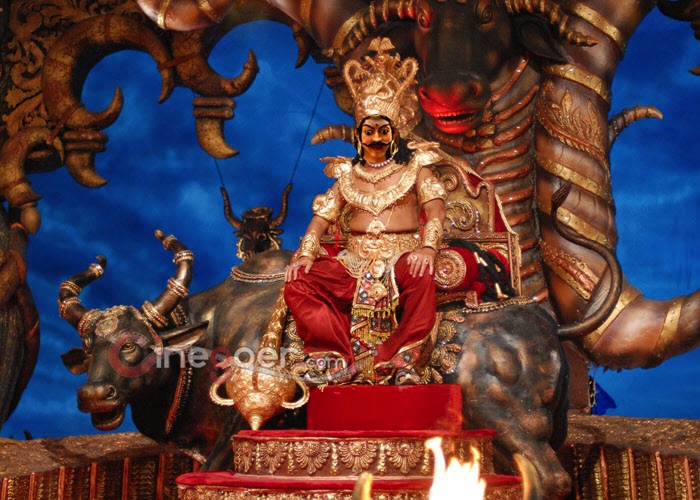
Lord Yama Dharma Raja discusses Amendment to Sec. 44 !


yamudiki-mogudu-movie-latest-stills-7-3

The Otherworld. The venue is the palace of Lord Yama Dharma Raja. Among those in the assembly were Prof. B.P. Adharkar, Sir William Beveridge, Robert Owen, Jerome Blanqui, Villerme, Daniel Legrand and others.

Lord: “Dear Mr. Beveridge ! I was hovering over the Heaven this morning ,watching the activities of the noble souls here. I was shocked to find you people sitting under a tree morosely. That was why I asked Chitragupta to bring you all here. How come you were sad? This is heaven; there is no reason for any soul here to feel worried. But, why is it that you were in a pensive mood, instead of enjoying the morning sun and the soft-blowing breeze?”

Beveridge: “My Lord ! Prof. Adharkar was sad about the activities of the bureaucrats and the politicians in power in India to amend the Sec. 44 of the ESI Act, 1948. He was the architect of the Act there. He knows the consequences of the amendment proposed by the bureaucrats now. He is, therefore, sad. When he explained the manner in which the Indian politicians go about it, I felt sad too. It so happened that Robert Owen and George Cadbury came that way. They were also shocked to hear about the amendment proposed by the Indian politicians. You might, perhaps, have seen us, then, when we were discussing about it”.

Lord: “Amendment to Sec. 44 of the ESI Act ! Did that make you so sad? I wonder why.  May I know what it is, Mr. Adharkar?’

Adharkar: “Yes, My Lord ! Mr. Beveridge had prepared a monumental document to provide social security to the people. It was published by the British Government in October, 1942. His report had, almost, been copied with some regional variations in many civilised countries. Mr. Beveridge had diagnosed the ills afflicting humanity and attempted to provide remedy only to one aspect of it. The ESI Act in India was inspired by his report on Social Security. But, the present day politicians want to do away with it. They are working for the rich to enable them to make more and more money and do not care for the poor who cannot raise their voice and make it to be heard”.

Beveridge: “Yes, My Lord ! It is the duty of the government to protect the commoners from being exploited by the rich and mighty. The Social Security enactments conceived of by me, work in that direction. The concept of Social Security is to make the world a civilised one. Humanity suffers from five ‘Giant Evils’. They are (i) Disease, (ii) Idleness, (iii) Ignorance, (iv) Squalour and (v) Want. Among these five evils, the last one, the “Want”, can be tackled in a relatively easier manner by the governments of every nation through organised action. The ESI Act was enacted by the Government of India in the year 1948 only for that purpose. But, the present day rulers do not care about the niceties of the concept of Social Security. Their present proposal to amend the Sec. 44 will ruin the entire nation. That is why Adharkar is upset so much”.

Lord: “Why do you feel upset Mr. Adharkar? Should the world stand still, as it was in the Forties? Why not the present day politicians make changes to suit the present conditions of the world? After all, more than 71 years have passed after you had given your report on 15th August 1944”.

Adharkar: “No, My Lord ! I would be happy if the concept of social security had been expanded and more benefits given, as is being done in Germany, Norway or Sweden, both in quality and quantity. But, in India the situation is otherwise. When I presented the report I recommended bringing the workmen who were drawing wages upto Rs. 200 pm, excluding Overtime wages, within the purview of this security-net. When the Act was enacted in 1948, the limit was kept as Rs. 400 pm. That was more than the salary of the District Collector in those days. Even in the 1970s, after the III Pay Commission Report was implemented, the limit for coverage was Rs. 1000 pm. That was more than the salary of the Local Office Manager of the ESI Corporation, who was disbursing the cash benefits. His Basic Pay was Rs. 550 pm, after the implementation of the said pay commission report and his total salary was only about Rs. 650 pm when the report was implemented. The Local Office staff members used to prepare the Dockets of payment to these Insured Persons with more respect, as those insured persons were drawing more salary than their own Local Office Manager. But, now the coverage limit is Rs. 15000 pm which is less than the salary of the employee appointed in the lowest cadre in the ESI Corporation. This itself would show that the scheme had not expanded in the real sense, although the number of persons brought under coverage has increased. But, I feel more concerned about the manner in which the politicians of these days want the government to abdicate its responsibility so that the rich businessmen would enter the field and make a mess of the nation”.

Lord: “How come ? Would such privatisation really make a mess of the entire nation? What is the reason given by these politicians to go for such privatisation?”

Adharkar: “These politicians say that the present scheme has resulted in holding the workers as hostages, within the ESIC fold. They say, in public, that privatisation would give them option to seek better facility elsewhere. But, that is not true, My Lord ! It is these politicians who are primarily responsible for corruption of various shades in large scale in every public organisation, including the ESIC. They spoil the organisation and then cite the same state of affairs to blame the organisation and sabotage it. Except some exceptions, the politicians in power do not come forward to make the organisation corruption-free and provide better service to humanity”.

Lord: “In that case, if corruption in public organisations cannot be prevented,  privatisation seems to be the better option”.

Adharkar: “No, My Lord ! These politicians who are not willing to  run this single public organisation corruption-free, in spite of the existence of effective tools like Conduct Rules and CCA Rules to control and monitor the officers, are not going to make the private organisations, which might venture into this field, to act in a corruption-free manner”.

Lord: “Why do they want private role in social security, then?”

Adharkar:  “Their real intention is not to protect the welfare of the workers but to provide more facility to the rich to make more and more money by opening up the field of social security also for them. The ESI Act came into existence after thorough study of the problems faced by the working population, for over a century. The Report of the Royal Commission of Labour of 1929-1931 necessitated it and the Report of Sir William Beveridge facilitated it. But, the present proposal to amend and dilute Sec. 44 did not emanate from any such public documents. There was no analysis of the experience of other nations, if any, in which such privatisation had been found to be a tremendous success. There was no public discussion on the issue, especially about the nitty-gritties of the nature of service that would be provided by the private players and the manner in which they would be monitored. The way in which the Obamacare was subjected to public discussion in the USA can be recalled in the context. No such discussion did ever take place before the bureaucrats of the PMO conspired to amend the Sec. 44 on the sly.

Lord: “Is it?”

Adharkar: “Yes, My Lord ! The aristocrats control the pliable bureaucracy in the PMO. The proposal to amend Sec. 44 originated from the bureaucrats of the Prime Minister’s Office who are habituated to bypass the Labour Minister’s Office and give directions directly to the Director General to do this and that. The very draft amendment as placed before the ESI Corporation on 07.04.2015. These bureaucrats who wield such unlawful power do not care about the welfare of the people. The very fact that the draft proposal placed on the table on 07.04.2015 received all-round condemnation (***) by the members of the apex body testify to the fact that it did not emanate from the people but from the top, as the brain child of those insensitive bureaucrats. And, those bureaucrats of the PMO believe that they are obliged only to please the rich. They believe that they are not accountable to the public. In regard to their political masters, they believe that the entire nation has been sold to them, once they get majority seats in the Parliament. It applies to all the political parties in India. The tradition of going to the people when they go for some major changes is absent in India. In essence, the Indian politicians do not know what Referendum means. They refuse to learn what UK did in the case of EEC. They just do not want the Indian democracy to mature.”

Lord: “Okay ! What, then, is your proposal to make the ESIC, a public organisation, corruption-free, if you want to retain the social security in public sector forever?”

Adharkar: “Corrupt bureaucrats are of four kinds, My Lord ! The first is Self-centred-Corrupt. The next is Organised-Corrupt. The third is Philanthropic-Corrupt. The fourth is High-fly Corrupt.

(Continued in Part II)

(***) Note: The Minutes of the meeting of the apex body of the ESIC is available at:

https://flourishingesic.info/2015/08/23/agenda-to-amend-sec-44-the-open-and-the-hidden/


(Image: courtesy: internet)

Leave a comment

Filed under Amendment 2015

Kerry Vs. Bush: Privatisation of Social Security !

2004 Presidential Election in the USA.

John Kerry wanted to scare away the voters from voting again for President George. W. Bush saying that the latter was planning a surprise second term attempt to privatise social security, and forecast a “disaster for America’s middle class”.  “I’ll tell you what. I will never privatise social security”, Kerry said.

The spokesman of George W. Bush, the Republican Party Chairman, Ed Gillespie, called the charge “just flat inaccurate”.

None of the parties wanted privatisation of social security there.

Kerry Bush

Asian Age 19.10.2004

But, Mr.Arun Jaitely, who allows himself to be influenced by power-brokers and who inserted the term ‘hostages’ in his Budget Speech (without proper document from any authorised source) to malign the ESI Scheme and the EPF Scheme is pressing hard on amending Sec. 44 of the ESI Act, 1948, to privatise social security.

People of India stand warned !

Your representatives are not working in your interest.

Leave a comment

Filed under Amendment 2015

Amending Sec. 44 : Agenda – The Open and the Hidden !

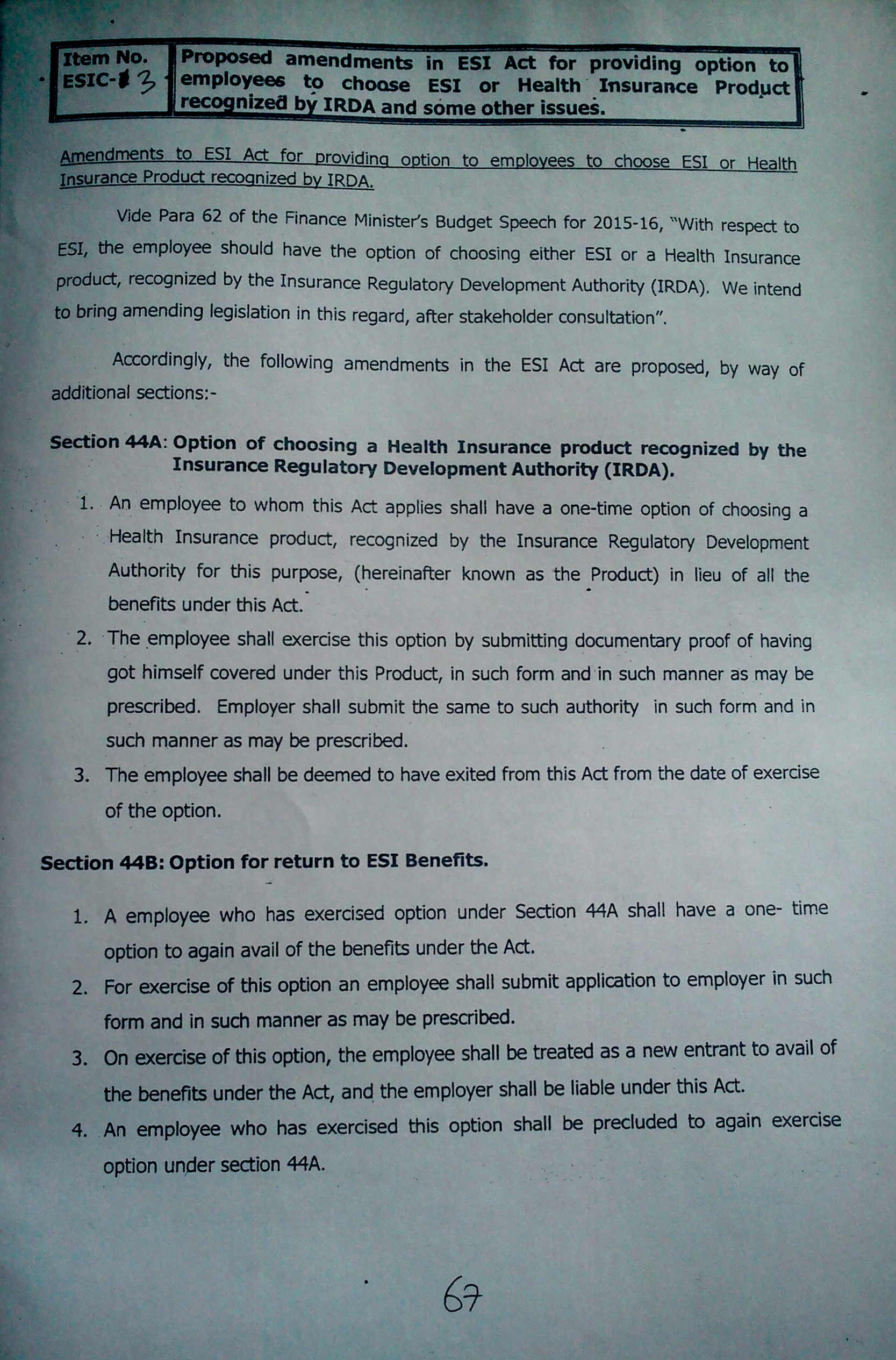
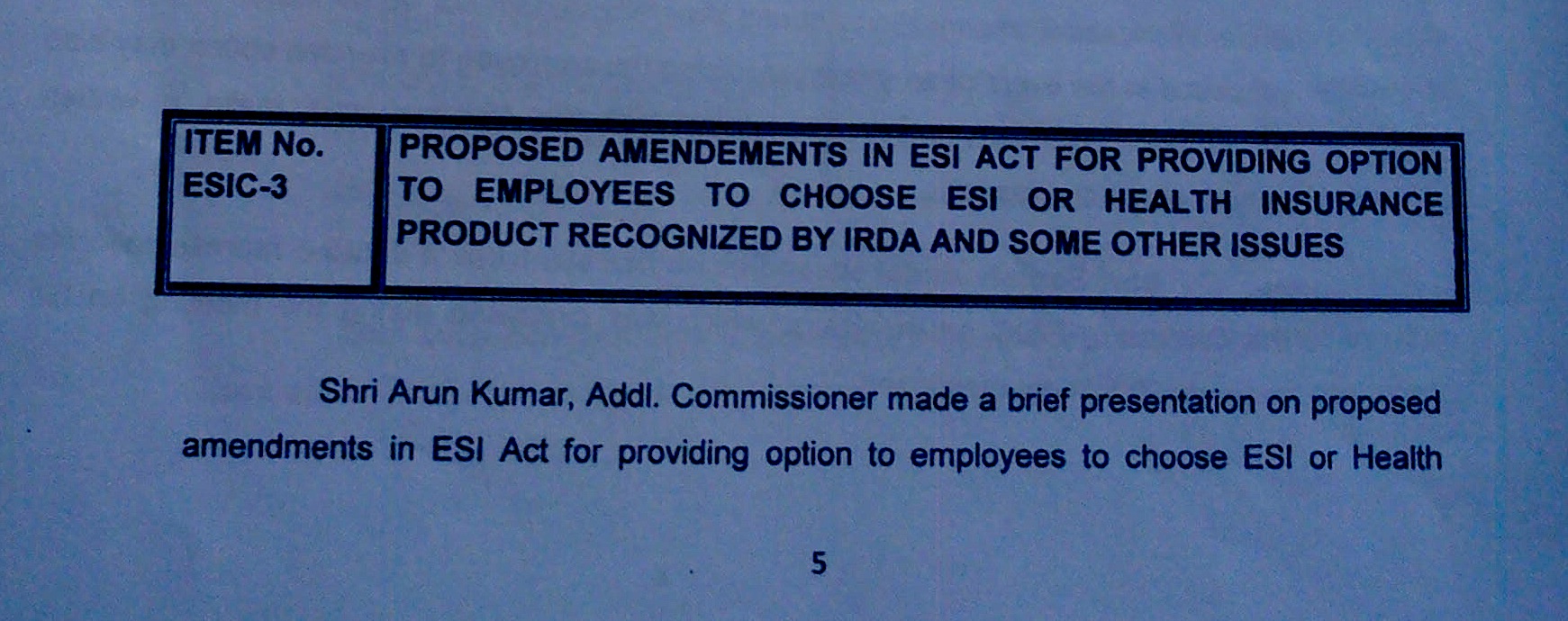
The following was the Agenda Item No. 3 placed before the meeting of the apex body of the ESI Corporation on 07.04.2015, proposing to amend Sec. 44 of the ESI Act, 1948:

The Agenda

DSC00255


DSC00259

The opening paragraph of the Agenda item says that the proposal to amend Art. 44 was born out of the need to fulfil the commitment made by the Hon’ble Finance Minister in Para 62 of his budget speech on 28.02.2015.

====

Paragraphs 61 and  62 of the Budget speech are re-produced here for easy reference of the readers:

61. Madam Speaker,  the situation with regard to the dormant Employees Provident Fund (EPF) accounts and the claim ratios of ESIs is too well known to be repeated here. It has been remarked that both EPF and ESI have hostages, rather than clients. Further, the low paid worker suffers deductions greater than the better paid workers, in percentage terms. 

62With respect to the Employees Provident Fund (EPF), the employee needs to be provided two options. Firstly, the employee may opt for EPF or the New Pension Scheme (NPS). Secondly, for employees below a certain threshold of monthly income, contribution to EPF should be optional, without affecting or reducing the employer’s contribution. With respect to ESI, the employee should have the option of choosing either ESI or a Health Insurance product, recognized by the Insurance Regulatory Development Authority (IRDA). We intend to bring amending legislation in this regard, afterstakeholder consultation.”

====

Fortunately for the insured population, the members of the ESI Corporation spoke very well during the meeting on 07.04.2015 against the Agenda Item that proposed to amend Sec. 44 of the Act that the Government had deferred the issue. The observations of the members of the ESIC as found recored in the Minutes of the meeting dated 07.04.2015 are given hereunder:

The Minutes

Page 5 of the Minutes

Page 5


Page 6

Page 6


Page 7

Page 7


Page 8

Page 8


Page 9

Page 9


Page 10

Page 10


Page 10

Page 11

Dear Readers,

The ‘power’ of the middlemen of the rich to manipulate the politicians in power to amend an important social security enactment, just through personal contacts, becomes evident from the insertion of the word ‘hostages’ in the Budget Speech of the Government of India.

The alertness of the Members of the ESI Corporation on 07.04.2015 saved the nation that day.

But, grapevine has it that the proposal placed from the above on 07.04.2015 for amending Sec. 44 has not been dropped but is being pursued by various vested interests which are after big money.

Let the representative of the employees who are members of the ESI Corporation continue to exercise the same vigil !

The ESIC would work wonders, when run corruption-free. It has worked wonders in every pocket that had been run corruption-free. Let it not be run down by the politicians and power-brokers who do not care for the future of the nation but only about their present and go with their hidden agenda.

Let us prove that Robert Owen, Sir William Beveridge and Prof. B.P. Adharkar have not toiled in vain!


=====================================================

N.B:

The following additional information is given for easy reference to recall the facts which are relevant to this issue:

The fact that the ESIC was not holding anyone as hostage had been brought out in the following post:

https://flourishingesic.info/2015/03/15/sorry-no-hostages-there-mr-finance-minister/

The fact is that the ESIC is the best bet to provide security net to the people and the details in this regard with reference to international experience and national level instances were brought out in the following post:

https://flourishingesic.info/2015/03/07/run-the-esic-corruption-free-do-not-run-down-the-esic/

Inviting private players to meddle with social security network was nothing but abdication of responsibility of the government, and the facts in this regard had been brought out in the following post:

https://flourishingesic.info/2015/02/28/making-esi-medical-facilities-optional-abdication-of-responsibility/

The sustained campaign by some middlemen to dilute the ESI Scheme so that the private players could enter the field and loot the people had been highlighted in the following posts:

https://flourishingesic.info/2015/04/05/kind-attention-esi-corporation-members-please-ask-these-questions-on-07-04-2015/

https://flourishingesic.info/2015/04/18/the-extent-of-confiscation-around-the-world/

It was, thereafter, decided to trace the origin of the term ‘hostages’ used by the Finance Minister in his Budget Speech to use it as an alibi to run down the ESI Scheme and to amend the  ESI Act to allow the private money-bags to enter the field of social security to make money for themselves and share a portion of it with the politicians who would help them.

https://flourishingesic.info/2015/07/08/healthcare-mr-jaitely-leads-the-nation-to-peril/

The fact that the word ‘hostages’ had been used by the Finance Minister in his budget speech, in a mysterious manner, without any supporting documents had been brought to the notice of the readers in the following post;

https://flourishingesic.info/2015/06/10/hostages-accusation-against-esic-epfo-without-documents/


Leave a comment

Filed under Amendment 2015