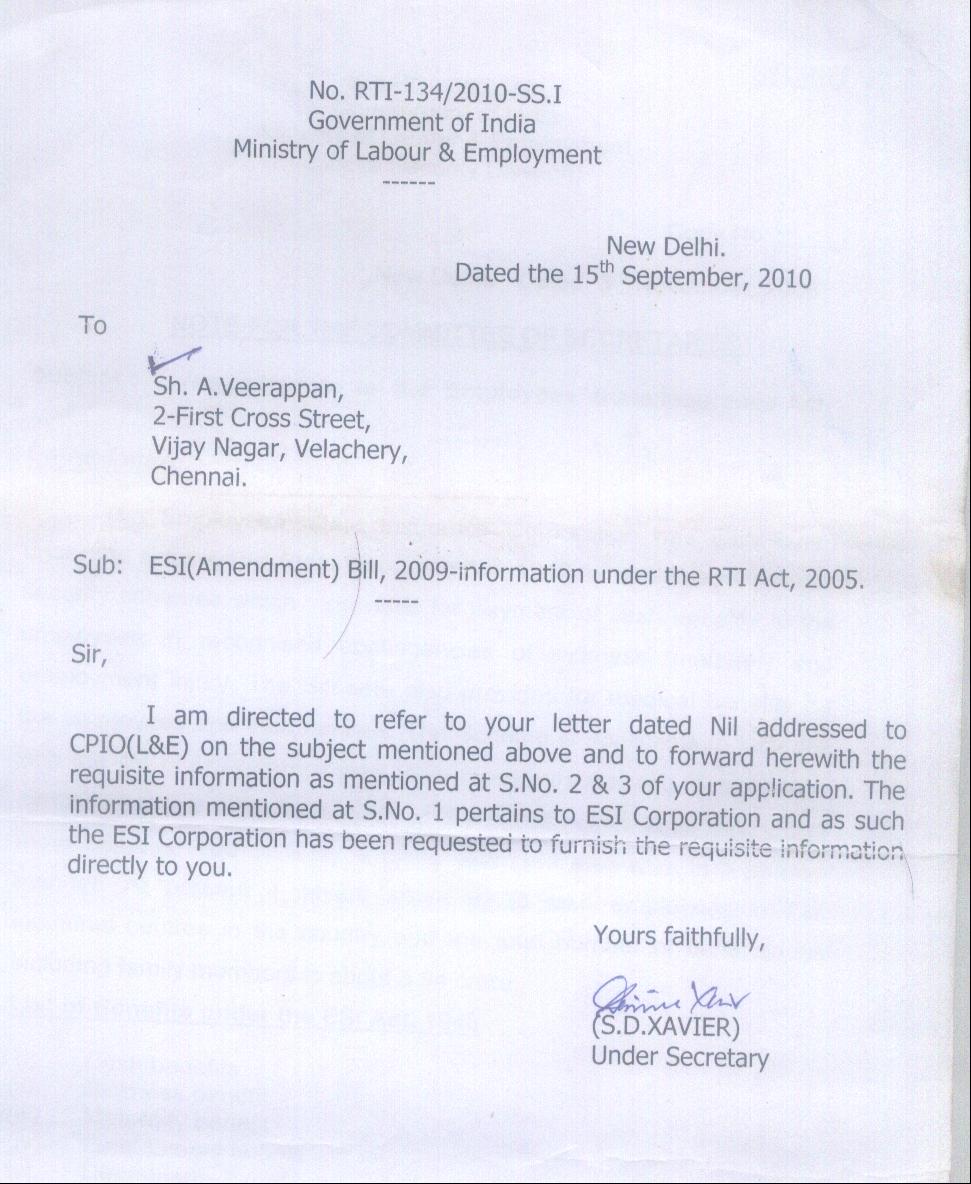
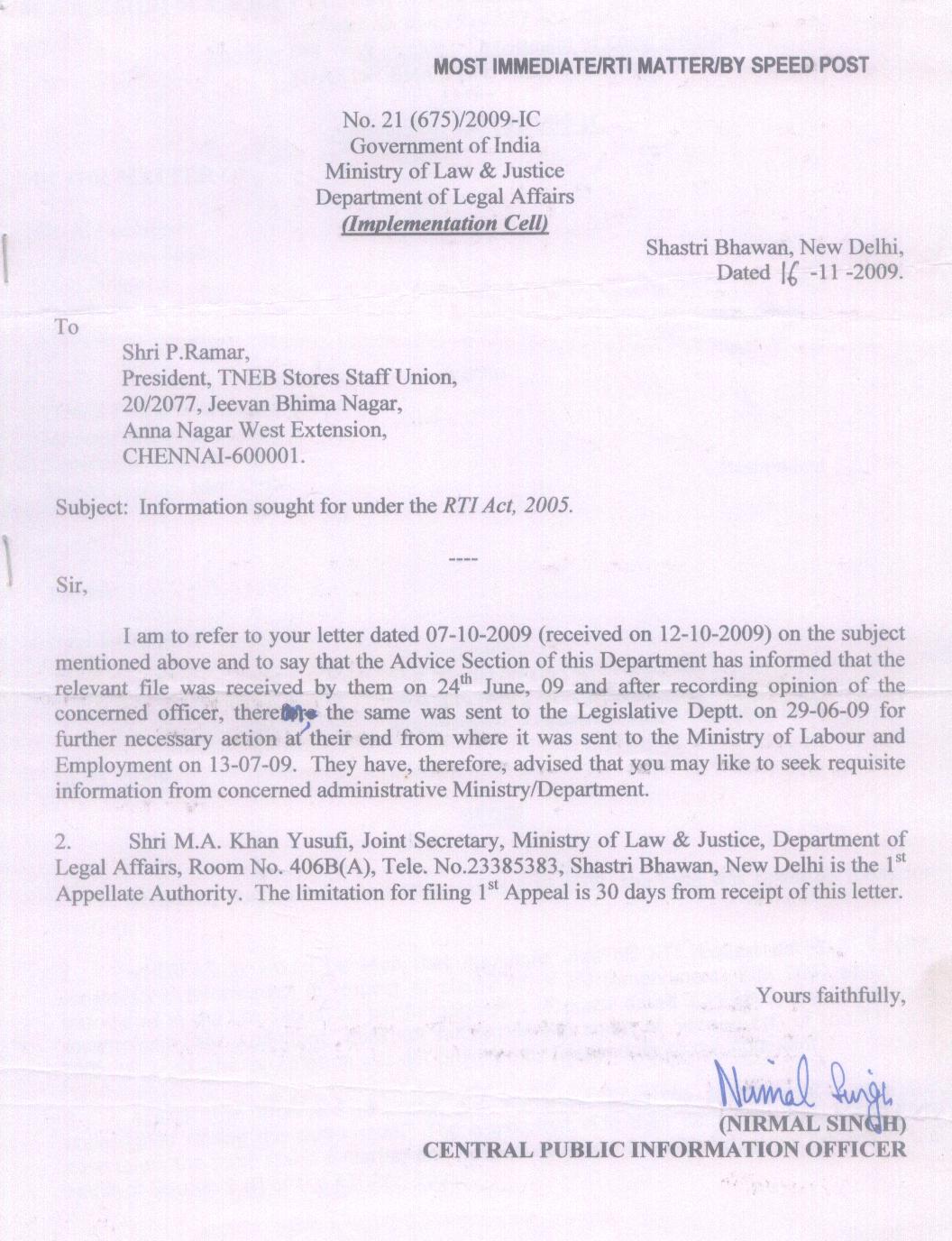
The Ministry of Law created a record on 26.6.2009

Anyone who interacts with the Ministry of Law knows how much time they take for clearing the proposals sent by various Ministries. Even a simple amendment to the Recruitment Rules of entry level posts like Lower Division Clerks takes months to pass through the Ministry of Law. The officers from the departments which proposed the amendments are called by the Ministry of Law, sometimes repeatedly, and clarifications sought in those cases. Such a Ministry created a record of sorts on 26.6.2009, when it cleared the multifaceted proposal sent by the Ministry of Labour for amendment of the ESI Act, 1948, ( later ESI Amendment Bill No. 66 of 2009 ) in spite of the fact that that they were very complex proposals with far-reaching consequences.

1. The proposal concerned had been received by the Advice Section of the Ministry of Law on 24.6.2009.

2. The file, sent by the Ministry of Labour in the Single File System, had been cleared by the Additional Legal Advisor on 26.6.2009, i.e., within two days.

3. The file was, then, sent to the Legislative Department on 29.6.2009.

4. The Ministry of Labour had, then, tabled the Bill No.66 of 2009 before the Parliament on 30.7.2009.

As per the administrative set-up of the Ministry of Law, its Advice Section (or Advice Department) is intended to examine the proposal for amendments “from legal and Constitutional angle”. In the case of the amendments proposed by the Ministry of Labour, the Additional Legal Advisor had said in his Note dated 26.6.2009 that “the proposed amendments are matter of policy and do not appear to be legally and constitutionally objectionable”.

Were the amendments proposed in that Bill not objectionable legally, as observed by the Additional Legal Advisor? Really?

Did the Ministry of Law render justice to its work?

1. Was the actual version in Clause 5 of the Bill for the amendment of Sec. 17 of the ESI Act, 1948, in respect of ‘appointment of consultants’ in tune with the explanation given in Para 4 (viii) of the ‘Statement of Objects and Reasons’?

2. Was the ‘Validation’ clause, the Clause 17 in the Bill, correctly placed at the appropriate place in the Bill? What were the contents? What could be the consequences?

3. What about the other legal intricacies in Clauses 9 and 15 of the Bill?

Were the Ministry of Law required to examine them or not?

Did they do so?

Or, was there any undue pressure on them to clear the proposal fast without proper scrutiny?

The endeavor of this website is to place all the relevant facts before the readers to arrive at their own decision. For that, they have to wait.


N.B: This web-site places on record the selfless services rendered by Mr. A. Veerappan and his friends, Mr. P. Ramar, Mr. S. Karthikeyan and others in collecting various details for about two years and also in making them available, now, to this website. The website recalls the sincerety, commitment and devotion of Mr. A. Veerappan towards the ESI Corporation. The remarkable perseverance exhibited by him for such a long duration was very touching. This thread is the result of his efforts. The more of it, later. May his soul rest in peace!

Leave a comment

Filed under Amendments 2010

Lessons from M/s Lehman Brothers

Image

Leslee Gelber has been at loose ends since losing her job. Ken Linton, center, was ousted before the firm collapsed, and he began shorting its stock. Tom Ollquist, right, sold packages of mortgages and other financial products for Lehman Brothers” – IHT

“Tom Ollquist remembers Sept. 9, 2008 — the day Lehman Brothers laid him off — as if it were yesterday. “You’re not going to believe it,” he told his wife. “I was shot.” Six days later, so was Lehman Brothers. Federal regulators let the foundering firm slip into bankruptcy, a collapse that touched off the most perilous week of the financial debacle, after years of freewheeling lending, trading and regulation produced outsize losses that devastated the banking system and brought the economy to its knees…”

“Some of those Lehman alumni who didn’t manage to hang on to Wall Street jobs are still angry, bitter and confused; many others, like Mr. Ollquist, have moved on in their lives. The luckiest, like Ken Linton, a former Lehman trader, made enough money during the boom years to avoid having to think about their next paychecks.

He spends his time flying jets. Others, unable to find banking jobs, are building new work lives.. And, of course, there are those like Leslee Gelber, who is out of work, professionally adrift, and fearful that Wall Street will bounce back without her….”

They simply obeyed and, therefore, felt they were blameless

“Yet few Lehman veterans, or their counterparts at other banks, blame themselves for the havoc their activities wrought. Instead, they point to the failures of regulators….Mr. McKinney left Lehman a month before the firm collapsed, to join a hedge fund. When asked whether he raised any red flags about problems in Lehman’s mortgage business, he declined to discuss that, or any other aspects of his work at the firm. But he noted that financial companies are responsible for adequately managing their own risks.

Those much further down the corporate ladder from Mr. McKinney, including about two dozen people interviewed for this story, say they don’t feel they deserve much blame for what happened at their firm. They were just following orders, they say”.

“It is very human and understandable to feel the pressure of the time and respond accordingly,” says Karen Brenner, a professor of business ethics and corporate governance at  New York University. “These people were operating in a culture where this behavior was prized and rewarded. But I think it is too easy to say, ‘They made me do it; I don’t have to examine what I did.’ These people are professionals with duties and obligations to clients.”

“I spent a long time being very angry,” says Mr. Schaefer, the former Lehman executive turned gas station owner. “Angry for working so hard and doing so much. More importantly, for my family and all the time I was away traveling — the time I put in away from them. Now all that money I earned, the money paid in stock, is gone. I can’t go back and remake it.”

Even a senior vice president could not raise questions

“Mr. Linton evaluated mortgages that were later sliced and diced into securitized investments. In his 13 years working at the firm, Mr. Linton, 43, impressed many with his intelligence. A native of Northern Ireland, he had earned a doctorate in engineering and computer science before moving to the United States to create models for Wall Street. Lehman laid him off in early 2008

He recalls vividly the days in early 2007 at Lehman when his financial models began to throw up more warnings showing delinquencies and defaults, and he remembers colleagues on his desk raising questions about loan quality.

But he said the firm’s ranking as the top loan originator on Wall Street, not to mention the pressures put on the desk by Lehman’s growth-obsessed leadership, made it difficult for even the most senior executives to raise questions, even a senior vice president like Mr. Linton.

He says he has no qualms about his work at Lehman or its economic after-effects.”

“Anyone at our level who had a different view from senior management would find themselves going somewhere else quick,” he says.

Excerpts from International Herald Tribune

with Thanks.

Leave a comment

Filed under For Trainees, International

Overview of ESI Scheme: Powerpoint

The Powerpoint Presentation regarding the Overview of the ESI Scheme is now made available, in public interest, in this website for the benefit of the employers and employees of the factories and establishments, because of specific demands from them. This presentation does not contain all the details pertaining to every issue, which are explained during the lecture. Presentation-slides are prepared only to aid and supplement the delivery of lecture by highlighting certain aspects for clarity and understanding. There need not be continuity between the contents of the slides, as Presentation is different from Write-up.

esi-scheme-overview-for-training-of-employers-and-emplyees

1 Comment

Filed under For Trainees, Powerpoints

Social Security in Europe: Warnings & Examples

Successful social security assures successful economy of a nation. West Germany’s economic miracle of the 1960s was, mainly, due to the successful implementation of social security measures.

Some interesting facts pertaining to the 1990s that highlight the important role played by social security measures in Europe and the manner in which the benefits are utilized or misused are given in this article. The relevant snippets are also made available as image files.

East Europe: 1994

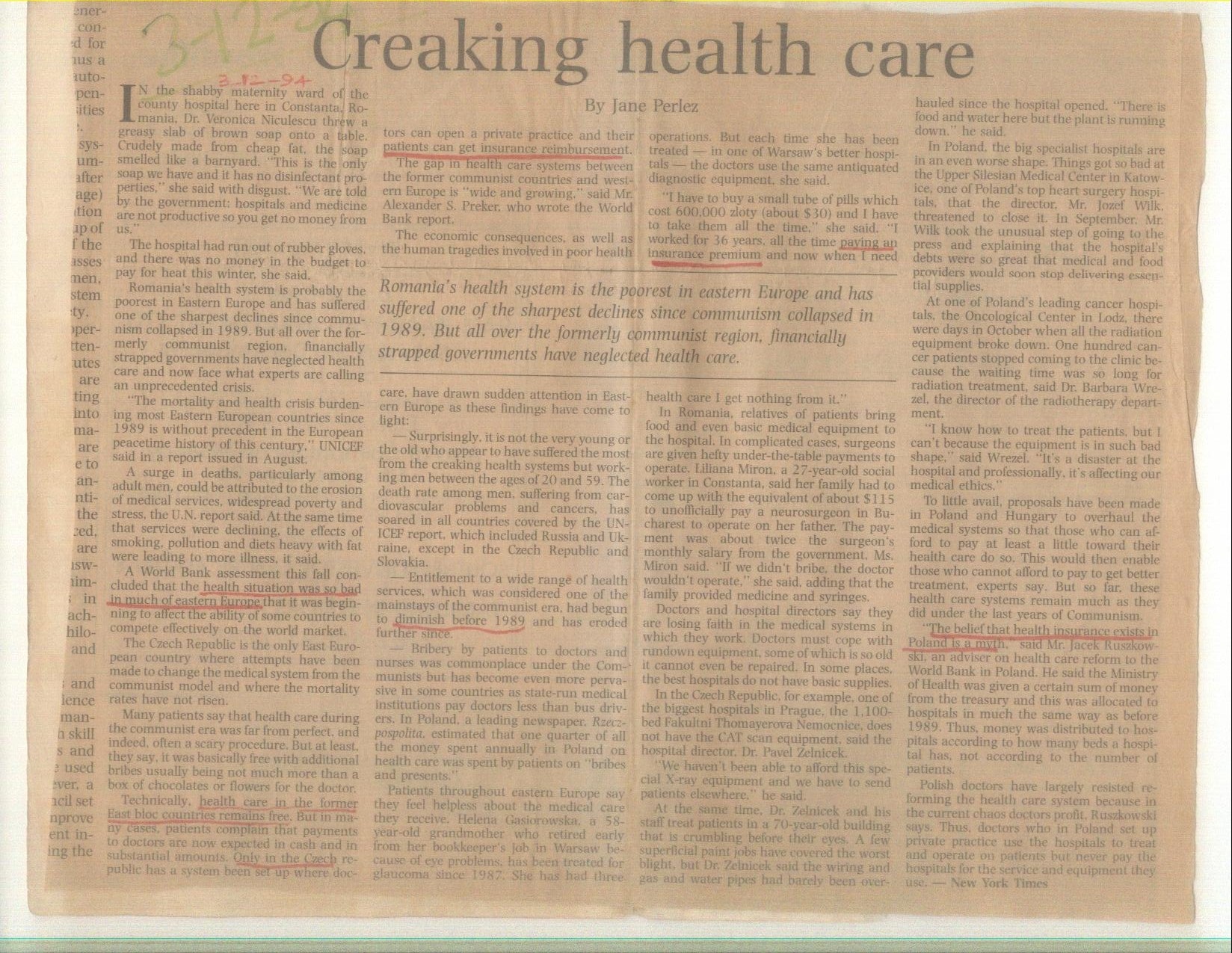
Romania:

The dispensary conditions are not conducive and are very unhygienic.

Government was not ready to spend on hospitals and medicine, as they were “not productive”.

Financially strapped governments had neglected health care and this resulted in unprecedented crisis.

Health situation was so bad in much of Eastern Europe that it was beginning to affect the ability of some countries to compete effectively on the world market.

Patients bring basic medical equipments to the hospitals.

Bribe in single case is much more than salary.

Doctors must cope with run-down equipment.

Czech:

Attempts were made to change the medical system from communist model. But, it was basically free, in the communist era. One had only to bribe which was not more than a box of chocolates or flowers.

Poland:

The director of the hospital threatened that he would close it, as there was no essential facility to treat patients.

Doctors who treat patients privately get them operated in State hospitals and do not pay for the service and equipment.

Eastern Europe:

Entitlement of the people to wide range of medical services that was available in the communist era had begun to diminish and got eroded.

State-run medical institutions paid doctors less than bus drivers.

(Refer to the uploaded article, ‘Creaking Health Care’ –The Hindu: 3.12.1994)

West Europe: 1996

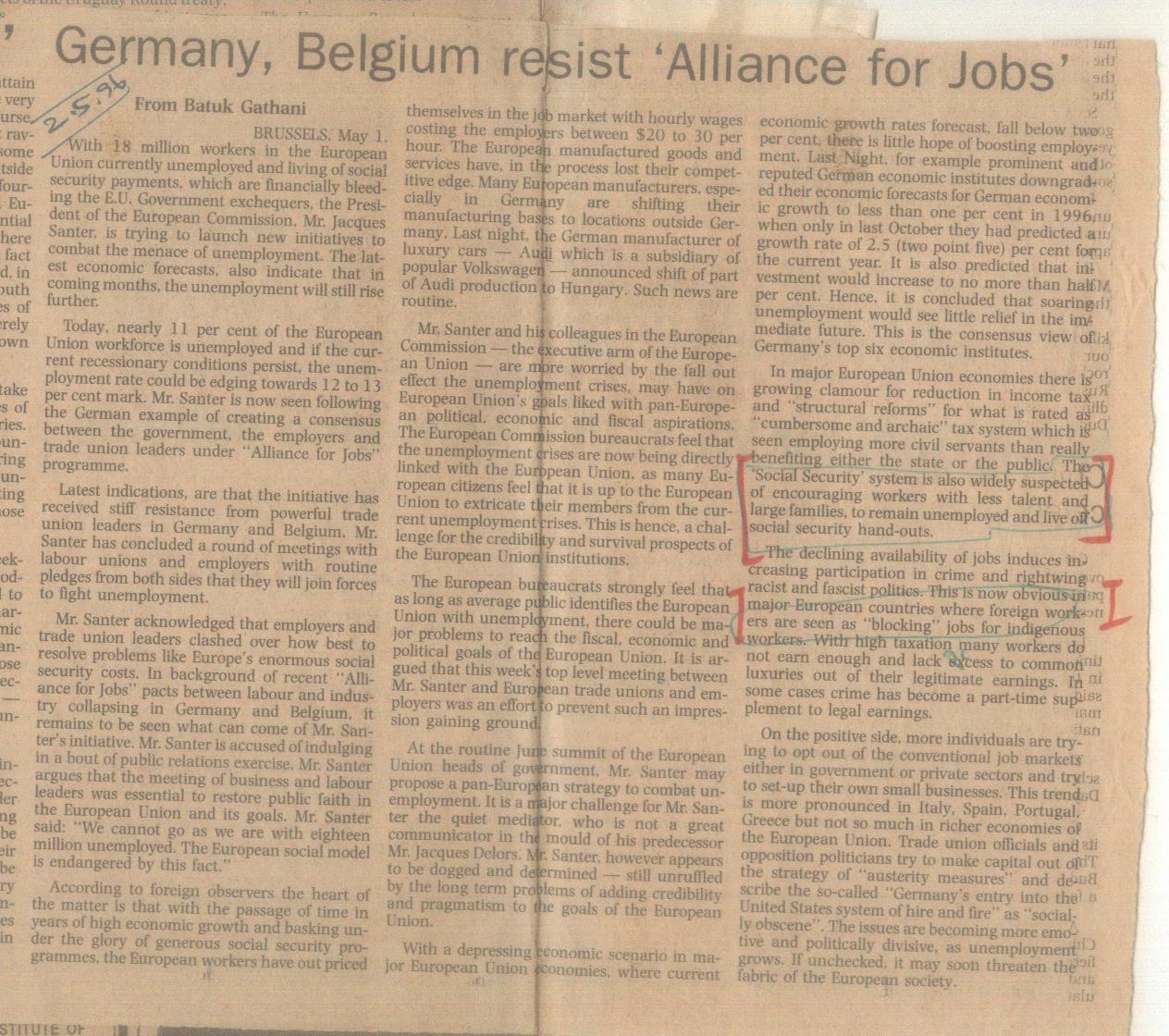
Social Security costs became enormous and the E.U. government exchequers were bleeding, because of unemployment benefits.

The reason was that because of the high economic growth and the generous social security benefits, the West European workers began to imagine that their services were costlier and starting demanding very heavy amount as wages.

The European goods had, thus, lost competitive edge.

Employers and Trade Unions could not agree on terms of revival.

West European manufacturers shifted their factories to east Europe.

Social security system encourages workers with less talent and large families to remain unemployed and live off social security hand-outs.

Foreign workers are seen as blocking jobs for indigenous workers.

High taxation affects the workers and they do not have access to common luxuries.

In smaller economies people set up their own businesses.

“Germany’s entry into the United States system of hire and fire” is described “as socially obscene”.

( Refer to the uploaded article ‘Germany, Belgium resist ‘Alliance for Jobs’ –The Hindu: 2.5.1996 )

2007

Malingering in Temporary Disablement Benefit in Germany.

One has to see to believe it.

( Refer to the uploaded news item with photo in the Times of India: 20.1.2007 )

This, in a country where the general level of honesty is admirable, as could be from one incident cited by Mr. Rahul Singh in the Outlook 27.08.2001.

Leave a comment

Filed under For Trainees, International

Inspection of factories

An article published in the Business Standard in December, 2010 brought out how the employees of the factories in Vellore felt that their legitimate rights would be protected only when the factories were inspected by the inspectors periodically. Long working hours, penalty for visit to toilets more than twice during a day, etc., were highlighted in that article.

As far as the ESIC is concerned, numerous cases of concealed employment are not detected because of absence of availability of information, lacunae in the Inspection Policy and lack of adequate number of Social Security Officers with reference to the actual work-load in such cases.

The ESIC has permitted the employers to register themselves online and get Employer’s Code Numbers generated. As a result, various kinds – repeat various kinds – of further problems have cropped up.

Monetary liability for the ESIC is, at present, created in respect of every TIC generated online by an employer or by a person posing as an employer even when the organisation is not sure whether the case is genuine and whether contribution as per rules would be forthcoming or not.

The EPFO is also facing only some of these problems. For more on this issue, please visit

http://www.business-standard.com/india/news/epfo-to-begin-endinspector-raj/466476/

But, the laxity in inspection does not  result in incorrect financial outgo as the EPFO pays benefits only with reference to the contribution paid, while the ESIC pays benefits not only on the basis of contribution paid but also on the basis of contribution payable but not paid.

The ESIC has not put in place adequate monitoring mechanism. The availability of man-power in the cadre of Social Security Officers is very very less when compared to the magnitude of the work in hand.

The government wants to do away with inspections, of course, for certain legitimate reasons. Please visit the following link:

http://www.thehindubusinessline.in/2002/12/14/stories/2002121402500100.htmB

But, controlling corruption and doing away with inspection are not synonymous. The government should also find a way and convince the working population how the problems faced by them would be located and solved.

Periodical and proper inspection of all factories and establishments will, alone, ensure coverage and protection of the workforce.

The very concept of compliance under the ESI Act is based on mutual trust and that was why the word ‘may’ is used instead of ‘shall’ in Sec. 45 (2) of the ESI Act, 1948.

But, the concept of Public Administration is “You do not get what you expect; you get only what you inspect’.

In other words, “Do not expect what you do not inspect”.

It would be helpful to the insured population if the inspection system of the ESI Corporation is streamlined to be ‘employee-friendly’ so that all employees are covered in time and contributions made to be paid on all items of wages as defined  under Sec. 2 (22) of the ESI Act, 1948.

ESI Corporation can ensure willing participation of labour in the making of the nation.

6 Comments

Filed under For Trainees, Inspections

ESIC Medical Colleges

Are they necessary? And, if so, how many?

6 Comments

Filed under Amendments 2010