Mr. O.A. Hameed, former A.C, on the Validation Clause!

Dear Readers,

Mr. O.A. Hameed, former Additional Commissioner in the Hqrs. Office of the ESI Corporation with illustrious track record in various capacities including his service as Regional Director in many regions has expressed his views on the Post dated 3.10.2012 on the Validation Clause in this website ( https://flourishingesic.info/2012/10/03/amendment-2010-the-amazing-validation-clause/). His analysis is comprehensive and deals with two aspects. One, the general Principles and Practices of Validation Clauses; two, the Validation Clause in the ESI (Amendment) Act, 2010 and its effect.

The depth of his write-up necessitates its display in the website as a separate post. Readers are welcome to get the benefit of his analysis. Now, Mr. Hameed speaks:

The concept of Validation Clause

Validation of previous action or what is called Retrospective amendment of law is not an unusual practice in India or countries like Australia, Canada, etc. where the legislative drafting policy in on similar line.  Though this practice is frowned upon and creates uncertainty in matters like taxation, frightening away investors, it is also a cover to ratify steps, which may have corrupt motives. Validating Legislation is passed when the executive arm of government, has acted relying on an erroneous view of the law. If an executive acting in tandem with the Political head of his realm, namely the Minister, wants something to be done in great hurry involving large outlay of money, and not sure that he or his Political master will survive for enough time to get proper law passed, such executive can go ahead and do whatever he chooses, often with corrupt motive or to unlawfully nurture a particular constituency (say Gulbarga, the only place in the country where all the four different medical institution of ESIC is sanctioned, though the major factory there is permanently closed and the IP population is paltry), and then seek a retrospective validation.

Sanctioning over 12000 crores of Rupees and releasing good part of it to contractors for over 42 medical education institutions all over the country in a short span of time, on the face of well-reasoned opinion that existing provision in Section 19 will not be adequate for such a venture, could be one such reason when the political Master agrees to this and promises to get law passed with Validation clause and rush the matter.

Continue reading →

2 Comments

Filed under Amendments 2010

Amendment 2010: The amazing Validation Clause

Action had been taken in the years 2008 and 2009 by the ESI Corporation for setting up large number of medical colleges. Parliament enacted law for this purpose only later in May, 2010 which came into effect from June, 2010.

Consultants were appointed for construction of buildings involving expenditure of thousands of crores of rupees.   Specialists / Professors were appointed to start medical colleges, with pay pockets of more than a lakh per month per person. The fee for the Consultant for setting up medical colleges was very huge.

All these things were beyond the powers conferred by the ESI Act and had been done without prior Parliamentary approval.

Although the Standing Committee meetings could usually be arranged even at short notice, expenditure of hundreds of crores of rupees was sanctioned without obtaining the prior approval of even the Standing Committee and those cases were placed before it later for ex-post facto approval.

Was the Parliament also, then, approached for ex-post facto approval?

If not, how were these actions regularised or validated?

Were these issues so urgent, at that point of time, that action had to be taken so early even when there was no provision in the Act?

An attempt was made by Mr. A. Veerappan to find out the truth.  If  you want to go through the amazing process of law-making in India, please click on the following link:

“presentation-on-validation-clause”

Mark you, Mr. Veerappan could make only an attempt.It would be helpful, if you could enlighten the public more on this issue.

3 Comments

Filed under Amendments 2010, Powerpoints

Enigmatic Amendment 2011 that affects the Benefits

There was, all of a sudden, an amendment, which came into force from 01.07.2011, stating that it was intended to simplify the term ‘average daily wages’ mentioned  in Rule 2 (1) (1-A) of the ESI (Central) Rules, 1950.  The definition in this sub-rule is meant for regulating the rates of various Benefits provided under the Act while the definition in in sub-rule 1-B is for deciding coverage.

The need for such simplification, after the vigorous efforts to computerize all works of the Branch Offices is not clear. But, the fact is that that amendment has reduced the rates of benefits which were available to the insured population up to 30.06.2011.

After 01.07.2011,

  1. the employees receiving wages at the lower level like Rs. 5000 or Rs. 8000 etc., p.m. get less amount when they seek two benefits, Sickness and Maternity;
  2. the employees in higher income group get less amount of benefit only for Maternity;
  3. but, all of them get more benefits for Disablement.

Natural justice demands that no amendment should result in reduction of benefits, unless such reduction is actually contemplated and discussed openly before making such amendment.

Can there be reduction of benefits through indirect amendments without making the public aware of it through categorical proclamations, beforehand?

How can the bar under Sec. 61 of the ESI Act be justified, hereafter?

Readers are welcome to share their enlightened opinions!

Please Click on the small Presentation on Amendment that affects Benefits

3 Comments

Filed under Amendments 2010, Benefits, Powerpoints

ESI Act – Statement of Objects and Reasons – 1951

The ESI Act, 1948 was amended first in 1951 even before the scheme was actually implemented first. Chaper V A was, mainly, introduced along with other amendments. The ESI Act (Amendment) Bill No. 24 of 1951 was introduced in Parliament on 19.3.1951. The Amended Act was notified in the Gazette of India Part II Section 2 dated 31.3.1951 in Pages from141 to 144.

1 Comment

Filed under For Trainees

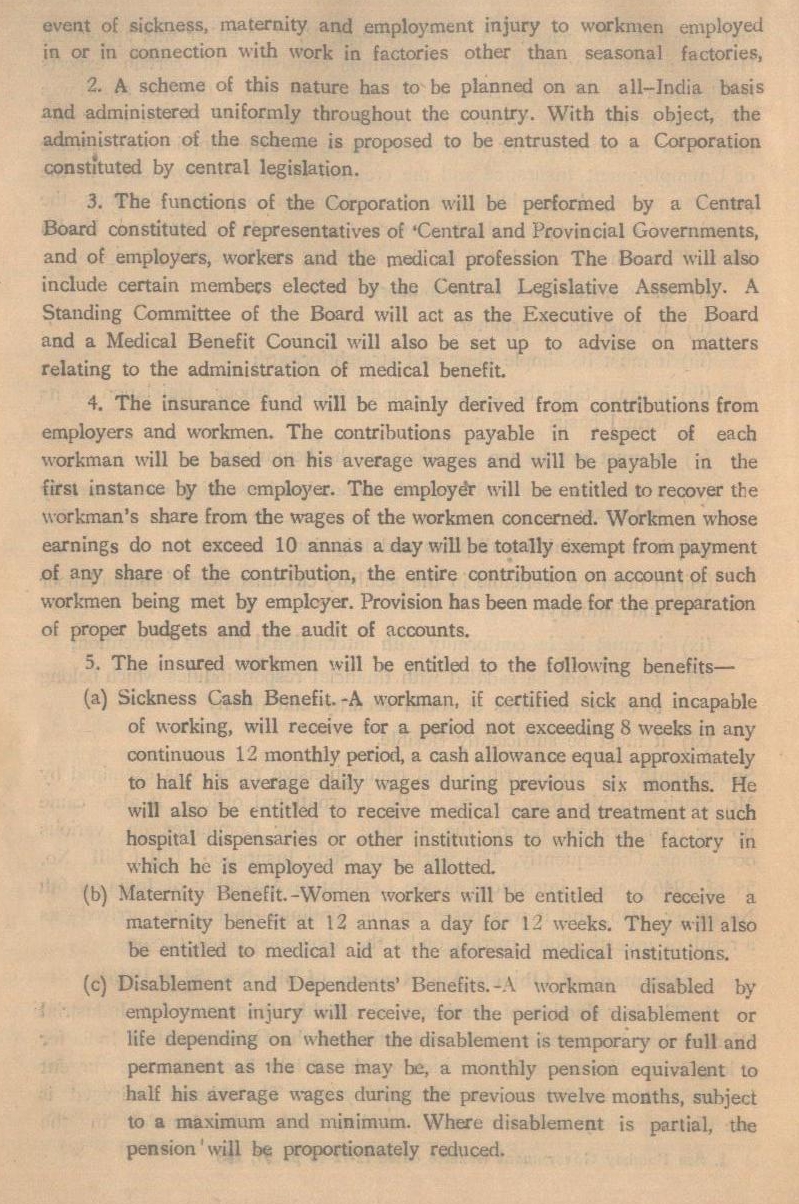
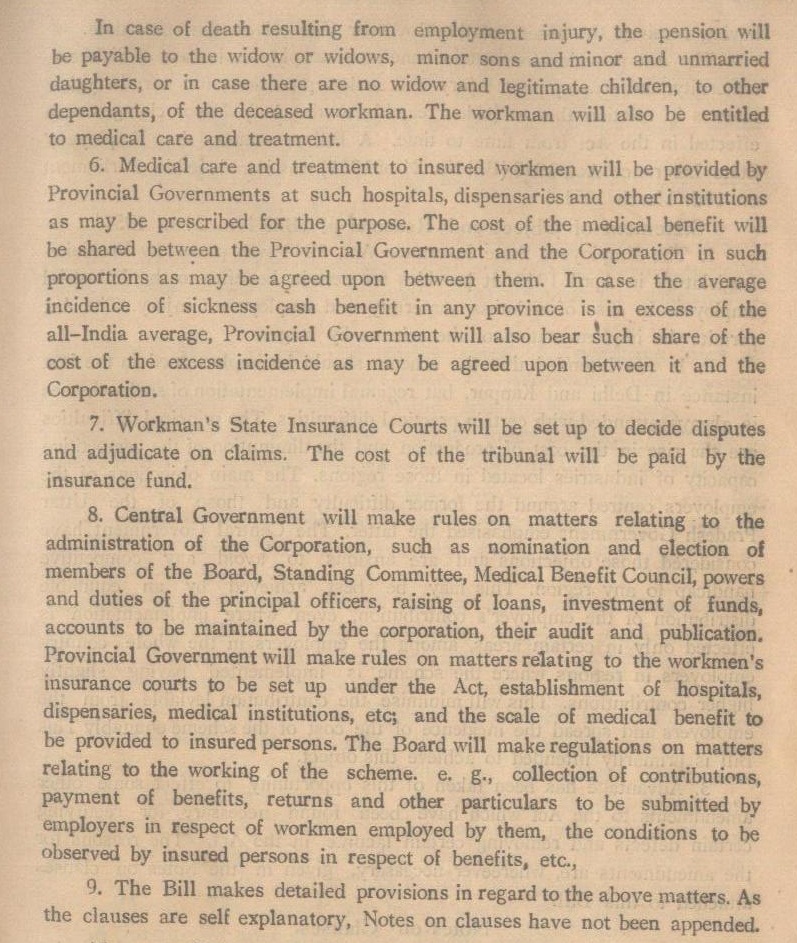
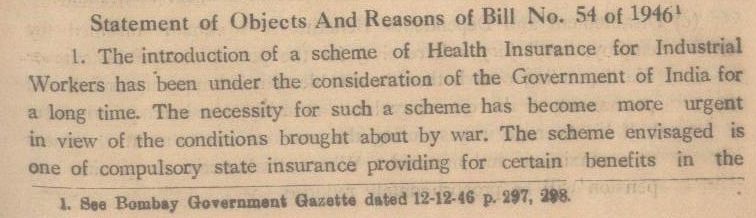
ESI Act – Statement of Objects and Reasons – 1946

The original Statement of Objects and Reasons that everyone is searching for happened to be available in a very old publication. The details of publishers could not be ascertained. The relevant pages containing only the contents of the Gazetted public document are posted here in public interest. The youngsters in the ESIC,  may find it useful.

We thank the publisher. There does not seem to be any subsequent publication by the publisher concerned. If there had been any such publication, the necessity of this Post would not have arisen.

Page 1:

Page 2:

Page 3:

The Bill was placed before the Central Legislative Assembly, as the Dominion Legislature was called at that time, for discussion. It was referred, thereafter, to the Select  Committee. The Select Committee had given its  report vide Gazette of India Part V of 1948 Pages 124 to 159.
The Act was passed by the Legislature on 19.4.1948.
The Governor General had also given his assent on 19.4.1948.

3 Comments

Filed under For Trainees

No time to read! So, ESIC got Medical Colleges.

“Why did the Congress bring the proceedings of the Lok Sabha to a stand-still for seven days over the issue of ….?” asks and justifies Ms. Girija Vyas in her article in http://www.congresssandesh.com/apr_issue/viewpoint1.html

That was when BJP was in power. Now a days, we see how BJP is also doing even more vigorously what the Congress was doing earlier.

Where is, then, the time for the MPs to read, study, understand, analyse and take a considered stand over the Bills placed before the House of the People for approval? Naturally, they do not have time.

The important Bills are just taken as read on the last day of the Session or simply ignored and taken to the next session. If people whose vote alone is essential for the Bills to become Law choose to remain indifferent or ignorant of the intricacies of the Bills and their votes are taken for granted on the last day of every session, with or without their being aware of it, who else can discuss the impact of a Bill?

Will there be any law to make all such Bills public and enable the Public to offer their opinion on the Lok Sabha website so that the points of view expressed therein are analysed on record and a report placed before the Lok Sabha so that the Members will be free from reading the Bills and will be free to stall the House.

Some solution, we have to find.

One such instance that shows what happened in the Lok Sabha  on 03.05.2010, when the Members did not have time to discuss the Bill because of the practice of stalling the proceedings of the House,  is analysed in the Powerpoint Presentation given hereunder. Please click on the links:

Presentation on Medical Colleges

Appendix I – Parliamentary Standing Committee report on Amendment Bill 2009

Appendix II – Parliament passed the bill

Readers are welcome to correct the mistakes, if any,or offer their viewpoints!

4 Comments

Filed under Amendments 2010, Powerpoints

When the PMO went wrong …

The PMO which happened to have some discussion about the workload of the employers once, issued a direction on its own, with the aim of reducing the workload of employers regarding ESIC and EPFO. Accordingly, a new challan format was devised and the ESIC and EPFO were directed to use it. It was a combined challan to facilitate the employers to pay the contributions of ESIC and EPFO at one go.
It resulted in chaos and posed a lot of administrative and legal problems in these organisations, besides making it inconvenient to the bankers to process the challans and credit the funds to the concerned organisations.
The employers asked why they should pay ESI dues also seven days in advance. Because, they had, as per law, one week’s time more to pay the ESI dues every month.
Things got changed when the ESIC introduced online payment later. But, during the period when the combined challan was being used because of the order of the PMO, the employers, the employees, the ESIC, the EPFO and the Banks had to face a lot of problems. But, nobody did say anything against the novel idea mooted by the PMO. They were reluctant to tell the PMO that it had diagnosed the problem wrongly.
The Lehman-Brothers-factor was at work.
Read, for more:

Lessons from M/s Lehman Brothers


This website will also be a forum to help the administrators by acting as a medium for expressing genuine grievances of the public, in public interest.
Patricia E. Powers recalls how the 1989 book, ‘The global village: transformations in World life and Media in the 21st century’, predicted that the customer as producer would take the initiative away from the conglomerate and cites Youtube as an example. (Newsweek July 30, 2012).
It would be helpful if the ESIC, which contemplates some more amendments, calls for the opinion of the public also, through their website, before making those proposals into law. Such a course of action will make the amendments, really purposeful and error free.

1 Comment

Filed under Inspections

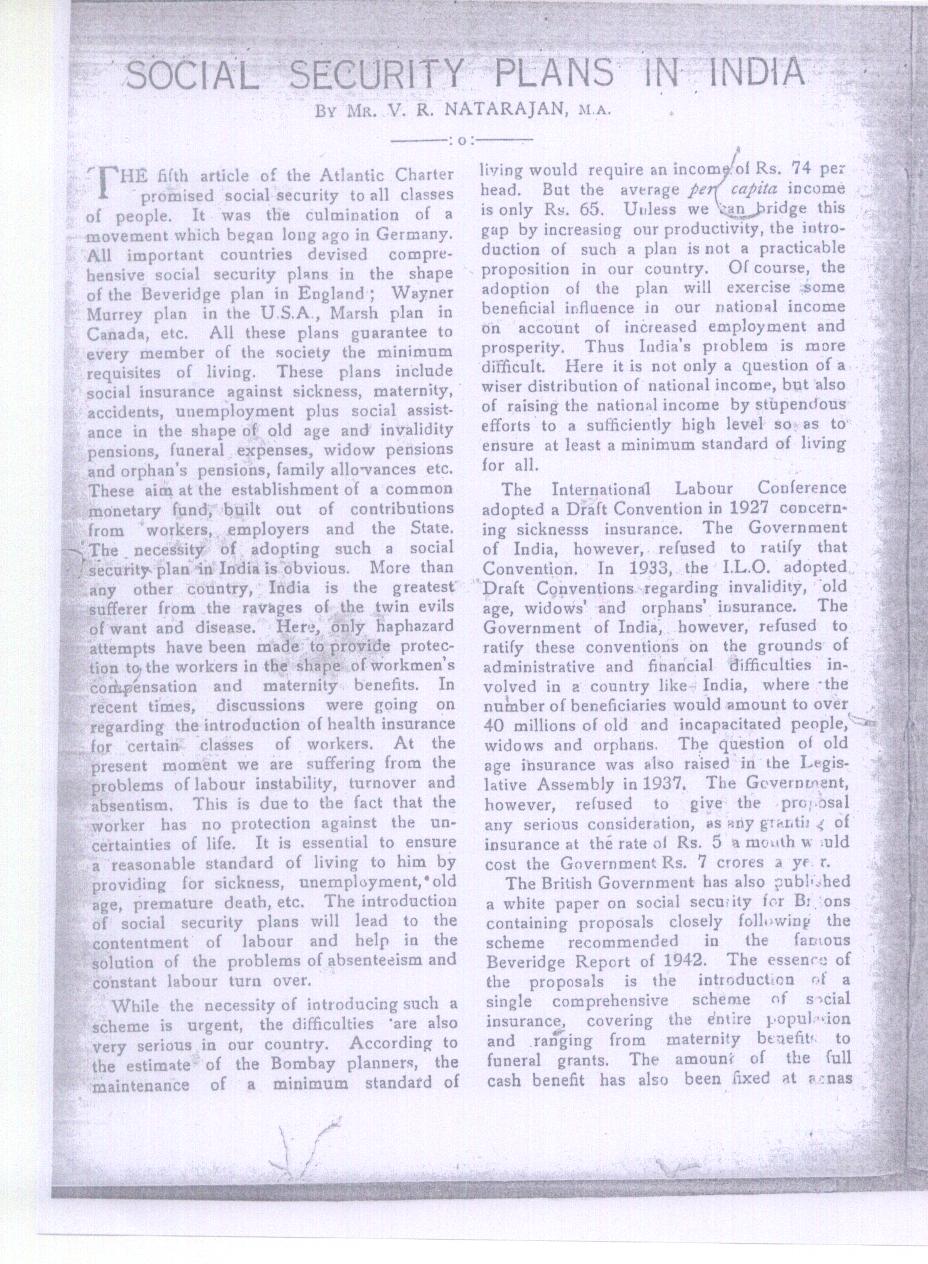
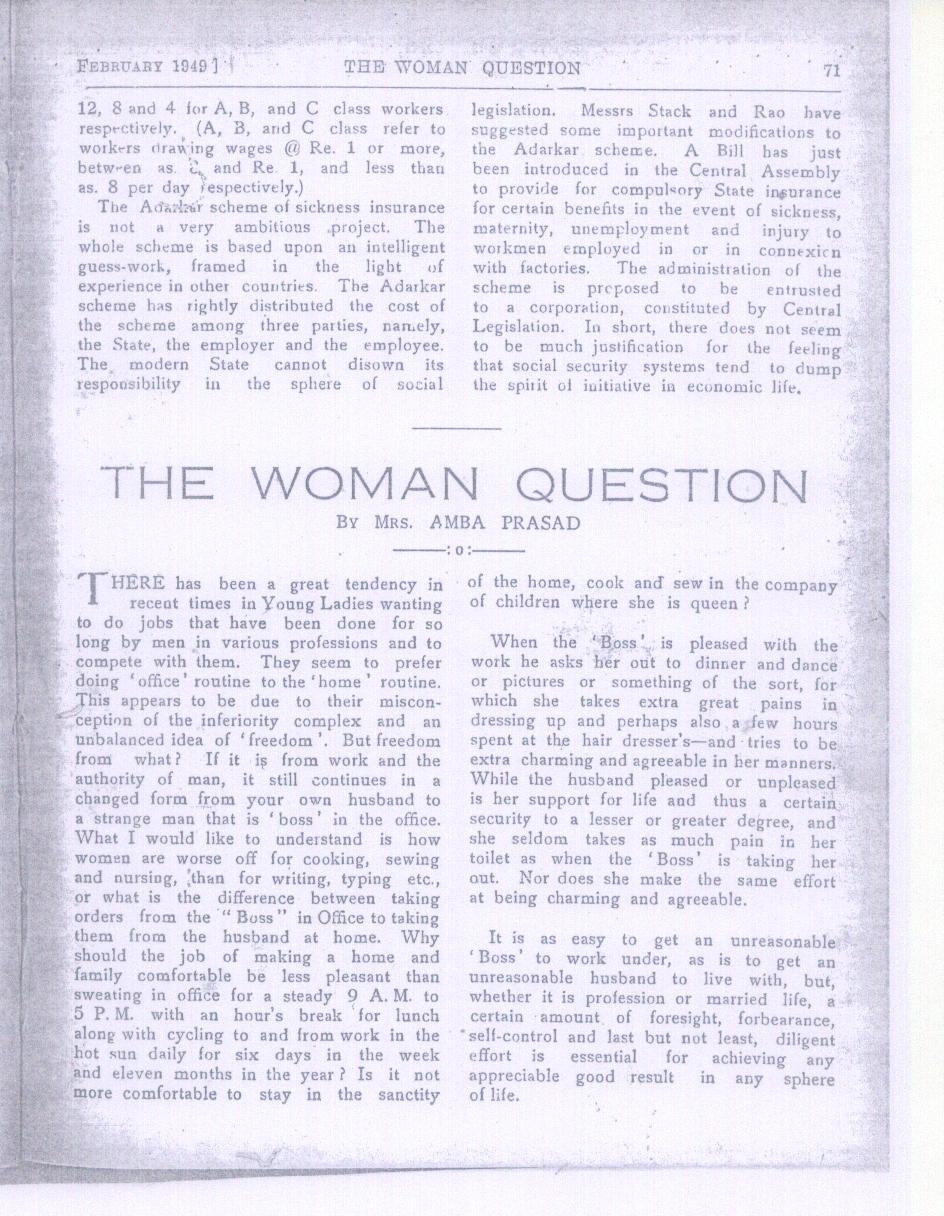
A 1949 article on ESIC

An article that appeared in the magazine Indian Review in the month of February, 1949 is posted here for the information of the readers.

We come to know about the annual per capita income of those days.

“as.” in this article refers to the word “Annas”.

3 Comments

Filed under For Trainees

Amendment 2010: The enigma – Episode 1

Amendment to Sec. 17 (2) (a) the ESI Act, 1948:

 Insertion of the second proviso regarding the appointment of Consultants.

The complete details on this topic, as made available to this website, run into fifteen pages, with date-wise details. The relevant photocopies, if scanned and uploaded, would add to the already unwieldy size of the article. The essential facts are, therefore, placed before the readers in the Powerpoint Presentation for the benefit of their own analysis.

Firstly, there was glaring discrepancy between the ‘Statement of Objects and Reasons’ and the actual version inserted as the second proviso to Sec. 17 (2) (a) of the ESI Act, 1948. While the former stressed on the need for Consultants and Specialists in medical field, the latter was an omnibus provision for appointment of anyone as Consultant or Specialist in any field.

Continue reading →

2 Comments

Filed under Amendments 2010, Powerpoints

Quasi-Judicial Procedure in the ESIC & EPFO: Powerpoint

The intricate aspects of quasi-judicial procedure are highlighted in the Powerpoint Presentation for the benefit of the stake-holders of the ESIC and EPFO.

Please click on the link:

Quasijudicial procedure in ESIC & EPFO for employers

It can be seen best with MS Powerpoint 2010

2 Comments

Filed under For Trainees, Powerpoints