Tag Archives: ESIC

Civil servant: how to be and how not to be!

Leaders in non-political fields!

Dr. Rajendra Prasad, the then President of India, used to go on tour to various places in India with a large entourage. Earlier, the Viceroys were doing that but they were visiting only the princely states in that manner where the local rulers used to look after them all by providing extravagant facilities. There were no such hosts for a President. Yet, the entourage of Rajendra Prasad was large.

Mr. Bimanesh Chatterjee was working as Military Secretary in the Presidential Palace at that time and he was there from the time of Mr. C. Rajagoplachari when he was the Governor General of India. The Government Hospitality Organisation had to maintain the Presidential Palace. That organisation was headed by Mr. Bimanesh Chatterjee but was part of the Prime Minister’s Secretariat. Mr. Chatterjee was under the direct administrative control of the Prime Minister while he had to work for the President. He was now working under two bosses.

Continue reading

2 Comments

Filed under For Trainees

Appointment of Advisor (Medical Education) in the ESIC!

A democratic government should not be too sensitive to helpful criticism as it always exercised a healthy influence on it. The aim of the government publicity organisations should therefore be to stimulate public interest to invite constructive criticism so that the government machinery (is) profited by it”.

Sardar Vallabhbhai Patel in the first issue of the Information Magazine

brought out by the Madhya Pradesh government.

==================================================================================================

 The story of consultants

 There had been many enigmatic episodes in the ESI Corporation during the period from 2007 onwards when the idea of medical colleges was conceived all of a sudden and executed with extraordinary alacrity causing surprise as well as disbelief. A few such episodes have, already, been dealt with in certain ‘Posts’ in this website. The episode of appointment of a person from outside as Consultant for setting up the Medical Colleges with the functional designation as Advisor (Medical Education) is discussed now.

Readers are aware that the ESIC authorities took steps to set up so many medical colleges, sanctioned large projects for construction of the buildings for those proposed-medical-colleges and incurred huge expenditure for doing spade work to commission those medical colleges even before the ESI Act authorised them to do so. So many consultants were appointed. Some of them started criss-crossing the country allegedly for their work and availing themselves of extravagant facilities. In sharp contrast, another set of consultants did not move out of Delhi even to see the buildings for which they were going to prepare remodel projects, in spite of the fact that the outlay for their projects was running into crores and crores of rupees. All, before any amendment.

Continue reading

1 Comment

Filed under Amendments 2010

Prof. Adarkar and ESIC Medical Colleges

The ESIC was intended to provide not only medical care in a better manner but also financial security in cases of sickness and in certain other contingencies.

Violation of the Fundamental Principles

While formulating the ESI Scheme, Prof. B.P. Adarkar had, very thoughtfully, specified eleven Fundamental Principles. They are, in fact, sound directive principles to be kept in view by the Government not only for any social security measure to be introduced through the ESI Scheme but also on any labour-welfare related matter. The one of his Fundamental Principles is that the proposed scheme “must not be too ambitious in the beginning”.

In the case of ESIC Medical Colleges, the following were the basic questions:

  1. Is it necessary for the ESIC to open and run Medical Colleges?
  2. Should those colleges be for post-graduate courses only or for under-graduate courses too?
  3. How many colleges must be opened and run by the ESIC?
  4. What would be the cost and what could be the benefit?

Continue reading

2 Comments

Filed under Amendments 2010

Amendment 2010: The amazing Validation Clause

Action had been taken in the years 2008 and 2009 by the ESI Corporation for setting up large number of medical colleges. Parliament enacted law for this purpose only later in May, 2010 which came into effect from June, 2010.

Consultants were appointed for construction of buildings involving expenditure of thousands of crores of rupees.   Specialists / Professors were appointed to start medical colleges, with pay pockets of more than a lakh per month per person. The fee for the Consultant for setting up medical colleges was very huge.

All these things were beyond the powers conferred by the ESI Act and had been done without prior Parliamentary approval.

Although the Standing Committee meetings could usually be arranged even at short notice, expenditure of hundreds of crores of rupees was sanctioned without obtaining the prior approval of even the Standing Committee and those cases were placed before it later for ex-post facto approval.

Was the Parliament also, then, approached for ex-post facto approval?

If not, how were these actions regularised or validated?

Were these issues so urgent, at that point of time, that action had to be taken so early even when there was no provision in the Act?

An attempt was made by Mr. A. Veerappan to find out the truth.  If  you want to go through the amazing process of law-making in India, please click on the following link:

presentation-on-validation-clause

Mark you, Mr. Veerappan could make only an attempt.It would be helpful, if you could enlighten the public more on this issue.

3 Comments

Filed under Amendments 2010, Powerpoints

Enigmatic Amendment 2011 that affects the Benefits

There was, all of a sudden, an amendment, which came into force from 01.07.2011, stating that it was intended to simplify the term ‘average daily wages’ mentioned  in Rule 2 (1) (1-A) of the ESI (Central) Rules, 1950.  The definition in this sub-rule is meant for regulating the rates of various Benefits provided under the Act while the definition in in sub-rule 1-B is for deciding coverage.

The need for such simplification, after the vigorous efforts to computerize all works of the Branch Offices is not clear. But, the fact is that that amendment has reduced the rates of benefits which were available to the insured population up to 30.06.2011.

After 01.07.2011,

  1. the employees receiving wages at the lower level like Rs. 5000 or Rs. 8000 etc., p.m. get less amount when they seek two benefits, Sickness and Maternity;
  2. the employees in higher income group get less amount of benefit only for Maternity;
  3. but, all of them get more benefits for Disablement.

Natural justice demands that no amendment should result in reduction of benefits, unless such reduction is actually contemplated and discussed openly before making such amendment.

Can there be reduction of benefits through indirect amendments without making the public aware of it through categorical proclamations, beforehand?

How can the bar under Sec. 61 of the ESI Act be justified, hereafter?

Readers are welcome to share their enlightened opinions!

Please Click on the small Presentation on Amendment that affects Benefits

3 Comments

Filed under Amendments 2010, Benefits, Powerpoints

No time to read! So, ESIC got Medical Colleges.

“Why did the Congress bring the proceedings of the Lok Sabha to a stand-still for seven days over the issue of ….?” asks and justifies Ms. Girija Vyas in her article in http://www.congresssandesh.com/apr_issue/viewpoint1.html

That was when BJP was in power. Now a days, we see how BJP is also doing even more vigorously what the Congress was doing earlier.

Where is, then, the time for the MPs to read, study, understand, analyse and take a considered stand over the Bills placed before the House of the People for approval? Naturally, they do not have time.

The important Bills are just taken as read on the last day of the Session or simply ignored and taken to the next session. If people whose vote alone is essential for the Bills to become Law choose to remain indifferent or ignorant of the intricacies of the Bills and their votes are taken for granted on the last day of every session, with or without their being aware of it, who else can discuss the impact of a Bill?

Will there be any law to make all such Bills public and enable the Public to offer their opinion on the Lok Sabha website so that the points of view expressed therein are analysed on record and a report placed before the Lok Sabha so that the Members will be free from reading the Bills and will be free to stall the House.

Some solution, we have to find.

One such instance that shows what happened in the Lok Sabha  on 03.05.2010, when the Members did not have time to discuss the Bill because of the practice of stalling the proceedings of the House,  is analysed in the Powerpoint Presentation given hereunder. Please click on the links:

Presentation on Medical Colleges

Appendix I – Parliamentary Standing Committee report on Amendment Bill 2009

Appendix II – Parliament passed the bill

Readers are welcome to correct the mistakes, if any,or offer their viewpoints!

4 Comments

Filed under Amendments 2010, Powerpoints

When the PMO went wrong …

The PMO which happened to have some discussion about the workload of the employers once, issued a direction on its own, with the aim of reducing the workload of employers regarding ESIC and EPFO. Accordingly, a new challan format was devised and the ESIC and EPFO were directed to use it. It was a combined challan to facilitate the employers to pay the contributions of ESIC and EPFO at one go.
It resulted in chaos and posed a lot of administrative and legal problems in these organisations, besides making it inconvenient to the bankers to process the challans and credit the funds to the concerned organisations.
The employers asked why they should pay ESI dues also seven days in advance. Because, they had, as per law, one week’s time more to pay the ESI dues every month.
Things got changed when the ESIC introduced online payment later. But, during the period when the combined challan was being used because of the order of the PMO, the employers, the employees, the ESIC, the EPFO and the Banks had to face a lot of problems. But, nobody did say anything against the novel idea mooted by the PMO. They were reluctant to tell the PMO that it had diagnosed the problem wrongly.
The Lehman-Brothers-factor was at work.
Read, for more:

Lessons from M/s Lehman Brothers


This website will also be a forum to help the administrators by acting as a medium for expressing genuine grievances of the public, in public interest.
Patricia E. Powers recalls how the 1989 book, ‘The global village: transformations in World life and Media in the 21st century’, predicted that the customer as producer would take the initiative away from the conglomerate and cites Youtube as an example. (Newsweek July 30, 2012).
It would be helpful if the ESIC, which contemplates some more amendments, calls for the opinion of the public also, through their website, before making those proposals into law. Such a course of action will make the amendments, really purposeful and error free.

1 Comment

Filed under Inspections

Amendment 2010: The enigma – Episode 1

Amendment to Sec. 17 (2) (a) the ESI Act, 1948:

 Insertion of the second proviso regarding the appointment of Consultants.

The complete details on this topic, as made available to this website, run into fifteen pages, with date-wise details. The relevant photocopies, if scanned and uploaded, would add to the already unwieldy size of the article. The essential facts are, therefore, placed before the readers in the Powerpoint Presentation for the benefit of their own analysis.

Firstly, there was glaring discrepancy between the ‘Statement of Objects and Reasons’ and the actual version inserted as the second proviso to Sec. 17 (2) (a) of the ESI Act, 1948. While the former stressed on the need for Consultants and Specialists in medical field, the latter was an omnibus provision for appointment of anyone as Consultant or Specialist in any field.

Continue reading

2 Comments

Filed under Amendments 2010, Powerpoints

Quasi-Judicial Procedure in the ESIC & EPFO: Powerpoint

The intricate aspects of quasi-judicial procedure are highlighted in the Powerpoint Presentation for the benefit of the stake-holders of the ESIC and EPFO.

Please click on the link:

Quasijudicial procedure in ESIC & EPFO for employers

It can be seen best with MS Powerpoint 2010

2 Comments

Filed under For Trainees, Powerpoints

The Ministry of Law created a record on 26.6.2009

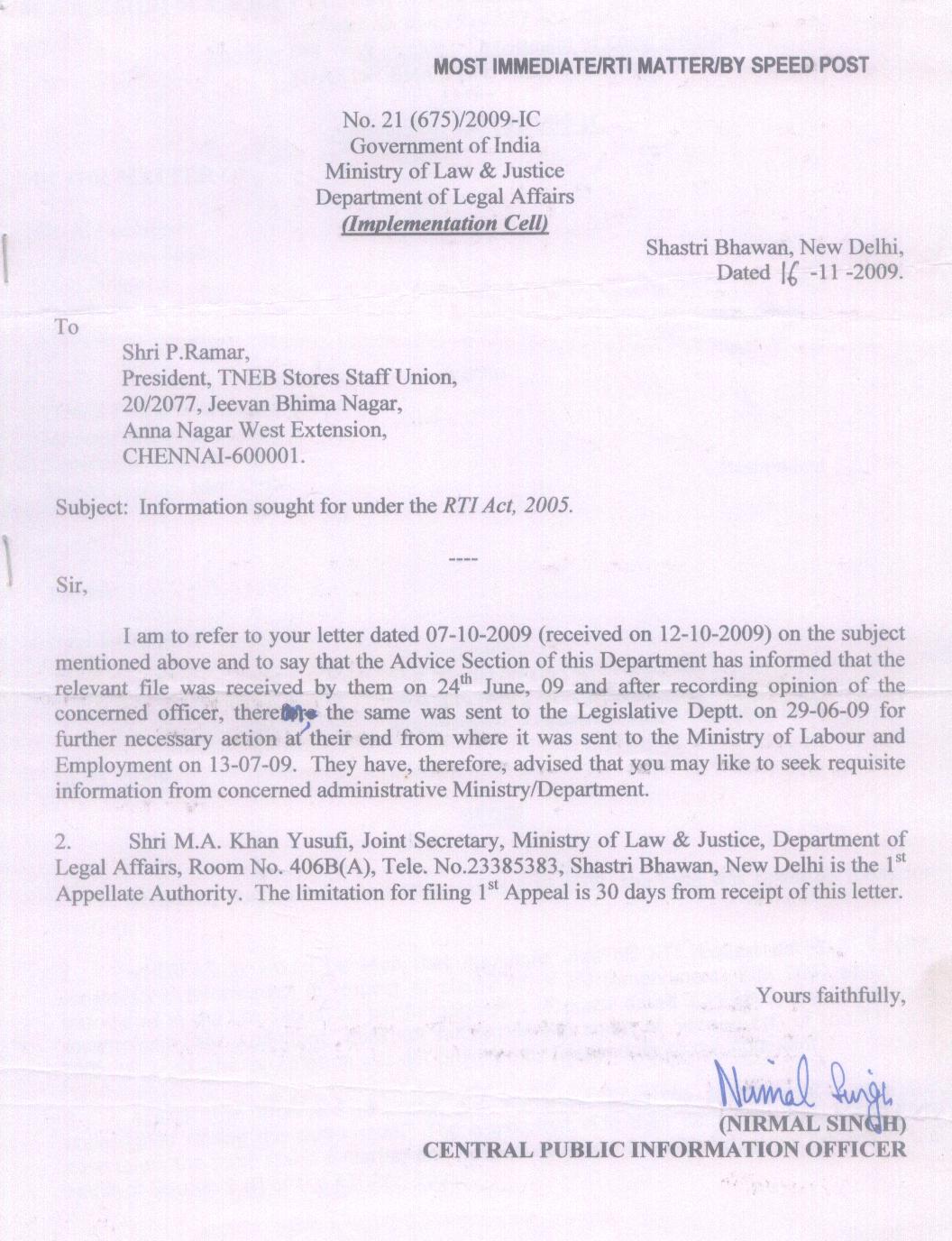
Anyone who interacts with the Ministry of Law knows how much time they take for clearing the proposals sent by various Ministries. Even a simple amendment to the Recruitment Rules of entry level posts like Lower Division Clerks takes months to pass through the Ministry of Law. The officers from the departments which proposed the amendments are called by the Ministry of Law, sometimes repeatedly, and clarifications sought in those cases. Such a Ministry created a record of sorts on 26.6.2009, when it cleared the multifaceted proposal sent by the Ministry of Labour for amendment of the ESI Act, 1948, ( later ESI Amendment Bill No. 66 of 2009 ) in spite of the fact that that they were very complex proposals with far-reaching consequences.

1. The proposal concerned had been received by the Advice Section of the Ministry of Law on 24.6.2009.

2. The file, sent by the Ministry of Labour in the Single File System, had been cleared by the Additional Legal Advisor on 26.6.2009, i.e., within two days.

3. The file was, then, sent to the Legislative Department on 29.6.2009.

4. The Ministry of Labour had, then, tabled the Bill No.66 of 2009 before the Parliament on 30.7.2009.

As per the administrative set-up of the Ministry of Law, its Advice Section (or Advice Department) is intended to examine the proposal for amendments “from legal and Constitutional angle”. In the case of the amendments proposed by the Ministry of Labour, the Additional Legal Advisor had said in his Note dated 26.6.2009 that “the proposed amendments are matter of policy and do not appear to be legally and constitutionally objectionable”.

Were the amendments proposed in that Bill not objectionable legally, as observed by the Additional Legal Advisor? Really?

Did the Ministry of Law render justice to its work?

1. Was the actual version in Clause 5 of the Bill for the amendment of Sec. 17 of the ESI Act, 1948, in respect of ‘appointment of consultants’ in tune with the explanation given in Para 4 (viii) of the ‘Statement of Objects and Reasons’?

2. Was the ‘Validation’ clause, the Clause 17 in the Bill, correctly placed at the appropriate place in the Bill? What were the contents? What could be the consequences?

3. What about the other legal intricacies in Clauses 9 and 15 of the Bill?

Were the Ministry of Law required to examine them or not?

Did they do so?

Or, was there any undue pressure on them to clear the proposal fast without proper scrutiny?

The endeavor of this website is to place all the relevant facts before the readers to arrive at their own decision. For that, they have to wait.
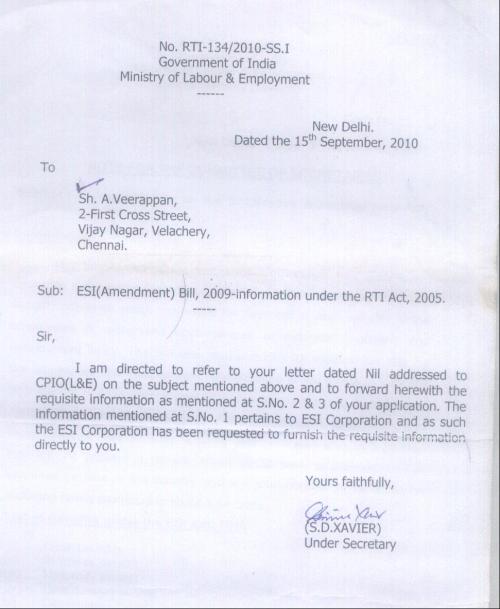
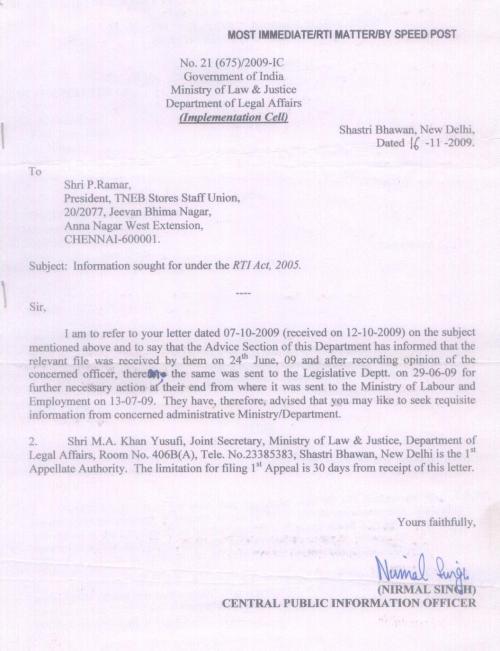


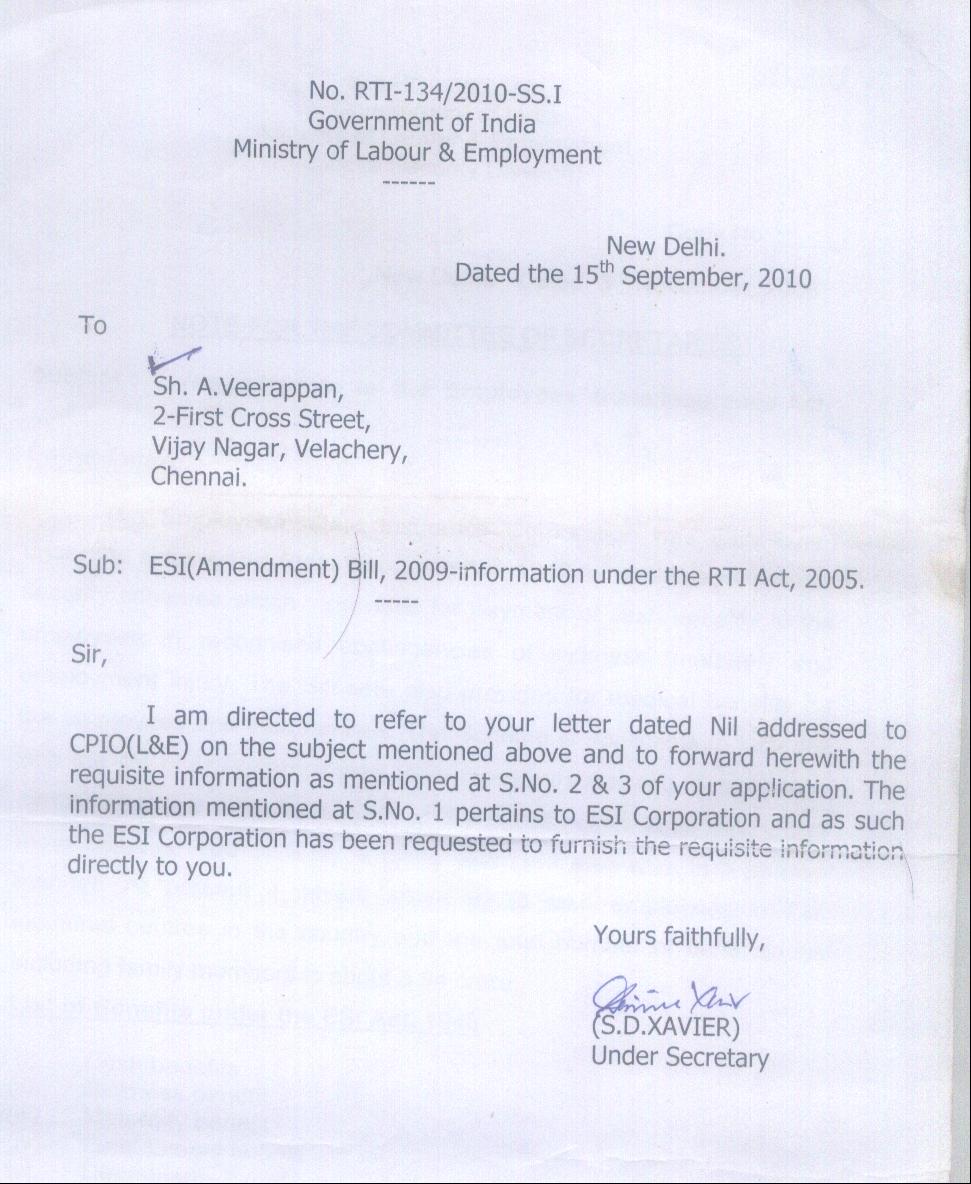
N.B: This web-site places on record the selfless services rendered by Mr. A. Veerappan and his friends, Mr. P. Ramar, Mr. S. Karthikeyan and others in collecting various details for about two years and also in making them available, now, to this website. The website recalls the sincerety, commitment and devotion of Mr. A. Veerappan towards the ESI Corporation. The remarkable perseverance exhibited by him for such a long duration was very touching. This thread is the result of his efforts. The more of it, later. May his soul rest in peace!

Leave a comment

Filed under Amendments 2010